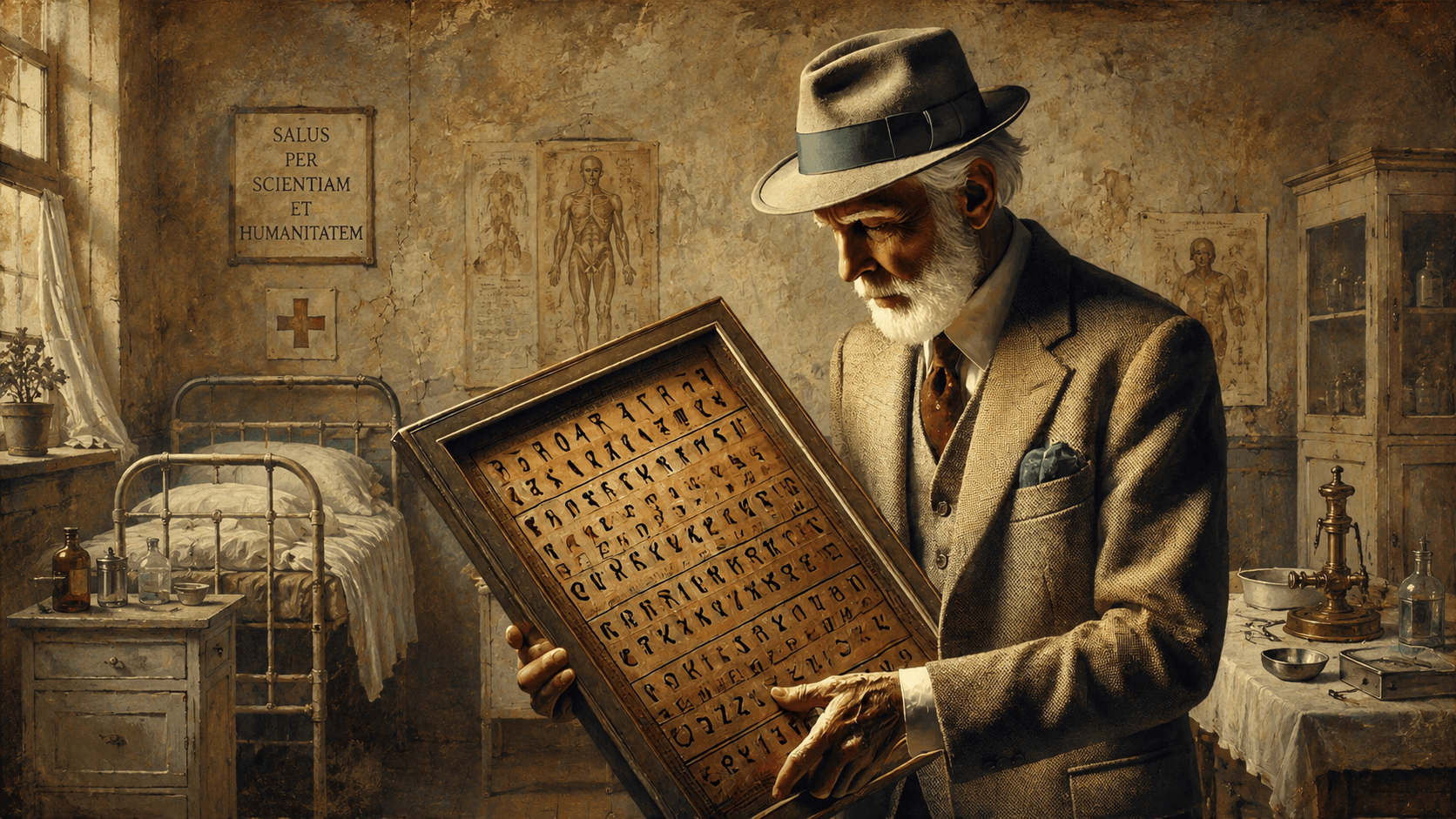
Character Encoding

Elderly bearded man in early 20th-century attire examines a framed tablet covered with archaic symbols inside a worn hospital ward, surrounded by an iron bed, anatomical charts, glass bottles, and antique medical instruments.

Character encoding is the process of assigning a unique number to each character, enabling computers to exchange data in a standardized and unambiguous manner. Various encoding systems have developed over time and across different regions. These systems often lack compatibility, have space limitations (and consequently character limitations), and may use the same encoding for different … Read more

Moments

A man in early 20th-century clothing stands beside a monumental hourglass in an old hospital room, surrounded by faded medical symbols, a large clock mural, and an iron bed.

The concept of “moment” has various interpretations depending on context, but generally refers to a unit of time, a specific occasion, or a particular state. In mechanics, a “moment” is the tendency of a force to rotate a body around a point or axis. In other contexts, it can refer to a precise instant in … Read more

How many Sums of Squares we’re dealing with in Repeated Measures ANOVA?

A lecturer in formal early 20th-century dress stands on a small stage addressing a seated audience in a historic hall, rendered as a warm sepia-toned painterly illustration with columns, red drapery, and soft antique light.

When setting up a repeated measures ANOVA test in SPSS, the dialog box for the model has “Type 3 sum of squares” selected by default. By exploring the window further, you’ll find that you can also choose multiple sums of squares: Type 1, Type 2, or Type 4. How many types of Sums of Squares … Read more