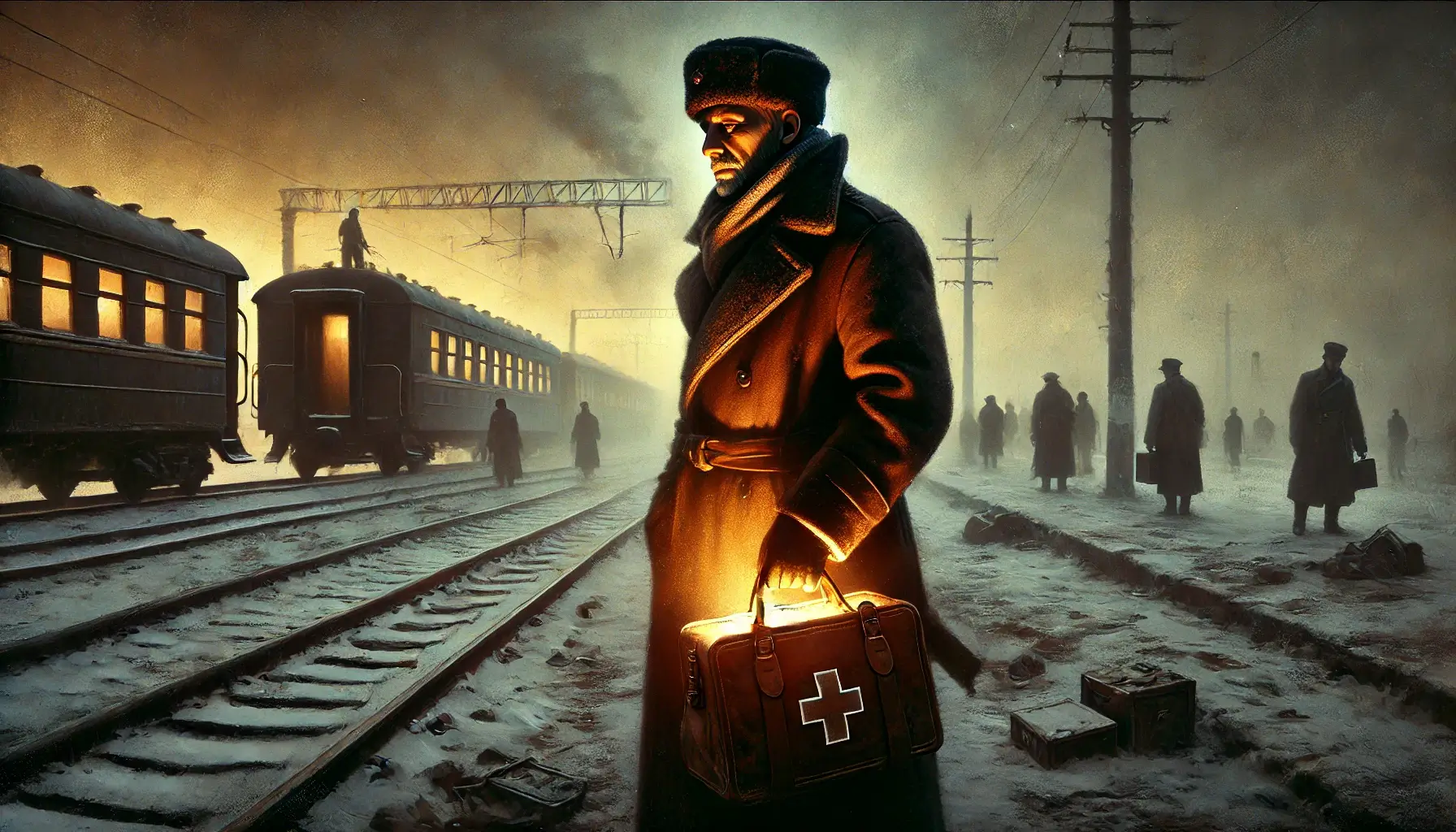
Doctor Zhivago turns the daily work of a physician into a lens for what care becomes when institutions break. War medicine, infectious disease, rural scarcity. Through these threads Pasternak delivers a lesson that still cuts close to contemporary, technology-driven healthcare: clinical judgment and ethical independence carry the most weight precisely when the system around them collapses.
1. Introduction and author background
Doctor Zhivago is more than a historical or political novel. In its pages medicine works as an ethical and epistemological anchor in a world that is coming apart. Boris Pasternak (1890–1960) places a physician at the center of one of the most turbulent stretches of modern history: late Tsarist Russia, the Great War, the October Revolution, the Civil War.
Pasternak was no clinician. He moved, however, in an intellectual milieu shaped by science, philosophy, and a stubborn realism. His protagonist, Yuri Zhivago, is deliberately doctor and poet at once: two complementary ways of approaching reality, clinical observation on one side, humanistic interpretation on the other.
For a medical reader the choice matters. Zhivago is not a revolutionary leader, not a political theorist. He is a clinician forced to practice under extreme constraints, material, social, ethical. Through him Pasternak quietly puts a question on the table: what does medicine become when institutions fail and ideology tries to override biological reality?
2. A medical-oriented synopsis (without retelling the whole plot)
Rather than walking through the storyline, it is more useful (especially on a medical blog) to follow the clinically relevant trajectory of Yuri Zhivago.
Zhivago trains as a physician in pre-revolutionary Russia, in a period when medicine is moving from late 19th-century bedside empiricism toward an early scientific modernity. As war and revolution unfold he is repeatedly displaced. Urban hospitals, then wartime settings. Then academic life, then rural isolation. Across each shift, he keeps practicing, often under coercion and scarcity.
What he actually does is recognizable to any reader with a clinical background:
- treating traumatic injuries and the complications of violence,
- managing infectious diseases,
- coping with malnutrition and exposure,
- improvising care with whatever is at hand.
Medicine in Doctor Zhivago is never told as a story of progress or heroism. It is persistent, adaptive, frequently powerless. The physician survives not because events are controllable. He survives because suffering keeps surfacing, and someone still has to respond.
3. Medical scenes and clinical situations
3.1 War medicine and field care
The wartime sections expose Zhivago to ballistic trauma, amputations, sepsis, shortages of anesthesia and antiseptics. Clinical decisions are dictated by triage, not by optimization. There is no illusion of “best practice” here, only survival medicine. The psychological burden is constant. The physician operates under moral pressure, negotiating between what should be done and what can actually be done.
A particularly striking dimension is the strain placed on medical neutrality. The novel shows the erosion of the clinician’s protected role under armed groups and shifting authority. Instead of treating “neutral care” as a given, it documents how easily that principle breaks once coercion enters the clinical space.
3.2 Rural and isolated medical practice
Later, in remote rural areas (the Urals in particular), medicine reverts to its essentials:
- clinical observation,
- basic physical examination,
- empirical decision-making.
No laboratory medicine. No imaging. A pharmacological arsenal that ranges from limited to symbolic. The doctor–patient relationship becomes direct and personal, stripped of institutional mediation. It is medicine that is pre-technological but not pre-scientific. The reasoning is still there. The tools are gone.
3.3 The body as counter-ideology
One of the strongest medical dimensions of the novel is the role of the suffering body. Pain, disease, hunger, death. They keep undoing political rhetoric. Ideological promises dissolve in front of biological vulnerability.
In this sense the physician is not merely a caregiver. He is a witness to an irreducible reality: the body does not obey slogans. The point is as clinical as it is philosophical.
Historical box (Russia 1900–1920): what “medicine under scarcity” realistically meant
- Antisepsis existed, but implementation was uneven, especially outside major centers and during war.
- No antibiotics: bacterial infections and wound complications could be lethal even when the “right” decision was made.
- Anesthesia and analgesia were limited by supply chains, training, and infrastructure; surgery was possible but high-risk.
- Diagnostics were mostly clinical: history and physical examination carried the weight, with few tests available.
- Logistics were a clinical variable: transport disruption, cold exposure, malnutrition, and crowding changed outcomes as much as “medical skill”. </aside>
4. What Doctor Zhivago suggests about medicine of its time
4.1 Historical plausibility of clinical practice
The medicine described in the novel is broadly consistent with what was historically plausible in Russia between 1900 and 1920. Antisepsis is known, but applied unevenly. Antibiotics do not exist yet. Surgery is possible but risky. Diagnosis leans heavily on clinical reasoning. Zhivago sits at the intersection between classical bedside medicine and the first stirrings of modern clinical science.
4.2 Implicit medical ethics
Zhivago’s practice keeps pointing back to a few recurring principles:
- individual responsibility,
- moral resistance to ideological capture,
- loyalty to the patient rather than to the institution.
In modern terms it anticipates a core ethical idea, namely that care must remain independent from political pressure. The novel does not romanticize the clinician as “pure”. It does insist, with some firmness, that medicine loses its meaning when it becomes only an instrument of power.
A caveat is worth stating. The text obviously does not provide a structured ethical framework, and reading too much theory into a literary work would be a stretch. Still, the orientation is clear enough.
5. Conclusion: why it still matters for technology-driven medicine
Read from today, with medicine increasingly shaped by technology, data, and algorithms, Doctor Zhivago offers a useful corrective:
- medicine can function without technology,
- it cannot function without judgment,
- and it cannot survive if it becomes fully subordinated to ideology.
In an era of artificial intelligence, predictive models, and automated decision support, Zhivago stands for the irreducible human core of clinical practice. When systems fail, when data vanish, when infrastructures degrade, medicine returns to its most basic form: one human being interpreting another’s suffering.
For a blog focused on medical technology, the novel is a useful counterbalance. Progress matters. Clinical meaning still comes first.
References
- “Between Killing and Curing: Doctors in Literary Depictions of the Russian Revolution and Civil War.” Synapsis: A Health Humanities Journal (Nov 26, 2024). https://medicalhealthhumanities.com/2024/11/26/between-killing-and-curing-doctors-in-literary-depictions-of-the-russian-revolution-and-civil-war/
- “Tragic hero of the Russian Revolution.” Irish Medical Times (Apr 21, 2008). https://www.imt.ie/lifestyle/literature/tragic-hero-of-the-russian-revolution-21-04-2008/
- “Doctor Zhivago | Novel, Themes & Russian Revolution.” Encyclopaedia Britannica (Feb 6, 2026). https://www.britannica.com/topic/Doctor-Zhivago-novel