
The state of the art, the gap between research and clinical practice, and a perspective on the next five years.
November 2026
1. A revolution that has yet to reach the operating table
If one were to judge the current state of cardiac surgery exclusively by scientific publications, technology conferences, and industry announcements, one might conclude that we are already living through a profound transformation driven by artificial intelligence.
Algorithms predict postoperative complications, neural networks interpret cardiac images, digital twins simulate therapeutic interventions, and intelligent robotic systems promise unprecedented surgical precision.
Yet entering a cardiac operating room today offers a rather different perspective.
Coronary arteries are still grafted by surgeons. Mitral valves are repaired through the interpretation of complex anatomical and functional relationships. Decisions during cardiopulmonary bypass remain largely dependent on the interaction between surgeons, anesthesiologists, and perfusionists. Postoperative complications are recognized and managed through a combination of physiological measurements, clinical experience, and judgment.
Artificial intelligence is increasingly present in the scientific literature surrounding these activities, but considerably less present in the activities themselves.
As a cardiac surgeon with a strong interest in statistics, computer science, and artificial intelligence, I find this discrepancy particularly interesting.
My skepticism is not about the computational capabilities of AI. It is about the distance between those capabilities and their practical translation into cardiac surgical care.
More importantly, I suspect that the most significant contribution of artificial intelligence to cardiac surgery over the next few years will occur not in the operating room, but in almost everything that surrounds it.
2. What do we mean by artificial intelligence in cardiac surgery?
Artificial intelligence is not a single technology. The expression encompasses computational approaches that differ substantially in their objectives, architectures, and potential clinical applications.
| Technology | Potential application |
|---|---|
| Traditional machine learning | Prediction of mortality and complications |
| Deep learning | Analysis of images and physiological signals |
| Computer vision | Anatomical recognition and surgical video analysis |
| Natural language processing | Extraction of information from clinical documents |
| Large language models | Clinical summarization and documentation |
| Reinforcement learning | Optimization of sequential therapeutic decisions |
| Intelligent robotics | Automated or assisted execution of surgical tasks |
| Multimodal AI | Integration of clinical data, images, signals, and text |
These distinctions are important because progress in one domain does not necessarily imply progress in another.
An algorithm capable of measuring left ventricular volumes from echocardiographic images is not necessarily capable of understanding mitral valve pathology. A language model that generates an excellent operative report is not capable of performing the operation it describes.
Similarly, a robotic surgical platform is not intrinsically an artificial intelligence system.
Much of the contemporary discussion tends to merge these technologies into a single narrative of innovation. In doing so, it obscures both their actual achievements and their limitations.
3. Preoperative risk assessment: the most extensively studied application
Cardiac surgery has a long tradition of quantitative risk assessment.
The original EuroSCORE, EuroSCORE II, and the Society of Thoracic Surgeons (STS) risk models represent well-established attempts to estimate operative risk using routinely available clinical variables.
In many respects, cardiac surgeons were already using computational decision-support systems long before artificial intelligence became a popular expression.
Machine learning introduces the possibility of moving beyond the predefined structure of traditional risk scores by identifying nonlinear relationships, complex interactions, and patterns distributed across numerous variables.
What has been investigated?
Machine learning models have been developed to predict a wide range of outcomes, including:
- Operative and postoperative mortality.
- Acute kidney injury.
- Postoperative atrial fibrillation.
- Prolonged mechanical ventilation.
- Blood transfusion requirements.
- Low cardiac output syndrome.
- Neurological complications.
- Prolonged intensive care unit stay.
- Hospital readmission and long-term survival.
Random forests, gradient boosting algorithms, support vector machines, and artificial neural networks are among the most frequently investigated approaches.
A systematic review published in 2026 by Ha and Vohra included 178 studies addressing AI applications and perioperative outcomes in cardiac surgery. Although many investigations reported encouraging predictive performance, only 26% included external validation, and just 19% reported adherence to TRIPOD reporting guidelines [1].
This is a remarkable contrast between the quantity of published research and its methodological maturity.
Is machine learning actually better than traditional statistics?
The answer is more complicated than it may initially appear.
Some machine learning models outperform established risk scores. Others achieve only modest improvements. In some circumstances, a conventional logistic regression model recalibrated or retrained on contemporary data can perform comparably to a more complex algorithm.
A study published in 2023 compared multiple machine learning approaches using a national cardiac surgical database containing more than 220,000 patients [2].
The improvements in discrimination provided by the more sophisticated models were relatively small.
More recently, a systematic review published in November 2026 specifically examined whether deep learning improves short-term mortality prediction compared with traditional statistical models in adult cardiac surgery. The authors found no convincing evidence of consistent superiority among the few studies in which genuinely deep architectures could be identified [3].
These findings illustrate a fundamental methodological problem.
When a newly developed machine learning algorithm outperforms an established risk score, we must ask whether the improvement derives from:
- A better computational architecture.
- A more recent patient population.
- A larger training dataset.
- Additional predictive variables.
- Differences in data preprocessing.
- Changes in the baseline risk of the population.
Without appropriate comparisons, these effects are difficult to disentangle.
Comparing an algorithm trained on contemporary patient data with a statistical model developed more than a decade earlier does not necessarily demonstrate the superiority of artificial intelligence.
It may simply demonstrate the importance of updating predictive models.
This methodological question also motivated our like-for-like comparison of machine learning models and EuroSCORE II for mortality prediction after cardiac surgery. The study has been accepted for publication in Heart, Lung and Circulation; the currently available version is a preprint [21].
Beyond the area under the ROC curve
The area under the receiver operating characteristic curve (AUC) has become almost ubiquitous in publications on medical AI.
However, discrimination is only one component of predictive performance.
A model may correctly rank patients according to their relative risk while systematically overestimating or underestimating their absolute probability of mortality.
For the individual patient, the latter may be considerably more important.
A clinically useful predictive model requires appropriate calibration, external validation, temporal stability, and evidence that its use can improve decisions.
Furthermore, predicting the outcome of a surgical intervention is not equivalent to identifying the best therapeutic strategy.
A model may accurately predict mortality after surgical aortic valve replacement without being able to determine whether the same patient would benefit more from surgery, transcatheter treatment, or conservative management.
This distinction belongs to the domain of causal inference rather than conventional prediction.
Nevertheless, risk assessment remains one of the areas in which I expect artificial intelligence to acquire increasing clinical relevance.
Its most interesting contribution may eventually be the transition from static risk scores to dynamic, continuously updated assessments of risk throughout the perioperative course.
4. Cardiovascular imaging: where artificial intelligence is closest to clinical reality
Among the different applications relevant to cardiac surgery, imaging is probably the most technologically mature.
Medical images constitute relatively standardized, structured digital representations of anatomical and physiological information. They are particularly suitable for the application of deep learning algorithms.
Current applications include automated measurements of ventricular volumes and ejection fraction, segmentation of cardiac chambers, quantification of myocardial strain, assessment of coronary anatomy, characterization of aortic anatomy, and three-dimensional reconstruction of cardiovascular structures.
The regulatory landscape reflects this technological development. By September 2026, the US Food and Drug Administration reported having authorized more than 1,600 AI-enabled medical devices, with imaging-related technologies occupying a particularly prominent position [4].
However, regulatory authorization, clinical adoption, and demonstrated clinical benefit are three different concepts.
Echocardiography
Echocardiography is an excellent example of the practical potential of AI.
The interpretation of an echocardiographic examination includes numerous repetitive tasks involving anatomical identification, contour detection, measurements, and calculations.
These activities are well suited to computational assistance.
In 2023, a blinded randomized trial published in Nature compared initial assessments of left ventricular ejection fraction performed by AI with those performed by sonographers, followed by cardiologist review [5].
The trial demonstrated that automated assessment could be effectively incorporated into the echocardiographic interpretation workflow.
For cardiac surgeons, the potential advantages extend beyond ejection fraction measurement. Artificial intelligence may facilitate the quantitative evaluation of ventricular geometry, valve function, and complex anatomical relationships.
Nevertheless, automatically identifying the contours of a ventricle is a fundamentally different problem from interpreting the mechanism of mitral regurgitation in a patient being considered for valve repair.
The latter requires an understanding of anatomy, hemodynamics, pathology, tissue characteristics, and surgical feasibility.
Quantification can support this interpretation. It cannot yet reliably replace it.
Computed tomography and procedural planning
Computed tomography represents another area of substantial development.
Automated segmentation and anatomical measurements may support the assessment of aortic aneurysms, aortic root geometry, coronary arteries, vascular access, and valve annular dimensions.
Transcatheter aortic valve implantation provides a particularly interesting example, although it belongs to the broader domain of structural heart interventions rather than exclusively to cardiac surgery.
A study published in September 2026 compared fully automated AI-based CT analysis with conventional procedural planning software. The reported mean absolute error in aortic annular diameter measurement was approximately 0.6 mm [6].
Such results suggest that artificial intelligence may reduce the workload associated with repetitive measurements and improve their reproducibility.
The real clinical challenge, however, is not measuring a relatively normal anatomical structure. It is recognizing when an apparently plausible measurement is unreliable because of an anatomical variant, severe calcification, poor image quality, or an unexpected pathological condition.
The average accuracy of a segmentation algorithm tells us relatively little about the individual cases in which it fails.
Digital twins and virtual surgery
Digital twins represent a potentially more ambitious application.
Patient-specific computational models could combine imaging, physiological measurements, biomechanics, and clinical data to simulate the consequences of cardiovascular interventions.
One could imagine evaluating the effects of different mitral repair strategies, predicting the hemodynamic performance of a prosthesis, or studying the consequences of alternative aortic root reconstructions before surgery.
The scientific potential is substantial.
The difficulty lies in representing the mechanical properties of biological tissues, their interactions, pathological alterations, and responses to surgical manipulation with sufficient accuracy.
Moreover, digital twins and computational simulations are not necessarily AI technologies. Much of their scientific foundation lies in numerical methods, fluid dynamics, and biomechanical modeling.
For the moment, I regard these approaches primarily as research instruments and potentially valuable tools for selected procedural planning applications, rather than routine instruments for surgical decision-making.
Imaging is arguably the strongest example of the current clinical contribution of AI to cardiovascular medicine. Even here, however, the technology has been more successful in automating individual analytical tasks than in replacing the integrated interpretation of an experienced physician.
5. Intraoperative artificial intelligence: seeing the operation is not performing it
The operating room offers numerous potential sources of digital information.
Arterial pressure waveforms, electrocardiograms, transesophageal echocardiography, cerebral oximetry, perfusion data, surgical video, and laboratory results collectively describe different aspects of the patient’s intraoperative physiological state.
Artificial intelligence could theoretically integrate these information streams to provide real-time decision support.
Some applications have already moved beyond purely retrospective research.
Hemodynamic monitoring and anesthesiology
The Hypotension Prediction Index (HPI), for example, uses arterial pressure waveform analysis to identify patients at risk of developing hypotension.
The HYPE-2 randomized clinical trial, published in 2025, evaluated an HPI-based intervention in patients undergoing cardiac surgery and during their subsequent intensive care stay.
Among the 130 patients included in the primary analysis, the intervention was associated with a 63% reduction in the median time-weighted severity of hypotension [7].
This is an important result because it represents the evaluation of an algorithm integrated into an actual clinical intervention.
However, reducing the burden of hypotension does not automatically establish that the system reduces mortality, neurological complications, or other major postoperative outcomes.
The distinction is between improving a physiological endpoint and improving the patient’s ultimate clinical outcome.
Cardiopulmonary bypass
Cardiopulmonary bypass is another potentially attractive domain for artificial intelligence.
Perfusion management involves continuous adjustments based on multiple variables, including arterial pressure, pump flow, oxygen delivery, temperature, hematocrit, and acid-base status.
Machine learning could assist perfusionists in identifying emerging physiological abnormalities, anticipating changes in patient requirements, or evaluating the consistency of different perfusion strategies.
Early feasibility studies have explored the possibility of developing systems that learn from the actions of experienced perfusionists [8].
However, learning to reproduce clinical behavior is not the same as learning optimal clinical behavior.
A model trained on historical perfusion decisions may reproduce local practice patterns, including their limitations.
Another important distinction concerns closed-loop control systems. Automated regulation of a pump, a ventilator, or the administration of a drug is not necessarily artificial intelligence. Conventional control engineering may be entirely sufficient for some of these applications.
I expect computational assistance to become progressively more important in intraoperative physiological management. But this is primarily an advancement in monitoring, anesthesiology, and perfusion rather than in the surgical act itself.
Computer vision and surgical navigation
Computer vision has been proposed for surgical phase recognition, instrument tracking, anatomical identification, and augmented reality navigation.
Potential cardiac surgical applications include identification of coronary arteries, recognition of anatomical structures during minimally invasive procedures, evaluation of surgical technique, and integration of preoperative imaging into the operative field.
However, the cardiac surgical environment is a particularly difficult domain for computer vision.
The anatomy changes continuously due to tissue manipulation, cardiac motion, bleeding, surgical exposure, and the effects of cardiopulmonary bypass.
Important structures may be partially obscured or completely invisible.
Furthermore, surgical expertise frequently depends on information that is not contained in an image.
The surgeon evaluates the consistency of tissue, its resistance to traction, the mechanical properties of a calcified structure, the behavior of a suture, and the immediate consequences of a maneuver.
Computer vision can potentially augment this process. It represents only one component of the information required to perform an operation.
6. Robotic cardiac surgery is not autonomous cardiac surgery
Few areas generate as much enthusiasm — and as much conceptual confusion — as surgical robotics.
The success of robotic cardiac surgery has demonstrated that complex procedures can be performed through minimally invasive approaches using sophisticated electromechanical systems.
Robotic mitral valve repair, robotic coronary revascularization, and even robotic heart transplantation illustrate the remarkable capabilities of contemporary surgical platforms.
But in these procedures, the intelligence performing the operation predominantly remains human.
The robot is an instrument controlled by the surgeon.
Its ability to improve visualization, filter tremor, scale movements, and manipulate instruments in confined anatomical spaces does not make it an autonomous surgical system.
A systematic review of surgical robots authorized by the FDA between 2015 and 2023 found that 86% belonged to the lowest level of surgical autonomy, corresponding to robotic assistance. Only 6% reached the level of conditional autonomy [9].
These figures concern surgical robotics in general, not specifically cardiac surgery, and represent the regulatory landscape during the period investigated.
The distinction nevertheless remains highly relevant.
In October 2026, the European Association for Cardio-Thoracic Surgery published an expert consensus document addressing the implementation, training requirements, and quality assurance of robotic cardiac surgery programs [10].
The emphasis on patient selection, surgical expertise, training, and team organization is a reminder that robotic surgery remains a fundamentally human clinical activity.
The emergence of autonomous surgical systems
Experimental surgical autonomy is advancing.
In 2025, researchers published the SRT-H framework, a hierarchical robotic system combining imitation learning and language-conditioned task planning [11].
The system demonstrated the ability to execute a sequence of surgical maneuvers related to gallbladder removal in an ex vivo experimental setting.
This represents a significant engineering achievement.
It does not represent an autonomous surgical system capable of safely operating on a human heart.
Interestingly, a comprehensive review of robotic-assisted beating-heart surgery published in October 2026 reported that active algorithmic motion compensation had not yet reached human clinical trials, despite many years of research [12].
The distance between experimental feasibility and clinical translation can be considerable.
Why the heart is a difficult target for autonomous surgery
Cardiac surgery presents a combination of challenges that makes broad surgical autonomy particularly demanding.
The first is anatomical variability.
No two coronary arteries, mitral valves, or aortic roots are identical. Pathological alterations introduce additional variability.
The second is tissue mechanics.
Calcified arteries, fragile aortic walls, infected tissues, and degenerated valve leaflets behave differently when manipulated.
The third is the limited availability of appropriate training data.
Unlike large language models, which can learn from enormous collections of text, autonomous surgical systems require detailed information about physical actions, anatomical conditions, and their consequences.
A surgical video does not necessarily contain information about contact forces, tissue resistance, instrument trajectories, or the reasoning behind a particular decision.
The fourth challenge concerns rare but potentially catastrophic events.
Unexpected bleeding, coronary injury, ventricular rupture, or sudden hemodynamic deterioration may require immediate actions that differ substantially from the planned procedure.
These situations are relatively infrequent, yet the system must be capable of managing them with exceptional reliability.
Finally, there is the problem of validation.
An error in a generated clinical summary can potentially be detected and corrected before the document is signed. An error during the execution of a coronary anastomosis may be irreversible.
This asymmetry is fundamental.
I do not exclude the possibility that individual cardiac surgical tasks will eventually become partially automated. Camera positioning, motion compensation, instrument navigation, and highly constrained repetitive maneuvers are plausible candidates.
What I consider considerably less likely, at least within the next five years, is the emergence of broadly applicable autonomous cardiac surgical systems that perform the essential steps of an operation independently.
7. Postoperative care: the patient as a physiological trajectory
One of the domains in which I see substantial potential for artificial intelligence is postoperative cardiac surgical intensive care.
A postoperative cardiac surgical patient generates a large volume of physiological data:
- Hemodynamic measurements.
- Blood gas analyses and laboratory results.
- Mechanical ventilation parameters.
- Urine output and fluid balance.
- Chest drain output.
- Vasoactive and inotropic drug administration.
- Electrocardiographic and other continuous physiological signals.
The difficulty is not necessarily the absence of information.
It is the integration of information distributed across different sources and different points in time.
A single lactate value may have limited meaning. Its evolution over several hours, interpreted alongside arterial pressure, urine output, vasoactive drug requirements, and evidence of bleeding, may be much more informative.
The patient should therefore be represented not simply as a collection of variables, but as a multidimensional physiological trajectory.
I explored this idea in From Static Risk Estimates to Dynamic Clinical Trajectories, a conceptual analysis arguing that perioperative risk may be better understood as an evolving physiological process rather than a single preoperative probability [22]. A related reflection appears in Bergson’s Time in Acute Medicine.
Artificial intelligence and longitudinal statistical modeling offer tools to study these trajectories and potentially recognize deviations from expected patterns of recovery.
Possible applications include the early identification of low cardiac output syndrome, impending acute kidney injury, respiratory deterioration, persistent tissue hypoperfusion, and failure to recover after an initial period of postoperative stabilization.
Some systems are already being investigated using prospectively collected cardiac surgical data, including hospital-integrated models for predicting cardiac surgery-associated acute kidney injury [13].
However, the development of early warning systems raises an important question:
What should the physician do when the algorithm identifies an increased risk?
A prediction that does not lead to an appropriate intervention may have little practical utility.
Worse, an excessively sensitive system may increase the number of unnecessary investigations, generate alarm fatigue, and ultimately reduce the attention devoted to meaningful clinical events.
The success of postoperative AI will depend not only on its predictive capabilities, but also on its ability to provide relevant, interpretable, and actionable information at the right moment.
8. Electronic health records: more data, less information?
Modern electronic health records represent a paradox.
We have progressively increased the amount of clinical data collected during hospitalization, yet this has not necessarily improved the accessibility of clinically meaningful information.
Patient histories are distributed across laboratory databases, clinical notes, nursing documentation, medication records, imaging reports, operative reports, and administrative systems.
The physician must continuously reconstruct a coherent clinical narrative from these fragmented sources.
This is a computational problem before it is an artificial intelligence problem.
I discussed this mismatch in Why Clinical Digitalization Fails, and explored the practical task of extracting computable clinical features in From Chart to Variable.
And it is precisely the type of problem for which contemporary large language models appear particularly promising.
Reconstructing the clinical narrative
Imagine a system integrated into the electronic health record that could reconstruct the clinical course of a cardiac surgical patient.
It could summarize the relevant preoperative history, identify significant events during hospitalization, describe the evolution of renal function, retrieve the reasons for changes in medication, and identify investigations that remain outstanding.
Instead of navigating dozens of different electronic interfaces, the physician could interrogate the patient’s longitudinal record using natural language.
Questions might include:
How has renal function evolved since surgery?
When was anticoagulation interrupted, and was the reason documented?
What were the relevant findings of the last three echocardiographic examinations?
Which postoperative complications remain unresolved?
Importantly, every answer should provide access to the original clinical data from which it was derived.
The language model should function as an interface between the physician and the medical record, not as an alternative source of medical facts.
Retrieval-augmented generation, structured database queries, and controlled access to clinical information systems may contribute to the development of such applications.
Unlike the development of autonomous surgical systems, these applications do not require artificial intelligence to interact directly with biological tissues or unpredictable physical environments.
They require it to organize and interpret existing digital information.
That makes their implementation considerably more plausible in the medium term.
9. Clinical documentation: an apparently modest revolution
The generation of clinical documentation may not appear particularly revolutionary.
It lacks the visual appeal of an autonomous surgical robot and the intellectual ambition of a patient-specific digital twin.
Yet it may become one of the most important practical contributions of artificial intelligence to medicine.
Cardiac surgeons spend considerable time writing clinical notes, preparing operative reports, completing discharge letters, reviewing medical records, and communicating with other physicians.
Much of this work involves the synthesis and structured representation of information that already exists.
A practical example is the extraction of structured information from discharge letters, discussed in my introduction to natural language processing for medical reports.
Large language models are particularly well suited to assisting with these activities.
Clinical evidence is also beginning to emerge outside the specific context of cardiac surgery.
Randomized studies of ambient AI documentation systems have investigated their effects on documentation time and physician well-being [14].
On November 17, 2026, JAMA Network Open published a particularly relevant study comparing AI-generated and clinician-authored discharge summaries from five London hospitals [15].
The analysis included 1,294 hospital admissions. The probability of a discharge summary being considered acceptable with no or minor modifications was approximately 22 percentage points higher for AI-generated documents.
However, the study also identified unsupported statements and omissions. Among the evaluated AI-generated summaries, approximately 6% contained information unsupported by the clinical documentation, and nearly a quarter omitted important clinical information.
The study was retrospective and did not establish improved patient outcomes following actual implementation.
These results are simultaneously encouraging and cautionary.
They suggest that AI-generated documentation may reach or exceed the quality of current clinical documentation in some respects, while remaining unsuitable for unsupervised use.
In cardiac surgery, potential applications include the preparation of:
- Preoperative clinical summaries.
- Daily progress notes.
- Operative report drafts.
- Intensive care transfer documents.
- Discharge letters.
- Instructions for patients and referring physicians.
The final document should remain under the responsibility of the clinician.
The objective is not to remove the physician from clinical documentation. It is to remove unnecessary manual work from the process of producing it.
10. Medication reconciliation and therapeutic verification
Another potentially valuable application concerns the verification of therapeutic prescriptions.
Cardiac surgical patients often undergo substantial modifications of their pharmacological treatment during hospitalization.
Medications may be interrupted, restarted, substituted, or adjusted in response to changes in renal function, hemodynamic status, bleeding risk, and postoperative complications.
Consequently, the transition from preoperative treatment to postoperative management and hospital discharge represents a particularly complex process.
Artificial intelligence could assist in identifying discrepancies between preoperative and discharge medication lists, potentially inappropriate dosages, duplicated treatments, undocumented medication changes, and important drug interactions.
A scoping review published in 2026 identified 94 studies investigating AI-based approaches to medication reconciliation [16]. A substantial proportion focused on extracting medication-related information from free-text clinical records.
However, many elements of therapeutic verification do not require generative artificial intelligence.
A deterministic software system connected to a validated pharmacological database can reliably check many drug interactions, dosage limits, and contraindications.
The most effective architecture may therefore be a hybrid system.
Traditional software would perform reproducible calculations and rule-based checks. Machine learning models could estimate patient-specific risks. Large language models could extract contextual information from clinical documents and explain the relevance of potential discrepancies.
The physician would remain responsible for the final therapeutic decision.
An AI system should not independently decide whether a patient requires anticoagulation following valve surgery. It might, however, identify an inconsistency between the implanted prosthesis, the documented indication for anticoagulation, the current prescription, and the planned follow-up.
That alone would be a valuable contribution.
11. Artificial intelligence in surgical education, research, and quality improvement
Beyond direct patient care, artificial intelligence may have a significant role in cardiac surgical education and clinical research.
Video analysis could assist in the quantitative evaluation of surgical maneuvers. Intelligent simulation environments could provide trainees with individualized feedback. Language models could support the study of complex clinical scenarios.
Nevertheless, most AI-based surgical training technologies have not yet been adequately validated within cardiac surgery itself [17].
The ability of a system to recognize technical patterns does not necessarily establish its ability to evaluate surgical competence.
Clinical research represents another attractive domain.
The extraction of structured information from medical records, identification of eligible study populations, preparation of clinical registries, detection of data inconsistencies, and analysis of longitudinal physiological data may all benefit from appropriately designed AI systems.
These applications may be particularly important because the quality of clinical research is frequently constrained not by the absence of sophisticated statistical methods, but by the difficulty of obtaining reliable and interpretable data.
Artificial intelligence may also contribute to institutional quality improvement by facilitating the identification of unexpected outcomes, variations in clinical practice, and complications requiring further investigation.
Here again, identifying a statistical association should not be confused with establishing a causal relationship or demonstrating an error in clinical management.
12. The missing link between research and clinical practice
The most important limitation of artificial intelligence in cardiac surgery may not be technological.
It may be methodological and organizational.
A systematic review published in 2026, appropriately titled From innovation to implementation: Addressing the AI adoption gap in cardiac surgery, identified a persistent discrepancy between algorithm development and clinical integration [18].
Another review, published in November 2026, examined similar problems across the cardiothoracic surgical pathway [19].
These limitations are familiar to anyone working with clinical data:
- Retrospective study designs.
- Inadequate external validation.
- Dataset shift and model deterioration over time.
- Inconsistent data quality.
- Limited reproducibility.
- Insufficient evaluation of clinical outcomes.
- Poor integration into existing clinical workflows.
A model developed in one institution may perform differently in another because of differences in patient populations, surgical indications, perioperative protocols, and data recording practices.
Its performance may also deteriorate within the same institution as clinical practice evolves.
I examined this problem in more detail in Dataset Shift in Medical AI.
Furthermore, the introduction of an AI system creates new interactions between technology and healthcare professionals.
A randomized study published in 2024 demonstrated that providing physicians with access to a large language model did not necessarily improve their diagnostic reasoning, despite the strong performance of the model when evaluated independently [20].
The performance of artificial intelligence and the performance of a physician using artificial intelligence are not equivalent.
Our comparative study of ChatGPT, Claude, and Gemini in cardiology highlighted the importance of task-specific evaluation and clinical oversight [23]. I also explored evolving postoperative decisions in the AI Giants Enter the Cardiac Surgery ICU series, an exploratory exercise rather than evidence of clinical safety.
This is why the ultimate object of clinical AI research should not be the algorithm in isolation, but the clinical system in which it operates.
13. My perspective for the next five years
Predicting technological development is inherently uncertain.
Nevertheless, if I were to formulate a forecast for cardiac surgery between 2026 and 2031, I would distinguish between applications surrounding the surgical intervention and those directly involved in its execution.
The following table represents my personal assessment, not a quantitative projection derived from published adoption data.
| Application | Current clinical maturity | Expected impact over the next five years |
|---|---|---|
| Automated cardiovascular imaging | Established for selected tasks | High |
| Preoperative risk prediction | Extensive research, limited routine implementation of newer models | Moderate to high |
| Electronic health record analysis | Early clinical implementation | Very high |
| Clinical documentation | Emerging clinical adoption | Very high |
| Discharge summary generation | Early implementation and evaluation | Very high |
| Medication reconciliation | Emerging applications | High |
| Postoperative predictive monitoring | Development and selected clinical implementations | Moderate to high |
| Clinical research and quality improvement | Emerging applications | High |
| Intraoperative physiological support | Selected clinically evaluated tools | Moderate |
| Surgical computer vision and navigation | Predominantly experimental | Low to moderate |
| Automation of individual surgical maneuvers | Predominantly experimental | Low |
| Autonomous cardiac surgery | Preclinical or experimental concepts | Very low |
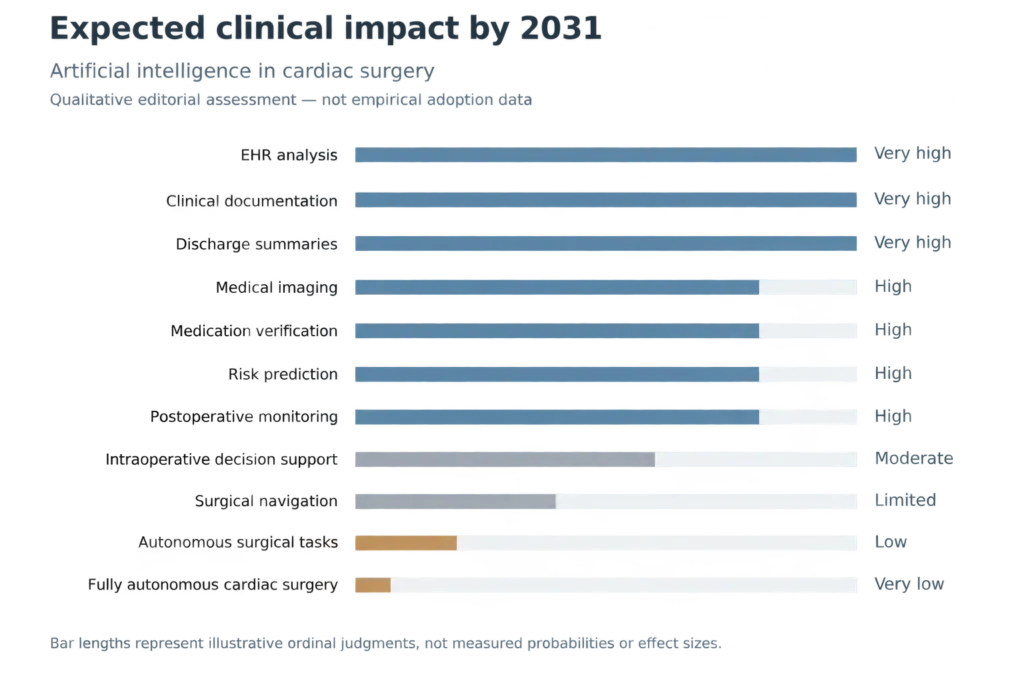
This forecast is not based on the assumption that progress in artificial intelligence will slow down.
On the contrary, computational capabilities may continue to improve remarkably quickly.
But clinical adoption is determined by more than computational capabilities.
It depends on data availability, reliability, infrastructure, economic sustainability, regulatory requirements, human factors, and the consequences of failure.
A system that prepares a draft discharge letter can be introduced progressively, evaluated, corrected, and withdrawn without directly manipulating the patient’s body.
A system that independently performs a critical surgical maneuver faces a fundamentally different set of requirements.
The digital and physical dimensions of medicine operate under different constraints.
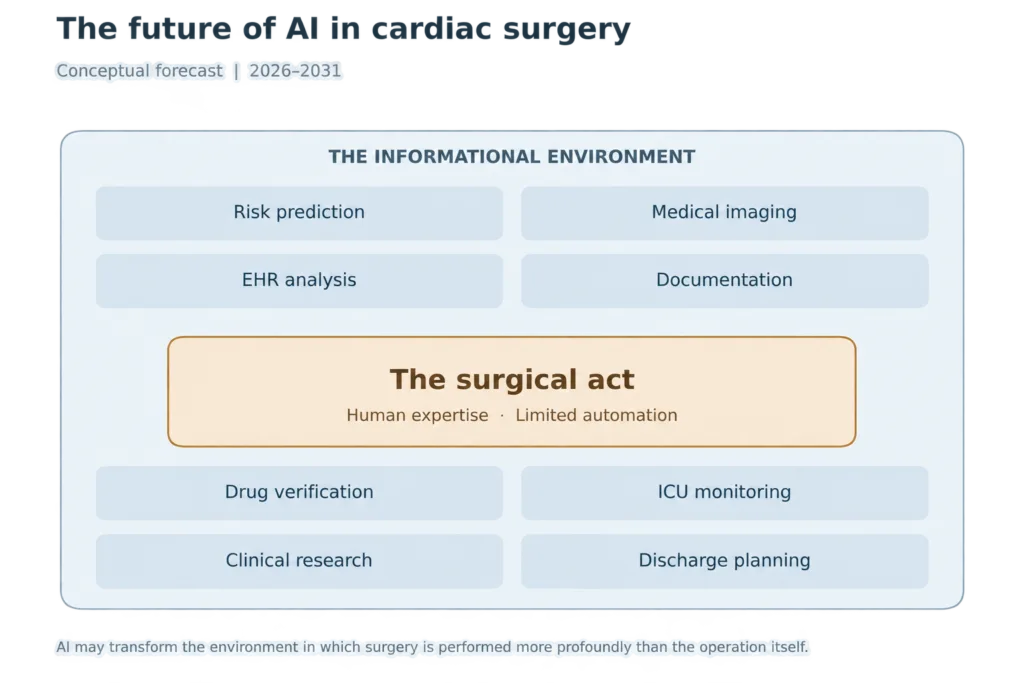
For this reason, I expect artificial intelligence to penetrate the informational dimension of cardiac surgery much faster than its physical dimension.
14. Conclusion: a more intelligent environment for human surgery
Cardiac surgery has always been a highly technological medical specialty.
Cardiopulmonary bypass, myocardial protection, mechanical circulatory support, prosthetic valves, advanced imaging, and minimally invasive instruments have profoundly transformed what surgeons can accomplish.
Yet none of these innovations has eliminated the central role of the surgeon.
Artificial intelligence will probably follow a similar trajectory, although its principal contribution may be somewhat different.
Where previous technologies expanded our physical capacity to intervene on the human heart, artificial intelligence may primarily expand our cognitive capacity to understand the patient.
It may help us identify relevant information hidden within electronic records, interpret complex physiological trajectories, estimate risk more accurately, detect inconsistencies in therapeutic decisions, and communicate clinical information more effectively.
It may also reduce the administrative and informational burden that increasingly occupies the time of modern physicians.
These achievements would be far from marginal.
A cardiac surgeon who enters the operating room with a better understanding of the patient, receives more relevant physiological information during the operation, and has better instruments for recognizing postoperative deterioration may become a more effective surgeon without delegating the operation itself to a machine.
Perhaps, therefore, we are asking the wrong question when we wonder whether artificial intelligence will become capable of performing cardiac surgery.
The more interesting question is whether artificial intelligence will help us create an environment in which cardiac surgery can be performed more safely, more intelligently, and with greater attention to the individual patient.
My expectation is that the operating room of 2031 will still be recognizable to a cardiac surgeon working today.
What may change substantially is the way in which information reaches that surgeon before, during, and after the operation.
The hands operating on the heart may remain the same.
The informational world surrounding those hands may be profoundly different.
Key takeaways
- Artificial intelligence has generated extensive scientific research in cardiac surgery, but its integration into routine practice remains limited.
- Cardiovascular imaging is among its most mature applications, particularly for automated measurements and anatomical segmentation.
- Machine learning does not consistently demonstrate clinically meaningful superiority over well-developed traditional statistical models.
- Robotic surgery and autonomous surgery are fundamentally different concepts.
- Postoperative physiological monitoring and longitudinal analysis represent promising areas for clinical decision support.
- Electronic health record analysis, documentation, discharge summaries, and therapeutic verification are likely to be among the most relevant applications in the medium term.
- The greatest contribution of artificial intelligence may be to improve the informational environment of cardiac surgery rather than to replace the surgeon.
References and further reading
Ha J, Vohra HA. Artificial Intelligence for Predicting Perioperative Outcomes in Cardiac Surgery: A Systematic Review. Innovations. 2026. DOI: 10.1177/15569845261457046.
Comparison of machine learning techniques in prediction of mortality following cardiac surgery: analysis of over 220,000 patients from a large national database. 2023. PubMed.
Deep learning versus conventional risk scores for postoperative mortality prediction in adult cardiac surgery: a systematic review. The Cardiothoracic Surgeon. 2026. DOI: 10.1186/s43057-026-00230-3.
US Food and Drug Administration. Artificial Intelligence-Enabled Medical Devices. FDA database.
He B, et al. Blinded, randomized trial of sonographer versus AI cardiac function assessment. Nature. 2023;616:520–524. DOI: 10.1038/s41586-023-05947-3.
Impact of fully-automated AI based CT-analysis on pre-procedural TAVI planning. Clinical Research in Cardiology. 2026. DOI: 10.1007/s00392-026-03017-y.
Schuurmans J, et al. Effect of a Machine Learning-Derived Early Warning Tool With Treatment Protocol on Hypotension During Cardiac Surgery and ICU Stay: The HYPE-2 Randomized Clinical Trial. Critical Care Medicine. 2025;53:e328–e340. DOI: 10.1097/CCM.0000000000006518.
AI-Based Decision Support for Perfusionists during Cardiopulmonary Bypass. 2025. Full text.
Lee A, et al. Levels of autonomy in FDA-cleared surgical robots: a systematic review. npj Digital Medicine. 2024. DOI: 10.1038/s41746-024-01102-y.
EACTS Expert Consensus Document on Robotic Cardiac Surgery Minimum Standards for Programme Implementation, Training and Quality Assurance. European Journal of Cardio-Thoracic Surgery. 2026. DOI: 10.1093/ejcts/ezag187.
Kim JWB, et al. SRT-H: A hierarchical framework for autonomous surgery via language-conditioned imitation learning. Science Robotics. 2025;10:eadt5254. DOI: 10.1126/scirobotics.adt5254.
Abuzied, Abayazid. Robotic-assisted beating heart surgery: a comprehensive review. 2026. PubMed.
Predicting kidney injury after cardiac surgery with cardio-pulmonary bypass using machine learning. 2026. PubMed.
Ambient AI Scribes in Clinical Practice: A Randomized Trial. Full text.
Goldsmith K, et al. Clinician Acceptance of Large Language Model–Generated Discharge Summaries. JAMA Network Open. 2026;9:e2644496. DOI: 10.1001/jamanetworkopen.2026.44496.
AI-Based Automation for Medication Reconciliation: Scoping Review. 2026. PubMed.
Artificial Intelligence in Cardiac Surgery and Surgical Training: Opportunities, Risks, and Safeguards for Preserving Expertise. Journal of Clinical Medicine. 2026;15:6313. Full text.
From innovation to implementation: Addressing the AI adoption gap in cardiac surgery. American Heart Journal Plus. 2026;64:100746. DOI: 10.1016/j.ahjo.2026.100746.
Artificial Intelligence in Cardiothoracic Surgery: Promises, Failures, and the Gap to Clinical Reality. Medical Sciences. 2026;14:734. Full text.
Goh E, et al. Large Language Model Influence on Diagnostic Reasoning: A Randomized Clinical Trial. JAMA Network Open. 2024;7:e2440969. DOI: 10.1001/jamanetworkopen.2024.40969.
Pierri MD, Galeazzi M, D’Alessio S, Spagnolo F, et al. A like-for-like evaluation of machine learning models and EuroSCORE II for mortality prediction after cardiac surgery. SSRN. 2025. Preprint; accepted for publication in Heart, Lung and Circulation. DOI: 10.2139/ssrn.5956858.
Pierri MD. From Static Risk Estimates to Dynamic Clinical Trajectories: A Conceptual Analysis of Perioperative Medicine. Health Care Analysis. 2026. DOI: 10.1007/s10728-026-00584-z.
Pierri MD, Galeazzi M, D’Alessio S, et al. Evaluating Large Language Models in Cardiology: A Comparative Study of ChatGPT, Claude, and Gemini. Hearts. 2025;6(3):19. DOI: 10.3390/hearts6030019.