
Upgrading a local AI workstation from an RTX 3060 12GB to an RTX 3090 24GB with real-world LLM, Flux and Whisper benchmarks.
Article authored by Michele D. Pierri, MD
Cardiac Surgeon & Medical Technology Researcher
Last checked: June 10, 2026
Reading time: 5 minutes
There are days when you don’t go to the operating room. Sundays, public holidays, the occasional free afternoon when the on-call schedule aligns in your favor. On those days, surgeons do what everyone else does: read, rest, spend time with family.
Or they operate on their PC.
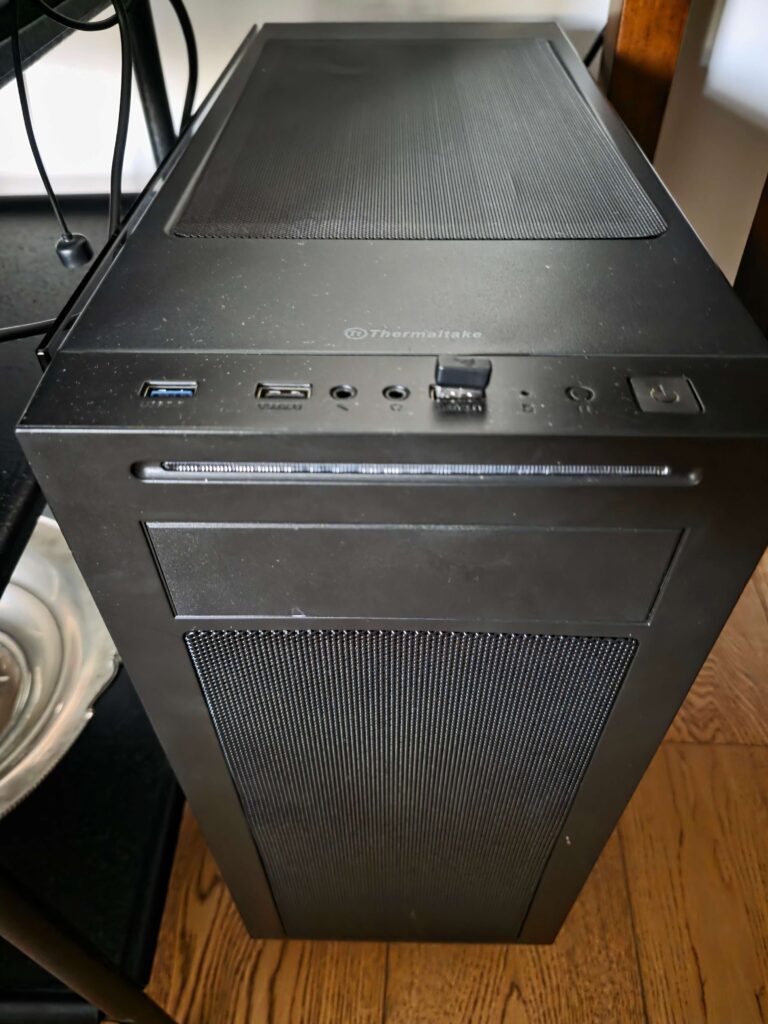
This is a clinical account of what happened on June 8, 2026, in a home study in Ancona. The patient — a desktop computer, age approximately four years — was admitted for elective hardware replacement. Diagnosis: GPU insufficiency with secondary power supply compromise. The procedure: combined transplantation of graphics processing unit and power supply unit. Anesthesia: none required. The patient does not feel pain. Or if it does, it hasn’t complained yet.
June 8, 2026 — Operative Report, Case #001
Preoperative Assessment
Every surgical intervention begins with a proper workup. In cardiac surgery, we assess ventricular function, coronary anatomy, risk scores. Here, the workup was somewhat different, but the logic was identical: identify the failing organ, understand why it’s failing, and select the appropriate replacement.
The patient presented with a well-documented history of progressive performance degradation. The primary GPU (an NVIDIA RTX 3060 with 12 GB VRAM) had been adequate for its original function. It was not adequate anymore. The ecosystem I’ve been building over the past months (local LLMs, image generation with Flux, audio transcription, the occasional multi-agent pipeline) had pushed the hardware past its operational envelope. Mistral-Nemo inference at 30 tokens per second. Flux image generation at 92 seconds per frame. Acceptable numbers two years ago. Not acceptable when you’re trying to build a production workflow.
The secondary finding was the power supply: a Corsair 600W non-modular unit. Non-modular means the cables are permanently attached: you get all of them whether you need them or not. In a patient already showing signs of internal disorganization (cable routing that could generously be described as “organic”), a non-modular PSU is a contraindication to clean surgical access. It had to go.
The selected implants: an NVIDIA RTX 3090 24GB Gainward and a Corsair RM850x 850W fully modular. The VRAM doubles. The power budget nearly doubles. The cable chaos — theoretically — resolves.
The Donor Organ
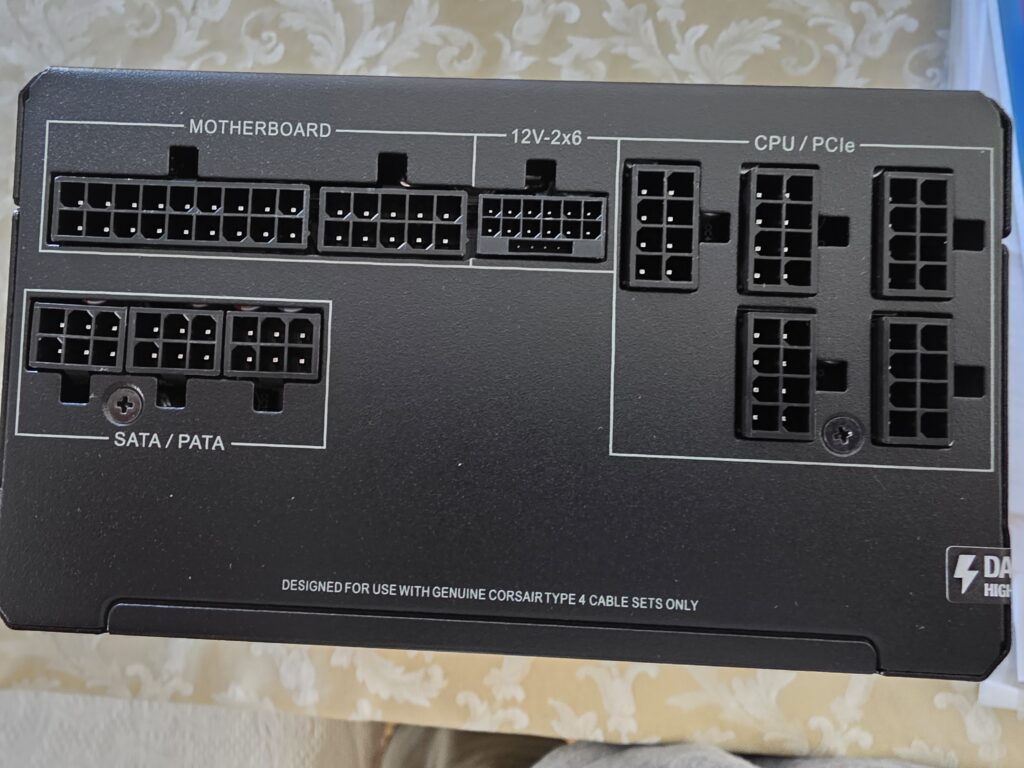
Before any transplant, you prepare the donor organ. In thoracic surgery, the harvested heart is inspected, flushed, assessed for structural integrity. Here, the Corsair RM850x was unboxed on the same floral tablecloth that would serve — entirely unintentionally — as the operative field for the entire procedure.
Look at that connector panel. MOTHERBOARD. CPU/PCIe. 12V-2×6. SATA/PATA. Each port labeled, each cable optional, each connection deliberate. There is a certain surgical elegance to a fully modular power supply: you attach only what the anatomy requires. No redundant structures, no extraneous tissue. The organ is clean. The implantation will be clean. In theory.
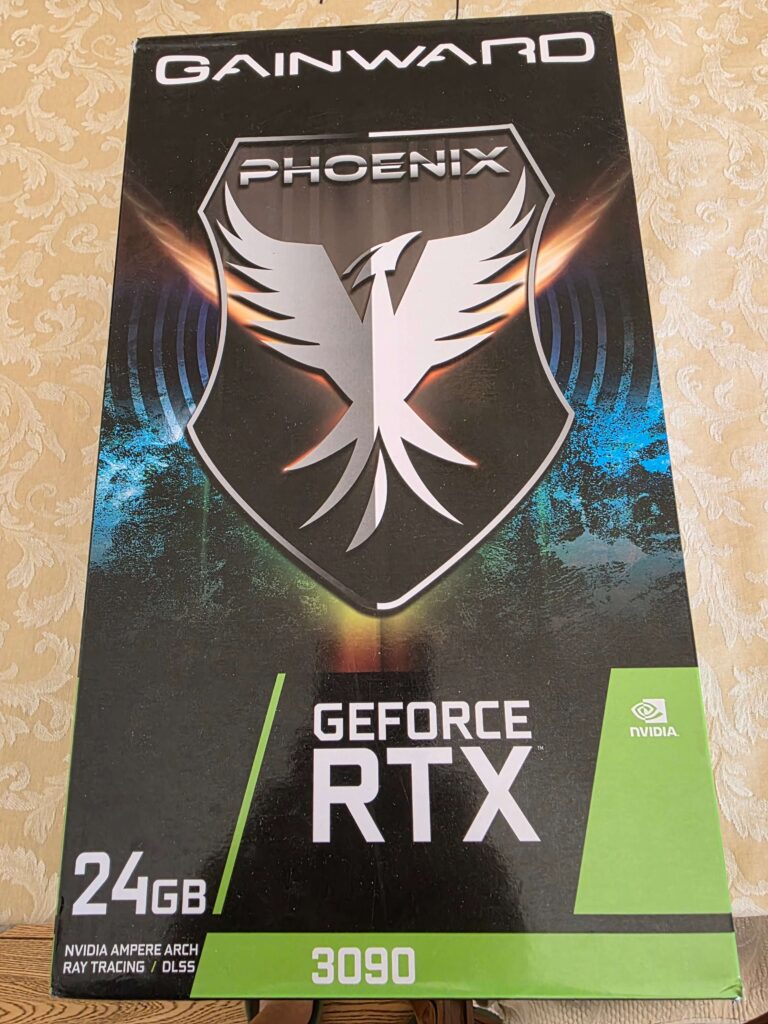
The RTX 3090 Gainward, for its part, arrived in packaging that suggested its designers were also not entirely unaware of the theatrical potential of high-end graphics cards. It is a large device. Substantially larger than the RTX 3060 it would replace. Sometimes the anatomy demands upsizing.
Opening the Field
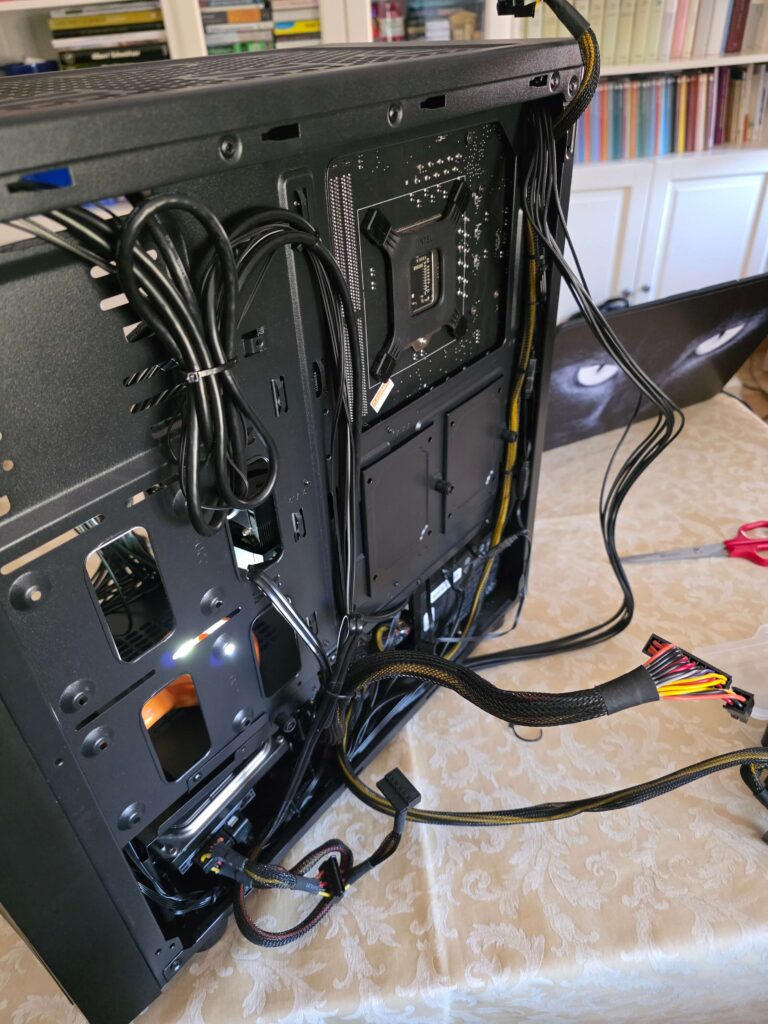
The case was placed on its side on the operative table — the floral tablecloth, which by this point had committed fully to its role as surgical draping. The side panel was removed. The field was opened.
What emerged was exactly what an intraoperative view sometimes reveals: more complexity than the preoperative imaging suggested. The existing cable routing — I will be generous here — reflected four years of incremental decisions made by someone who was always planning to fix it properly later. The mediastinal anatomy was present. The structures were identifiable. The access was not ideal.
The red-handled scissors visible in the background were, I want to clarify, for cable ties. Not for anything else. Though I understand why the photograph raises questions.
With the field open, the sequence became clear: explant the PSU first (it sits at the bottom of the case, access is direct), then address the GPU (which occupies the PCIe slot mid-chassis and requires disconnection of the PCIe power cables before extraction), then close in reverse order with the new components.
Textbook operative planning. The execution, as always, is where things get interesting.
Explantation: The Old Heart Comes Out
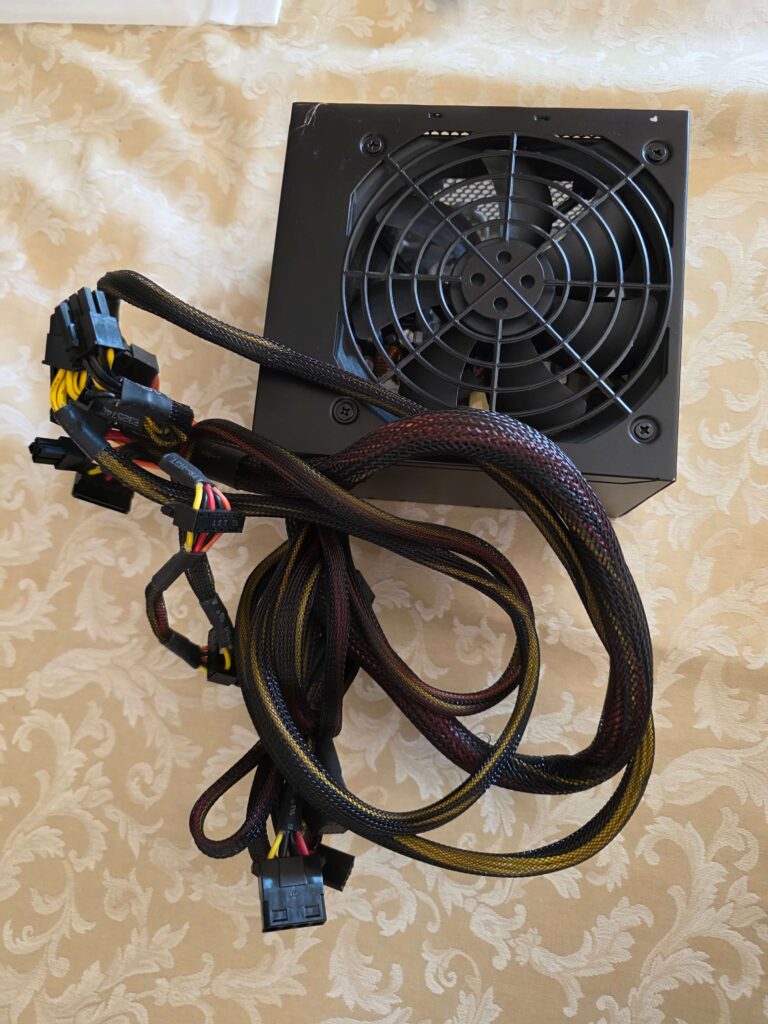
Here it is. The explanted organ, photographed post-removal on the operative field.
The non-modular Corsair 600W, with its full complement of permanently attached cables — every wire that was ever wired into it, regardless of whether it was ever used, spread out on the floral tablecloth like a vascular pedicle after harvest. The braided sleeving in black, yellow, and red is not decorative: those are the actual voltage rails. Twelve volt. Five volt. Three point three volt. The colors of the cardiovascular system, if the cardiovascular system ran on direct current.
Anastomosis: Connecting the New Organ
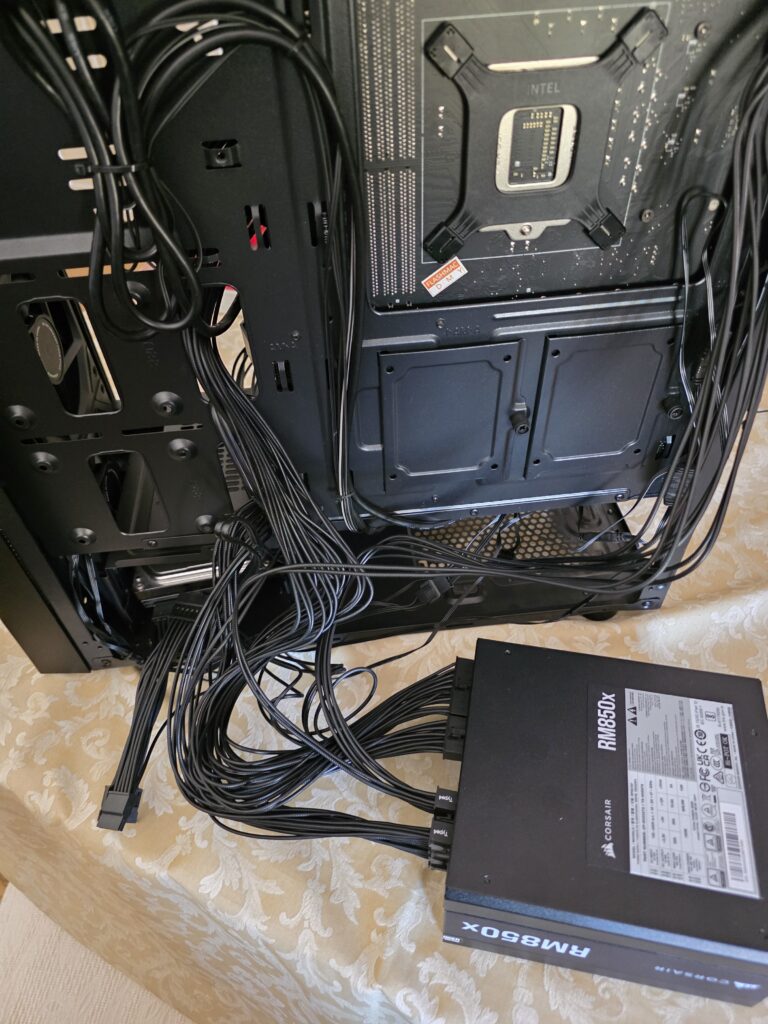
This photograph documents what in surgical terms would be called the anastomotic phase: the moment when the new organ, still partially external to the operative field, is connected to the host’s vascular supply before final positioning.
The RM850x sits on the table beside the open case. The modular cables — all black, all selected specifically for this configuration, no excess — run from its connector panel into the chassis interior. This is cable management done properly, which is to say: done once, deliberately, before everything is enclosed and inaccessible for the next four years. In surgery, you want your anastomoses under direct vision. You don’t want to be working around other structures, correcting an angle you can’t quite reach. Same principle applies here. This is the moment for precision.
The 12V-2×6 connector for the GPU — a relatively recent standard, replacing the older 8-pin PCIe configuration — carries up to 600W to the graphics card. To put that in physiological terms: the RTX 3090 at full load draws more power than some cardiac surgical bypass circuits. This seemed like relevant context while routing the cables.
The New Anatomy in Situ
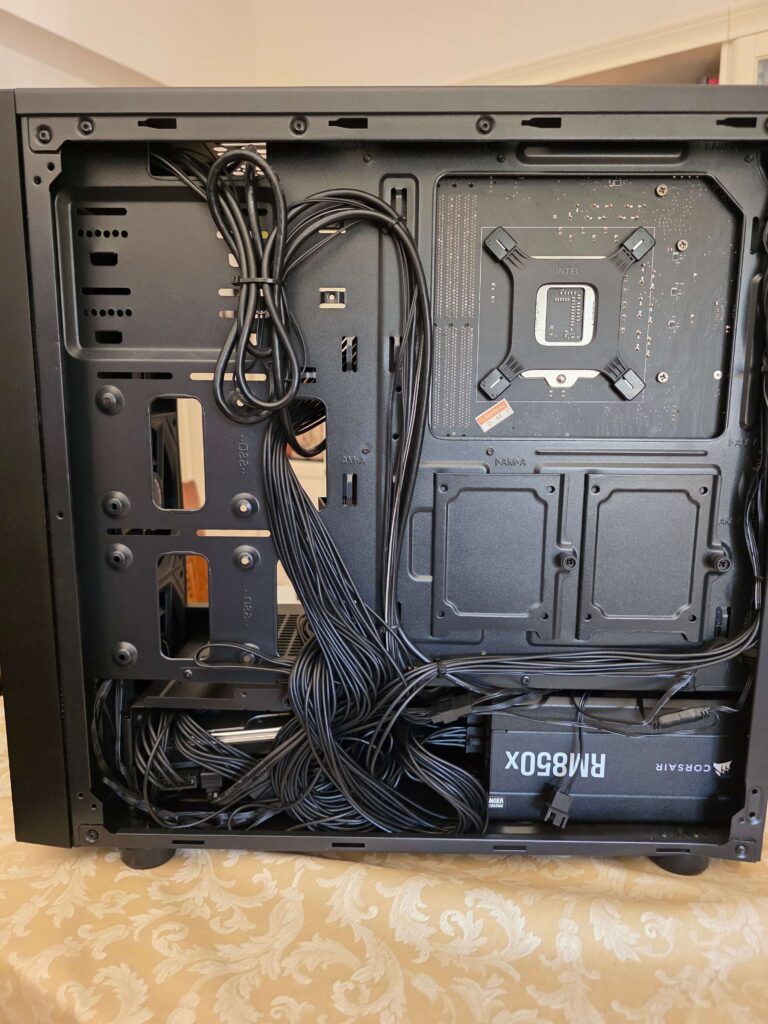
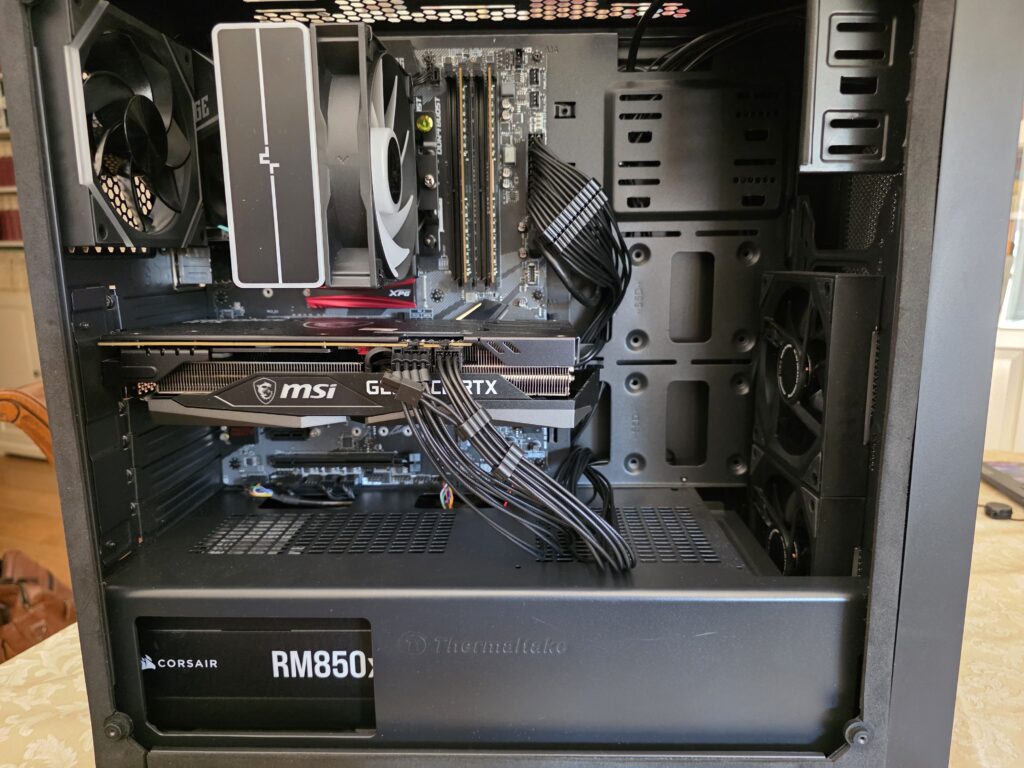
By early afternoon, the new anatomy was in place.
The RTX 3090 Gainward occupies the primary PCIe slot. “GEFORCE R—” is visible on the shroud — the rest obscured by the case edge, which seemed appropriately modest for a device about to receive considerably more attention than it had any right to expect. The PCIe power cables converge on it from the lower right like coronary vessels approaching a hypertrophied ventricle. The Corsair RM850x sits at the base of the chassis, label facing outward, entirely settled into its new home.
The frontal view shows the full operative result before closure: MSI cooling solution on the CPU (the pulmonary apparatus, in this extended metaphor — keeping everything cool, keeping everything running), the XPG motherboard visible behind the GPU, the cable routing through the chassis floor grating, the Thermaltake case providing structural containment for everything inside it.
It looked correct. It looked clean. The question — as it always is, at this point in any procedure — was whether it would work.
Post-Operative Course and Outcome Measures
The panel was replaced. The case was closed. The patient was connected to power and display and powered on.
POST-OP DAY 0: BIOS detected both components correctly. No POST errors. Windows loaded normally. nvidia-smi confirmed RTX 3090 24576 MB VRAM. Temperature at idle: 39°C core. Hemodynamically stable.
POST-OP DAY 0 (LATER): Stress testing with HWInfo64. GPU core peak 60.3°C. Hotspot 71.5°C. Voltages within normal range throughout. No instability events. The patient tolerated the workload without complications — which is, in both medicine and hardware, the outcome you were hoping for but never quite take for granted until you see it.
The benchmark results — the objective outcome measures of this intervention — were collected the following day using the same protocol applied to the pre-operative system:
| Metric | Pre-op (RTX 3060) | Post-op (RTX 3090) | Delta |
|---|---|---|---|
| Mistral-Nemo gen speed | 30.1 tok/s | 51.5 tok/s | +71% |
| Phi-4 gen speed | 27.4 tok/s | 48.7 tok/s | +78% |
| LLM gen speed (long prompt) | 33–40 tok/s | 76–86 tok/s | +114–126% |
| Flux image generation | 91.8 s/image | 44.1 s/image | −52% |
| Whisper transcription | 10.1× realtime | 11.6× realtime | +15% |
The LLM inference improvement — particularly the generation speed on long prompts, which more than doubled — reflects the additional VRAM: with 24 GB, models that previously required partial CPU offloading now run entirely in GPU memory. The Flux result is the most immediately visible change in daily workflow: images that took a minute and a half now take forty-four seconds. Over a production session of ten images, that’s nearly eight minutes recovered per session.
Whisper improved modestly. Whisper large-v3 was already comfortable in 12 GB; the 3090 doesn’t resolve a bottleneck that didn’t exist.
Discharge Summary
The patient was discharged to home the same day, in good general condition, with improved functional capacity across all measured domains.
The RTX 3060 and Corsair 600W are awaiting evaluation for secondary use or resale — both functional, both simply superseded by the requirements of the case. In cardiac surgery, explanted tissues occasionally end up in tissue banks. In hardware, they end up on eBay.
The operative field — the floral tablecloth — survived the procedure without incident and has since returned to its primary function.
The surgeon went to bed at a reasonable hour, which is more than can be said for most OR days.