
From passive Q&A to autonomous agents that debate, challenge, and assist clinicians.
Article authored by Michele D. Pierri, MD
Cardiac Surgeon & Medical Technology Researcher
Last updated: June 2026
Reading time: 15 minutes
Key takeaways
- Agentic AI is not just a better chatbot. It is goal-driven, tool-using, stateful, and designed to work with clinicians.
- Multi-agent / multi-persona deliberation can mitigate diagnostic cognitive biases (anchoring, premature closure, availability) by forcing structured counterarguments.
- Real clinical value comes from grounding (EHR/FHIR + knowledge tools), traceability, and evaluation, not from eloquent text alone.
- In healthcare, human-in-the-loop and safety-by-design are non-negotiable: agents should prepare, summarize, and request confirmation; they should never execute irreversible actions autonomously.
- The same blueprint scales beyond diagnosis (med rec, trial matching, safety monitoring, patient journey).
1. Redefining AI in Medicine: What Is an Agentic System?
The first wave of AI in healthcare gave us chatbots. Helpful for fetching information, yes, but essentially reactive: you ask a question, you get an answer. Today, a different paradigm is taking shape, one that I find genuinely more interesting from a clinical standpoint: agentic systems, AI architectures that set goals, use tools, retain memory, and orchestrate multiple specialized components to complete complex, multi-step tasks with minimal human hand-holding.
An agentic system is more than a language model that answers prompts. It’s an architecture in which one or more autonomous AI agents perceive their environment, make decisions, call external tools (APIs, databases, calculators), and adapt their strategy to achieve a predefined clinical or operational goal. The distinction matters more than it might seem.
To avoid confusion, a brief vocabulary:
- Agentic: goal + planning + tool use + state/memory.
- Multi-agent: multiple specialized agents coordinated by an orchestrator/controller.
- Multi-persona: a multi-agent pattern where each agent embodies a distinct cognitive/clinical style (e.g., pragmatist, scholar, devil’s advocate).
Contrast this with familiar alternatives:
- Passive chatbot: responds only when addressed; no initiative, no state.
- Deterministic automation: follows rigid rules (e.g., “IF creatinine > 1.2 THEN alert”) without contextual reasoning.
- Single LLM pipeline: one model, one prompt, one answer. No memory, no interplay of perspectives.
Key characteristics of an agentic healthcare system:
- Goal-oriented: Not “give me information about chest pain” but “determine the most likely causes of this patient’s chest pain, considering their history, and propose the next three diagnostic steps ranked by appropriateness.”
- Tool use: The agent doesn’t just rely on its internal knowledge; it actively queries electronic health records (via FHIR APIs), drug databases, clinical guidelines, calculators (e.g., Wells score), and even PubMed.
- Memory and state: It maintains a longitudinal view of a patient journey that may span months, remembering previous interactions and decisions.
- Multi-agent orchestration: Specialized agents, each with a distinct role, persona, and tool set, collaborate, debate, and converge on a better outcome than any single model could achieve alone.
- Human-in-the-loop by design: In clinical contexts, agents never execute irreversible decisions (prescriptions, procedures) autonomously; they prepare, summarize, and ask for confirmation.
This is not a distant vision. The building blocks are already here: large language models with function calling, vector databases for memory, and orchestration frameworks. The real question is how to assemble them for clinical value. And that, frankly, is where most implementations still fall short.
2. Under the Hood: The Building Blocks of a Clinical Agent
Before diving into the case study, let’s demystify the tech stack that makes a clinical agent work:
- LLM as reasoning core: Models like GPT-4 or open-source alternatives (Meditron, Llama 3 fine-tuned on biomedical text) generate plans, synthesize information, and simulate different clinical perspectives.
- Tool calling / function calling: The agent can execute API requests, retrieving lab results from a FHIR server, checking drug interactions with a medication knowledge base, or searching medical literature via PubMed.
- Memory systems: Short-term memory (conversation history) and long-term memory (vector stores of patient summaries, clinical guidelines) allow the agent to accumulate context.
- Orchestration logic: A “controller” agent manages the flow, parsing the user’s goal, dispatching sub-tasks to specialized agents, and synthesizing their outputs.
- Safety guardrails: Output filters, clinical confidence thresholds, mandatory human validation steps, and “no-autonomy” policies prevent hazardous recommendations.
Minimum viable stack (practical blueprint)
- An LLM with tool/function calling
- A controller/orchestrator prompt (or a simple state machine)
- Retrieval (RAG) over local guidelines + a curated knowledge base
- Structured logging (inputs, tool calls, outputs, decisions)
- Evaluation harness (see section 5) + red-team cases
- UX/Workflow integration (EHR context, confirmation step, traceability)
For healthcare specifically, interoperability standards like HL7 FHIR are the plumbing that lets agents talk to real hospital systems. Even a prototype can use public FHIR test servers (e.g., the SMART Health IT sandbox) to simulate real-world data flows. In practice, getting this integration right is considerably harder than the demos suggest.
3. Case Study: A Multi-Persona Agent for Differential Diagnosis
To test these ideas, I built a rudimentary agentic system for differential diagnosis that simulates a team of experts with distinct cognitive styles. The premise is simple: a clinician enters a chief complaint and a few anamnestic clues; the system engages an internal panel of AI personas that reason, critique each other, and converge on a weighted list of hypotheses. A bit like a real case discussion, though with its own obvious limitations.action, healthcare data governance
Why this matters
Diagnostic errors often stem from cognitive biases: premature closure, anchoring, availability. A single AI can easily fall into the same traps. By introducing multiple deliberative agents, we can expose blind spots, consider counterfactuals, and broaden the differential. Whether this actually reduces diagnostic error rates at scale is still an open question, one that proper clinical validation would need to answer.
The Agent Trio
- The Clinical Pragmatist: the frontline expert. Thinks in terms of probabilities, common presentations, and “what you can’t miss.” References real-world prevalence, prioritizes immediate actionable steps, and avoids over-investigation.
- The Academic Scholar: the literature-driven mind. Retrieves the latest evidence, rare syndromes, recent cohort studies, and genomic associations. Prioritizes pathophysiological coherence and flags emerging disease phenotypes.
- The Provocateur (Devil’s Advocate): the critical foil. Generates counterfactual reasoning: “What if the main symptom is a red herring?” “What if two diseases are co-occurring?” “What if a lab result is falsely normal?” Challenges assumptions and forces alternative explanations.
How it works: a narrative walkthrough
Let’s trace a real interaction. The user input is a sparse clinical snapshot:
“72-year-old man, 3-month history of fatigue, unintentional weight loss of 8 kg, mild diffuse abdominal pain. No fever, no blood in stool. Former smoker.”
Step 1 – Data parsing and goal setting:
The orchestration layer structures the input into a problem representation and assigns the goal: Generate a ranked differential diagnosis, highlighting red flags and evidence gaps.
Step 2 – Independent reasoning:
Each agent receives the structured case and is instructed to produce:
- A ranked list of 3-5 possible diagnoses
- The clinical rationale
- One key “what else?” counterpoint
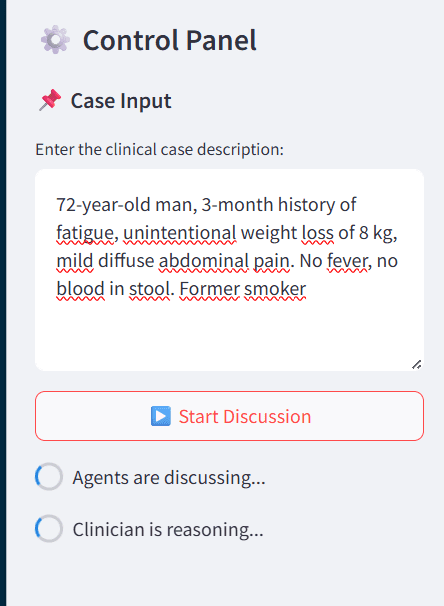
Step 3 – Deliberation and synthesis:
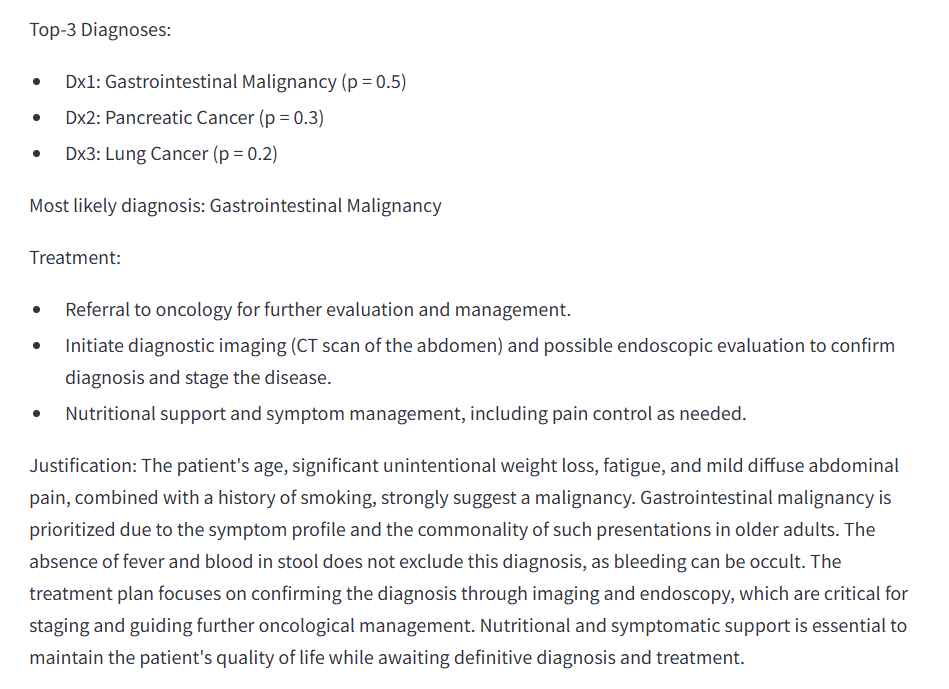
The controller feeds these outputs into a moderator step, asking the agents to comment on each other’s contributions and adjust their confidence. The Provocateur forces the group to address the “colon cancer without bleeding” scenario; the Academic adds that the absence of jaundice doesn’t exclude a pancreatic body/tail tumor. The Pragmatist absorbs the suggestions and updates the list, now including TSH and a medication review as immediate low-cost steps.
Step 4 – Final output artifacts (what the clinician actually gets):
Tools used in this prototype
The system leverages an LLM with function calling to:
- Query PubMed for recent case reports (Academic agent)
- Compute pre-test probabilities using simple epidemiological priors
- Check drug databases for medications that cause weight loss/fatigue
Still rudimentary, it demonstrates a fundamental shift: the AI stops being a black-box oracle and becomes a transparent, multi-voiced assistant that explicitly questions its own reasoning. Whether that shift translates to measurable clinical benefit remains to be tested properly.
4. Beyond Diagnosis: Other Agentic Patterns in Healthcare
The multi-agent paradigm is not limited to differential diagnosis. The same architectural patterns apply across the entire patient journey. A few high-impact scenarios worth considering:
- Patient Journey Concierge: a proactive agent that monitors appointment schedules, medication adherence, and patient-reported symptoms. It reaches out via WhatsApp, adjusts reminders based on mood and engagement, and escalates to a human when it detects worsening.
- Safety Watcher for Inpatient Wards: an agent that streams vitals and labs in real time, correlates subtle trends (e.g., rising heart rate + falling urine output), and sends structured, actionable alerts to the responsible nurse, moving beyond noisy threshold alarms.
- Trial Matching Navigator: an agent that nightly scans clinical documentation and matches patients to active trials, flagging eligible candidates and requesting missing genetic tests, thus accelerating research enrollment.
- Medication Reconciliation Mediator: at admission and discharge, an agent reconciles home medications with hospital orders, flags dangerous interactions and omissions, and generates patient-friendly medication plans with follow-up reminders to prevent readmissions.
Each follows the same agentic recipe: clear goals, tool integration, memory, evaluation, and, in many cases, the interplay of multiple specialized agents. The execution details vary considerably, and so does the risk profile.
5. The Critical Layer: Safety, Governance, Evaluation, and the Human in the Loop
If you’re a developer or clinician reading this, the safety question is probably already forming: Who is liable when a multi-agent discussion misses a key diagnosis?
This is the most important design consideration. In any agentic healthcare system, four principles are non-negotiable:
- Human-in-the-loop for clinical decisions: The system provides decision support, not autonomous orders. The final differential, test ordering, and treatment remain firmly in the clinician’s hands.
- Explainability / traceability: Every recommendation must be traceable to the agent reasoning and to the tools used (inputs, tool calls, retrieved snippets, timestamps).
- Legal and UX framing: The output is “clinical decision support” or “evidence synthesis,” not a medical act. This distinction must be explicit in the interface and documentation.
- Data privacy and consent: Agents that access patient data must run inside secure, compliant environments. In prototyping, synthetic or de-identified data should be the default.
Evaluation (often missing, always required)
To move from a demo to something clinically credible, you need an evaluation layer. This is the part most teams skip, and the omission shows:
- Case-based benchmarking: a curated set of vignettes (common + edge cases) with expected differentials and failure modes.
- Error taxonomy: track where the agent fails (missed “can’t miss,” over-testing, hallucinated evidence, wrong prioritization).
- Calibration: compare confidence vs correctness; force abstention or escalation below thresholds.
- Human review workflow: structured clinician feedback loops (what changed, why, and whether the tool helped or harmed).
Our differential diagnosis agent, for example, wraps every final output in a disclaimer and always includes a confidence statement. If internal consensus drops below a threshold, the system explicitly suggests escalation to a human consultation rather than pushing a low-confidence guess. It’s a small design choice, but an important one.
6. From Insight to Action: A Starter Kit for Agentic Healthcare
To move from theory to practice, the community needs open, safe sandboxes. I propose a Medication Reconciliation Agent Starter Kit, a minimal but extensible agent that:
- Connects to a public FHIR test server (e.g., HAPI FHIR) populated with synthetic patient data.
- Ingests a mock admission note and home medication list.
- Deploys two agents: a Pharma Checker that flags interactions/omissions and a Patient Communicator that generates a plain-language discharge medication plan.
- Produces concrete artifacts: interaction flags with sources, a reconciled med list for clinician confirmation, and a patient-facing summary.
- Operates with guardrails by default: no dosing changes suggested, mandatory clinician confirmation, and full trace logging.
This starter kit would give developers a concrete blueprint for building agentic healthcare tools that are safe by design, interoperable, and grounded in real-world workflows. The same principles can then be extended to more ambitious multi-persona diagnostic agents. Whether hospitals will actually adopt something like this depends on factors well beyond the technical, including procurement, liability, and clinician trust.
Conclusion: A Debate Club Inside Your Clinical Workstation
Agentic AI in healthcare is not about replacing clinical judgement. It’s about augmenting it with a tireless, transparent, and multi-perspective reasoning partner. Even a simple orchestration of three distinct agent personas can surface diagnoses that might otherwise be missed and, critically, explain why.
The next step is to harden these prototypes with real data integration, rigorous evaluation, and thoughtful clinician-in-the-loop interfaces. The open-source community and health-tech builders have an opportunity to create the building blocks of a new generation of clinical AI, one that debates, double-checks, and ultimately serves the patient.
If you’re building in this space: what agentic pattern would you add to this list?
See also on this site: OpenClaw and Cowork in Healthcare