micheledpierri.com: statistics, data analysis and coding

Nexus of Statistics, Data analysis, Coding, Art and Medicine

Menu
  • Home
  • Courses
    • Python Foundation
    • Statistics
    • Data Analysis
    • Machine Learning
  • Blog
    • All Pages
    • Health Informatics
    • Programming
    • Art
  • Illustrations
  • About
  • Contact
Menu
Home / Art / Page 3

Category: Art

Explore the fascinating intersection of art and medicine through paintings, illustrations, and visual representations of physicians, medical procedures, and healthcare throughout history.

A nurse in an early 20th-century hospital ward holds a large horseshoe magnet over a patient lying in an iron bed, surrounded by vintage medical equipment.

Mozart aria “Eccovi il medico, signore belle”

Posted on July 31, 2024August 9, 2026 by Michele Danilo Pierri

Mozart aria “Here is yout doctor, lovely ladies”

“Here is yout doctor, lovely ladies” is an aria from the opera “Così fan tutte” by Wolfgang Amadeus Mozart.

The opera, composed between 1789 and 1790 with a libretto by Lorenzo Da Ponte, was first performed in Vienna on January 26, 1790. The full title is “Così fan tutte, ossia La scuola degli amanti,” and it is set in Naples . The plot centers on a bet between Don Alfonso and two young men, Guglielmo and Ferrando. Don Alfonso bets that the young men’s fiancées will not be faithful when tested. To prove his point, Don Alfonso organizes a series of deceptions with the help of the maid Despina.

In the opera’s second act, Don Alfonso convinces Guglielmo and Ferrando to disguise themselves as noble Albanians to test their fiancées’ fidelity. The two men pretend to be poisoned, and Despina, disguised as a doctor, enters to cure them.

The aria “Here is yout doctor, lovely ladies” introduces this moment. It plays on the absurdity of the situation and the satire of medical practices of the time. Additionally, this scene amplifies the theme of disguise and deception, which is central in “Così fan tutte”.

Text of the mozart aria "here is the doctor"

Historical context

The aria “Eccovi il medico, signore belle” is not just a comic moment in the opera; it is also a social commentary and a critique of 18th-century medical practices.

In the 18th century, medicine was undergoing a significant transition. On one hand, many practices were still based on superstitions and traditional remedies. On the other hand, more scientific medicine was emerging thanks to developments in anatomy, physiology, and chemistry.

At the far end of that spectrum stood the itinerant sellers of miracle remedies, whose theatrical performances Donizetti would immortalise a generation later in the figure of Dulcamara.

However, medicine was often seen as a mix of science and spectacle. Doctors had to balance their reputation between the effectiveness of treatments and their ability to gain patients’ trust through a certain degree of theatricality.

“if they are ill, they are certainly because of a love potion”

The phrase “because of a love potion” suggests a simplistic and romantic explanation for diseases, reflecting a pre-scientific view of medicine where emotions and external influences were often seen as causes. This conception remained common despite scientific progress.

“With this philosophical instrument, this device invented by the great Newton…”

The mention of the “philosophical instrument” and the “great Newton” introduces a parody of the scientific revolution. Isaac Newton, known for his discoveries in physics and mathematics, symbolizes the new era of science. However, Despina’s “magnet” is a ridiculous device with no real scientific basis, highlighting how many medical instruments of the time were more related to superstition than science.

“I will remove from the stomach, from the chest, and from the heart the witchcraft”

The description of Despina that “will remove from the stomach, chest, and heart the witchcraft” is an ironic reference to exorcistic and magical practices still used in some areas of folk medicine. This highlights the persistence of archaic beliefs in an era just beginning to better understand human physiology and pathology.

Mesmerism and Animal Magnetism

Mesmerism, or animal magnetism, was a theory and practice proposed by the German physician Franz Anton Mesmer in the late 18th century. Mesmer believed in a universal fluid that could be manipulated to cure diseases. He used magnets and later only his hands to direct this fluid into patients’ bodies, inducing trance states and seemingly miraculous healings.

During the 18th century, practices like mesmerism gained popularity due to their apparent effectiveness and the ability to tap into people’s desire for miraculous cures.

In the aria, Despina, disguised as a doctor, uses a “magnet” as a “philosophical instrument,” directly parodying mesmerism practices. This reflects a satire of Mesmer’s practices, which were very popular but also very controversial in Mozart’s time.


The history of medicine is full of theories and practices that were initially popular but later discredited. This still resonates today with many alternative and complementary practices that, despite their popularity, lack solid scientific foundations.

Mozart’s work is therefore not only entertainment but also a critical commentary on the medical practices and beliefs of the time. It highlights the tension between science and pseudoscience, emphasizing the importance of relying on evidence-based medical practices rather than popular and unscientific beliefs.

The Anatomy Lesson of Dr. Nicolaes Tulp

Posted on July 23, 2024August 8, 2026 by Michele Danilo Pierri

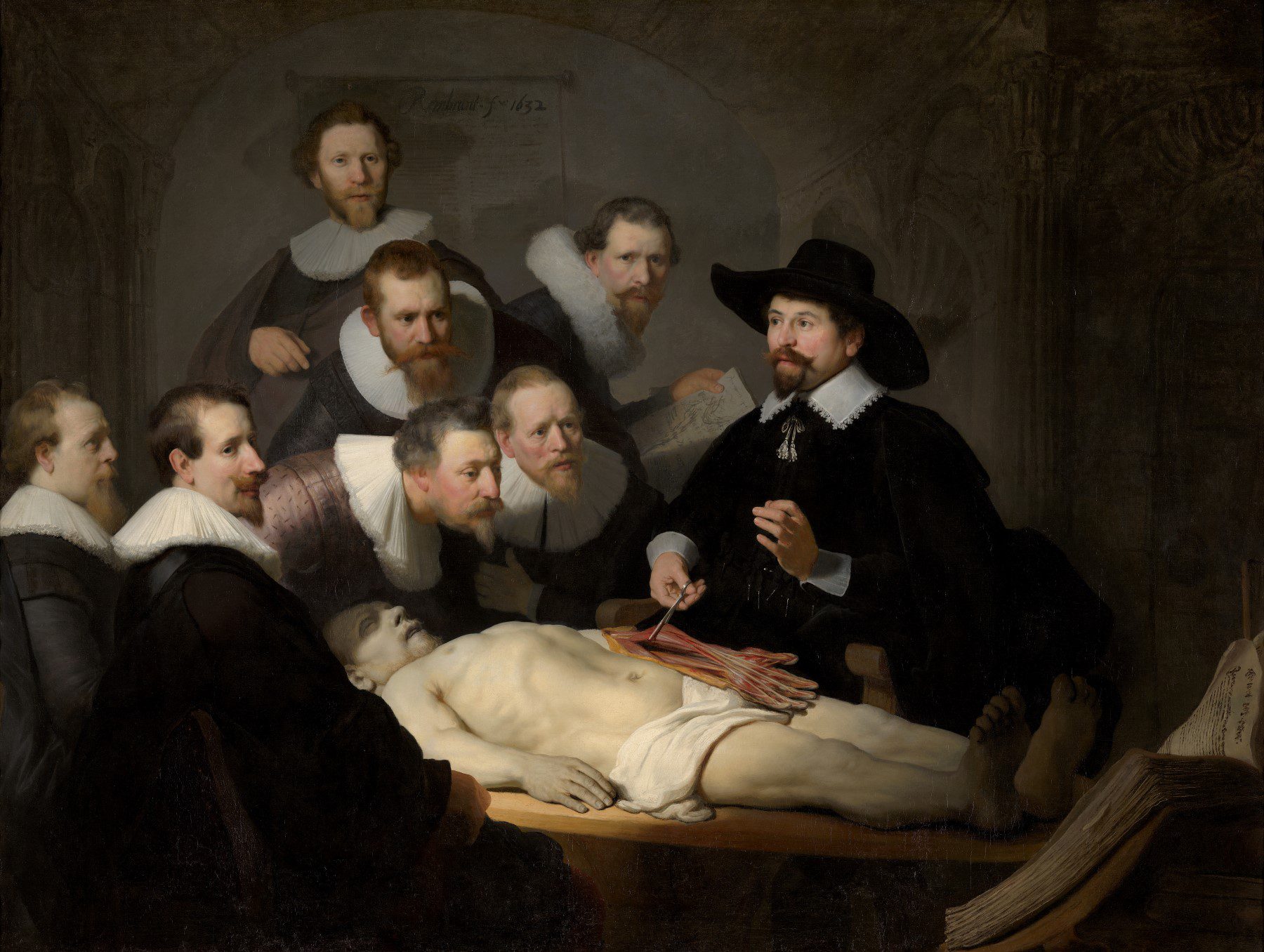
The painting “Anatomy Lesson of Dr. Tulp” is one of Rembrandt’s masterpieces, currently housed at the Mauritshuis museum in The Hague, Netherlands. Created in 1632, it is significant not only as an exceptional example of Baroque art but also as an important historical document of medical history and anatomical practices.

The Artist

Rembrandt Harmenszoon van Rijn, commonly known simply as Rembrandt, was born on July 15, 1606, in Leiden. He is considered one of the greatest painters in the history of art. He primarily worked in Amsterdam, gaining fame for his portraits, self-portraits, and historical scenes, showcasing his skill in using light and shadow and his ability to convey vivid portrayals of the human condition.

The Painting

“Anatomy Lesson of Dr. Tulp” was commissioned by the Amsterdam Guild of Surgeons and marked a pivotal moment in Rembrandt’s career, solidifying his reputation as a talented portraitist. The subject of the painting is Dr. Nicolaes Tulp, a surgeon and anatomy lecturer, depicted conducting a lesson. The cadaver is that of a criminal, Aris Kindt, who had been executed for theft. Tulp is surrounded by seven members of the Guild of Surgeons to whom he is giving a lesson. The painting vividly captures the event, significant both scientifically and socially at the time, with great realism and detail.
The scene is set in a dimly lit anatomical theater; Dr. Tulp is identifiable by his black attire and wide-brimmed hat, signifying his professional status. He is shown illustrating the muscles of the cadaver’s left arm, which lies supine on the table, using anatomical forceps. The seven guild surgeons are arranged in a semicircle, formally dressed, and their faces show concentration and interest.
The painting measures 169.5 cm by 216.5 cm and is executed in oil on canvas. Noteworthy is the use of chiaroscuro to draw attention to the center of the work. There is a strong contrast between the dark background and the brightly lit cadaver and Dr. Tulp.
Also notable are the precise anatomical details, demonstrating the artist’s careful observation of the human body. The expressions and postures of the surgeons add a psychological dimension to the scene.

The Protagonist

Dr. Nicolaes Tulp, originally named Claes Pieterszoon, was born on October 9, 1593, and died on September 12, 1674. He lived during a particularly prosperous period for the Netherlands, marked by the growth of the Dutch East India Company and the development of extensive international trade.
Tulp was a renowned physician, a member of the Amsterdam Guild of Surgeons, and conducted several public anatomy lessons, an activity reserved only for high-ranking doctors. In 1641, he published the book “Observationes Medicae,” a collection of clinical cases that gained wide circulation and was translated into several languages. Besides his medical career, Tulp was also a politician, becoming a member of the city council and later the mayor of Amsterdam.

Historical Context

In addition to its undeniable artistic values, “Anatomy Lesson of Dr. Tulp” is a valuable document of medical history. In the 17th century, human dissection was a relatively new and controversial practice, beginning to develop thanks to the gradual relaxation of religious restrictions.
Public anatomy lessons were crucial opportunities for educating doctors and advancing anatomical knowledge.

The historical observation of Rembrandt’s fresco highlights two fundamental aspects that shaped the organization of medicine in that historical period.

Firstly, we must emphasize the emancipation of the surgeon’s role compared to that of the physician. Initially, surgeons were considered inferior to physicians: physicians had university education and dealt with non-invasive treatments; surgeons were regarded as craftsmen engaged in manual tasks like amputations and fracture reductions.

This distinction was particularly clear in the Middle Ages and the Renaissance, but later, around the 17th century, the surgeon’s role began to gain importance and prestige.
This was primarily due to the expansion of surgical techniques and improved outcomes, which in turn resulted from a more detailed understanding of the human body. The publication and dissemination of Andreas Vesalius’s text “De humani corporis fabrica” in 1543 certainly contributed to this knowledge. The spread of the knowledge of the successes and techniques of some great surgeons, like Ambroise Paré (1510-1590), considered the father of surgery, also had a significant impact.

Furthermore, “schools of surgery” began to emerge, offering structured training for surgeons comparable to that of physicians. Guilds, which were common in many European cities, were professional organizations of merchants and craftsmen that regulated their respective trades.
The Amsterdam Guild of Surgeons played a pivotal role in ensuring that only qualified individuals could practice surgery. The Guild not only examined and certified surgeons but also provided education and training.

IIn this context, the anatomy lessons given by the Amsterdam Guild’s most prestigious doctors, such as Dr. Tulp, were highly significant. These lessons often included dissections of cadavers, usually of executed criminals, and were public, meaning they were open not only to doctors but also to the general public.

The Amsterdam Guild played a fundamental role in the development and dissemination of modern surgery. Commissioning the painting from the already famous Rembrandt was not only a celebration of one of its most prestigious members but also aimed to demonstrate the importance of training and the prestige achieved by the surgical profession.

  • Previous
  • 1
  • 2
  • 3
© 2024–2026 micheledpierri.com · Privacy Policy · Impressum