Dante’s Inferno as a Clinical Gaze

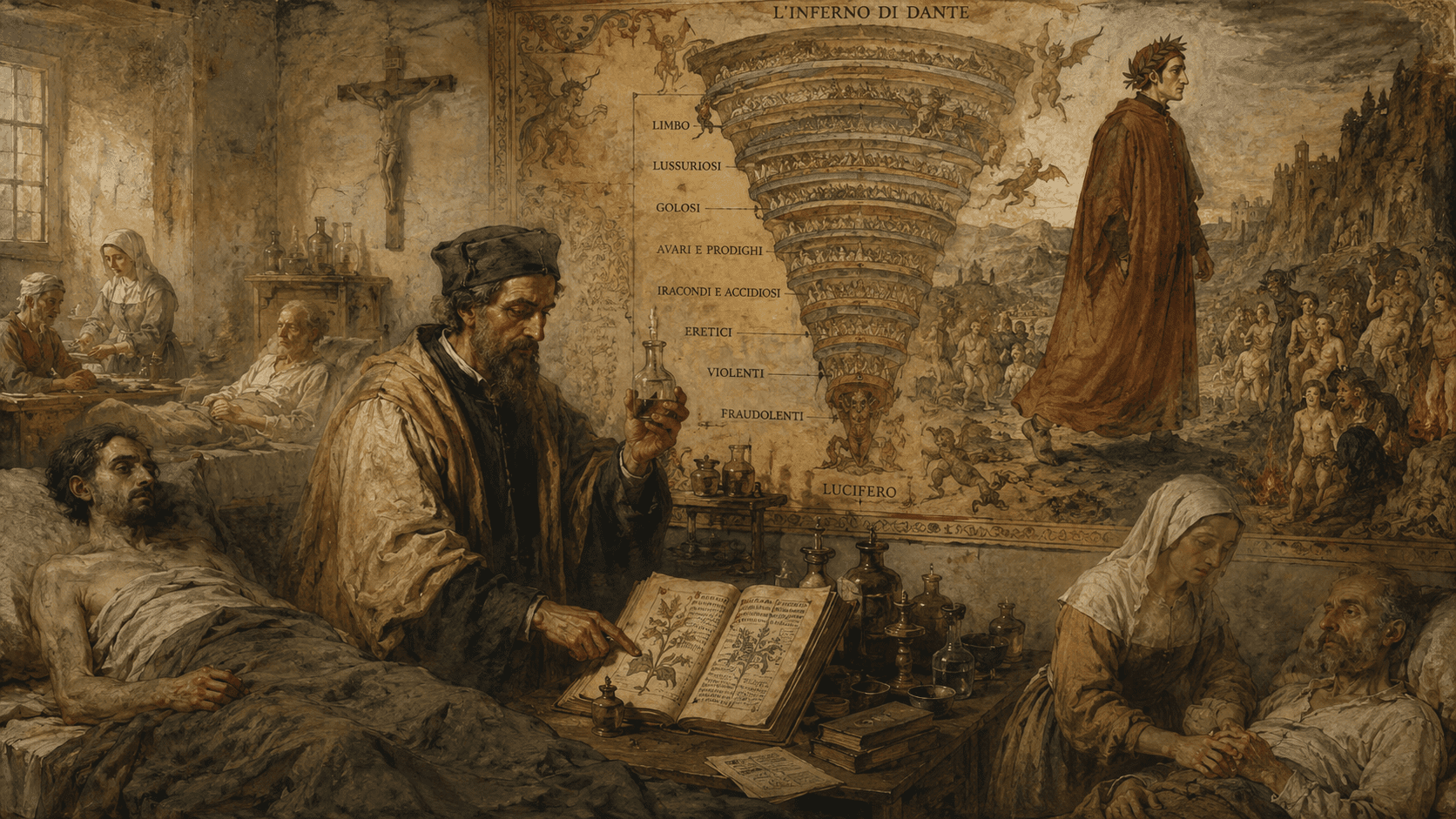
Historical medical illustration showing a medieval physician examining patients in a hospital ward, with a large mural of Dante’s Inferno behind him, connecting disease, clinical observation, and medieval visions of suffering.

SummaryDante Alighieri’s Inferno is a theological poem, yes, but it is also, almost incidentally, a forensic catalogue of medieval disease and healthcare. This article reads the poem through the lens of medical history: how Dante represents specific pathologies (dropsy, scabies and possibly leprosy, neurological deformity, hypothermia, traumatic mutism), how he mimics diagnostic observation, and how … Read more

From Hippocrates to Artificial Intelligence

a solemn council / meeting of physicians, gathered around a large wooden table, each doctor representing a different era of medical “seeing”.

I am a cardiac surgeon. My work is rooted in the operating room, in clinical decisions, and in the care of individual patients. At the same time, I have become deeply interested in medical data, statistics, coding, and artificial intelligence. My fascination with the history of medicine, however, has remained just as strong. At first … Read more

Edvard Munch and Illness: The Ailing Body, the Soul Aflame

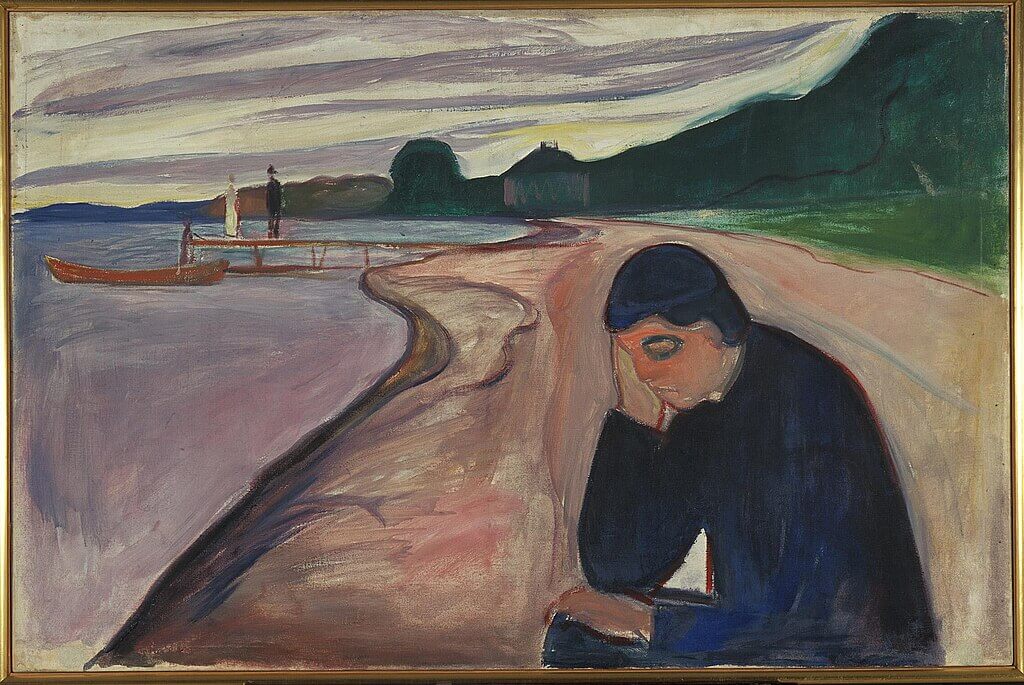
Edvard Munch Melancholy

“Sickness, madness and death were the dark angels that had accompanied me since childhood.” Edvard Munch, Diaries, 1890 In the cold north of Europe, between the late nineteenth and early twentieth centuries, a Norwegian painter transformed his pain into vision. Not abstract pain, but one rooted in flesh, lungs, and nerves: a pain named tuberculosis, … Read more

The Death of the Grandmother in Proust’s “À la recherche du temps perdu”

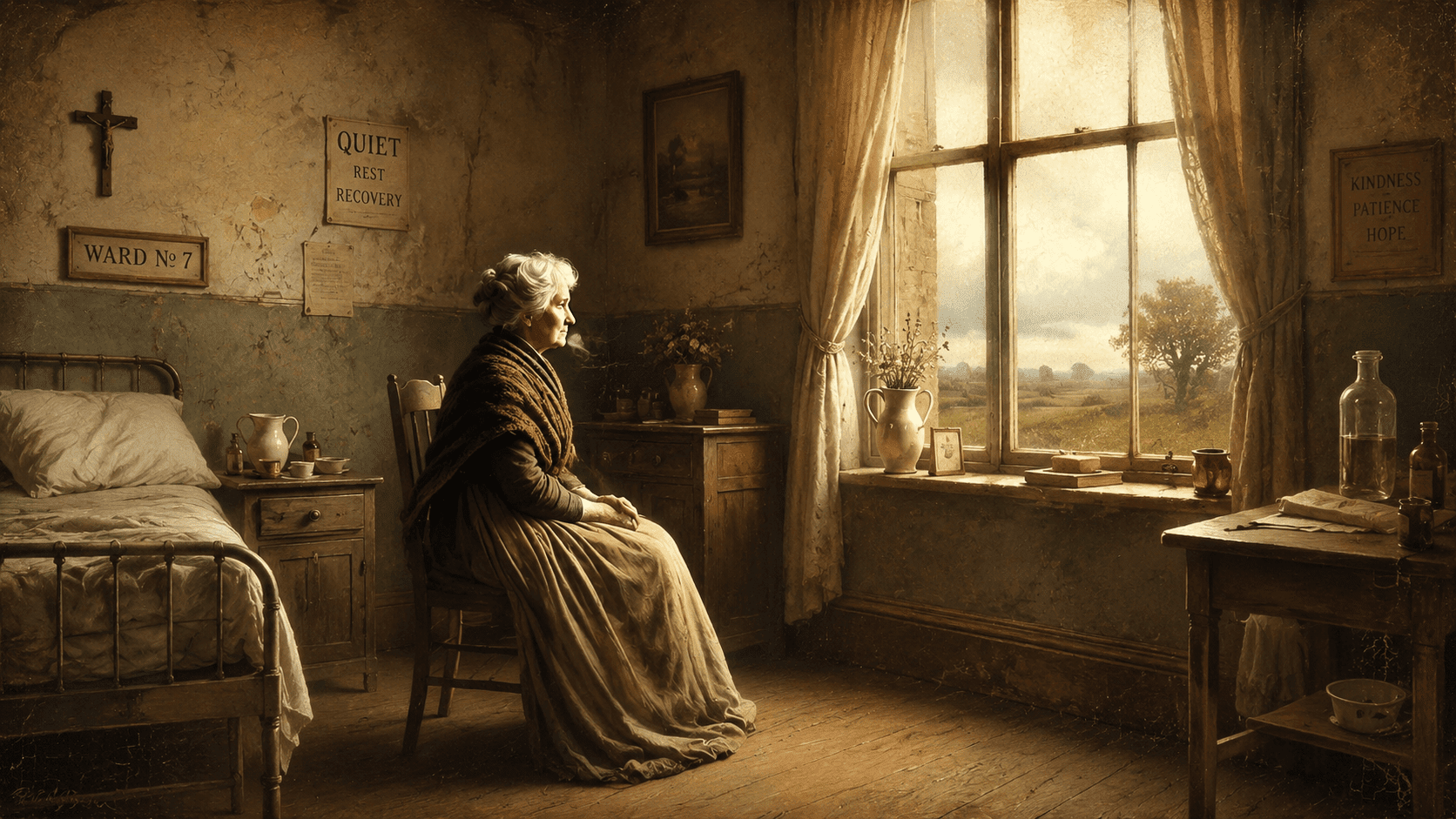
An elderly woman sits quietly on a wooden chair beside an iron hospital bed, gazing out a sunlit window in a softly lit early 20th-century convalescent room filled with worn furniture, simple bottles, and a calm, reflective atmosphere.

The Death of the Grandmother: A Moment of Truth, Fragility, and Revelation Introduction In the third volume of “À la recherche du temps perdu”, Marcel Proust portrays the gradual illness and death of the narrator’s grandmother. This episode stands as one of the emotional, philosophical, and narrative pinnacles of the entire work. Through his meticulous … Read more

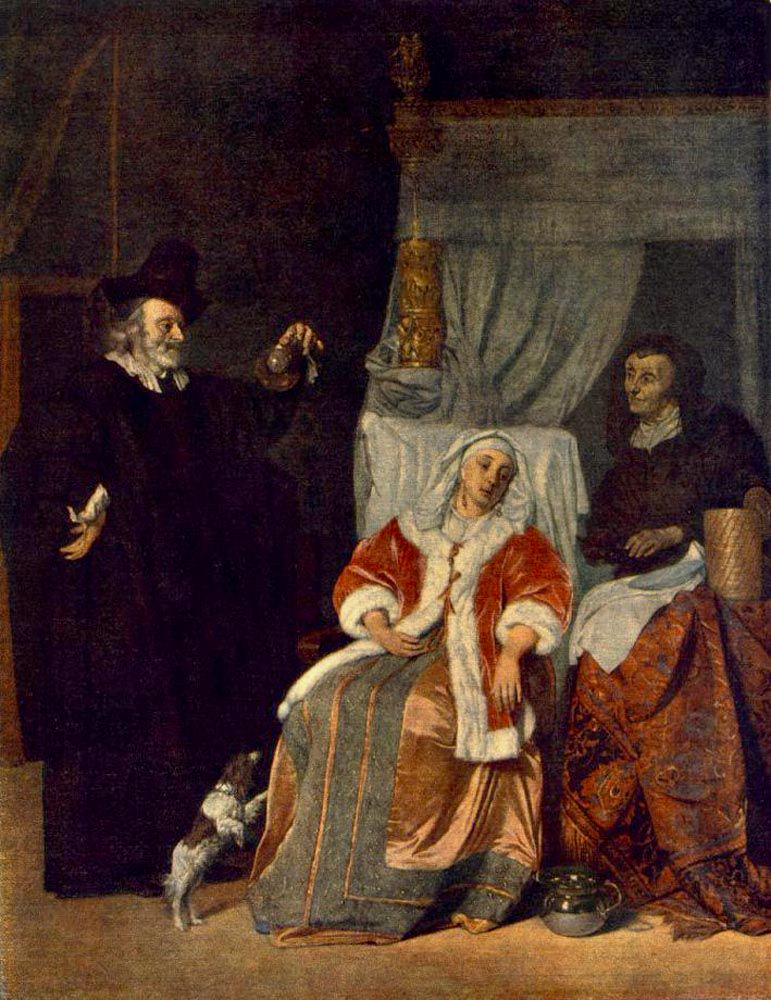
“The Doctor’s Visit” by Gabriel Metsu

La visite du docteur Metsu

The Artist Gabriel Metsu (1629-1667) was a Dutch painter. Born in Leiden, where he studied at the Guild of Saint Luke, he later moved to Amsterdam. His paintings depict everyday life scenes with meticulous attention to detail. The Artwork Multiple versions of “The Doctor’s Visit” are attributed to Metsu, with the most renowned one housed … Read more

“The Doctor” by Luke Fildes

The Doctor

This highly acclaimed painting is not only a masterpiece of craftsmanship but also carries a powerful social message. It portrays the doctor as a deeply human figure, selflessly dedicated to caring for his young patient. The Artist Luke Fildes (1843–1927) was an English painter renowned for his portraiture. A prominent figure in Victorian art, he … Read more

Dr Rieux in Albert Camus’ “The Plague”

A physician stands on a glowing divide between two opposing worlds: a dark quarantined industrial city with masked medical staff on one side, and a fiery militarized landscape with rows of soldiers and an authoritarian flag on the other.

The Author Albert Camus (1913–1960) was a French writer-philosopher and a key figure in existentialism. Born in Mondovi, Algeria, Camus began his philosophy studies in Algiers. He later moved to Paris where, during World War II, he actively participated in the resistance against Nazi occupation. His most renowned novel is “The Stranger.” In 1957, Camus … Read more

“The Scarlet Plague” by Jack London

An elderly bearded scholar sits among open books in the ruins of a devastated city, speaking to a young boy as a crumbling cathedral rises in the background.

I alone remember. And if I don’t tell you, children, everything that was and everything we knew, all will be lost. Jack London (1867–1916) was a prolific American writer. He’s best known for adventure novels like “The Call of the Wild” and “White Fang,” but his vast work also addressed social issues. “The Scarlet Plague,” … Read more