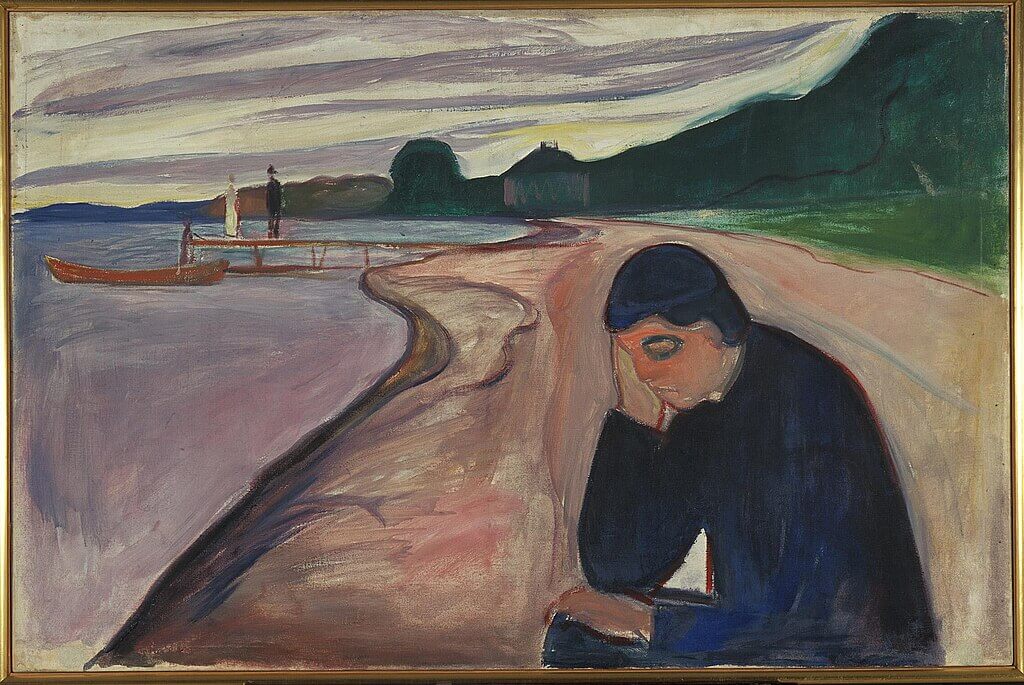
“Sickness, madness and death were the dark angels that had accompanied me since childhood.”
Edvard Munch, Diaries, 1890
In the cold north of Europe, between the late nineteenth and early twentieth centuries, a Norwegian painter transformed his pain into vision. Not abstract pain, but one rooted in flesh, lungs, and nerves: a pain named tuberculosis, grief, existential anguish.
Edvard Munch did not paint illness as an external theme: he lived it, breathed it, embodied it. His art became an autopsy of the soul, a clinical specimen of the invisible.
For physicians (accustomed to reading the body through signs, symptoms, and examinations) Munch’s work offers a unique field of observation. Not for anatomical precision (which he deliberately neglects), but for the phenomenological representation of suffering.
Here, illness is not merely pathology but lived experience, laden with emotional, symbolic, even metaphysical meaning.
Key takeaways
Munch’s illness imagery foregrounds experience over diagnosis and remains clinically relevant.
“The Sick Child”, “The Scream”, and “Madonna” trace grief, anxiety, and eros‑thanatos with striking clarity.
“Self‑Portrait with the Spanish Flu” offers a rare, direct view of post‑viral exhaustion.
Serial reworking of motifs functions like a visual follow‑up, paralleling clinical trajectories.
1) The Sick Child: Tuberculosis and Childhood Trauma
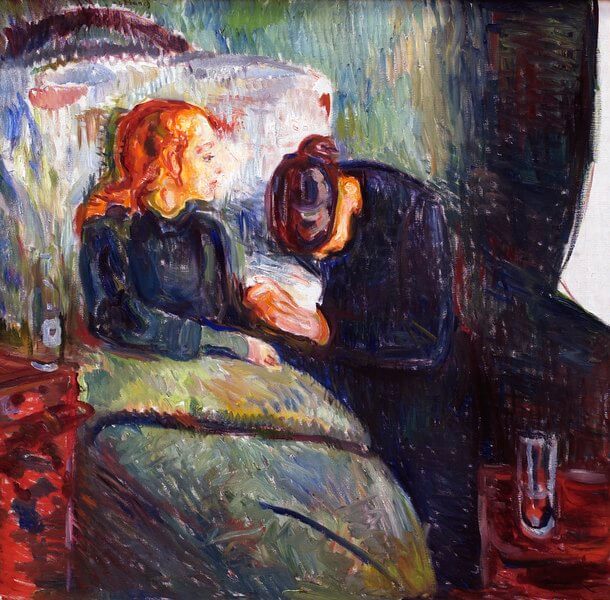
In 1868, when Edvard was only five, his mother Laura died of tuberculosis. Eight years later, his fifteen-year-old sister Sophie succumbed to the same disease.
The young Munch witnessed her slow decline: fever, hemoptysis, waxy pallor, breathing that grew increasingly labored. The bedroom became a theater of death.
The White Plague: Tubercolosis and Childhood Trauma
In nineteenth-century Europe, tuberculosis was not an isolated tragedy but a mass epidemic. Known as “the white plague,” it accounted for nearly one in four deaths across the continent, with mortality rates reaching 400 per 100,000 in urban areas like Oslo.
Children and young adults were particularly vulnerable: pulmonary tuberculosis in adolescents carried a mortality approaching 50% before the advent of antibiotics.
The disease was not only medical but deeply social—associated with poverty, overcrowding, and the rapid industrialization that defined the era.
For families like the Munchs, tuberculosis was an almost inescapable presence. The household became a site of contagion and vigil, where the slow consumption of the body unfolded over months or years.
There was no effective treatment: rest, fresh air, and cod liver oil were the main prescriptions, while the coughing, night sweats, and hemoptysis continued relentlessly. The emotional toll was compounded by the sense of inevitability: once the diagnosis was made, survival was uncertain at best.
Visual Analysis
This episode marks the genesis of The Sick Child (1886, with a more mature version from 1896 held at the Munchmuseet in Oslo). The work is painted in oil on canvas, with dense, textured brushstrokes in the later version that evoke the physical weight of pain.
The bed sits at the center of the composition, tilted diagonally, creating a spatial tension that denies the viewer visual rest.
Sophie lies supine, her pale face turned toward a window through which cold, almost lunar light enters. Her hands are crossed on her chest, a pose reminiscent of the deceased in nineteenth-century funeral portraits.
Beside the bed, a second figure, likely her younger sister Inger, bends forward, her face hidden in her arms. Her black dress merges with the shadow of the room, suggesting that mourning is not merely an event but an atmosphere enveloping everything.
The floor is bare, the walls stripped of ornament: there is no religious consolation, no visible medical intervention. Only the looming presence of the end.
Clinical Relevance
For the contemporary physician accustomed to viewing tuberculosis as a curable disease this scene may appear remote. Yet it remains profoundly relevant in its existential dimension.
Munch does not document Koch’s bacilli; he documents the wait for death, the void that opens around the sick person’s bed, the solitude of the dying body.
Museum link: Edvard Munch, Public domain, via Wikimedia Commons – Munchmuseet

2) Self-Portrait with Spanish Flu: Post-Viral Exhaustion Visualized
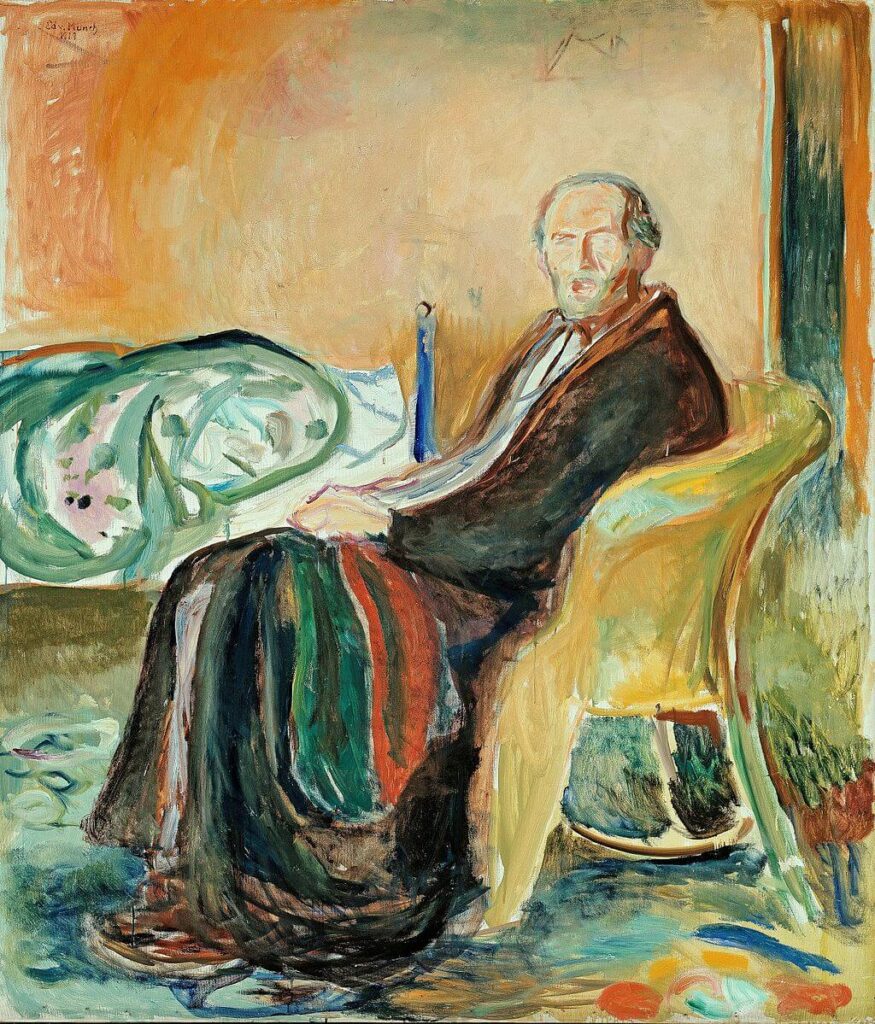
For a clinically unambiguous self‑image, Edvard Munch’s Self‑Portrait with the Spanish Flu (1919) holds a truly pivotal place in art history. In this haunting painting, Munch is depicted wearing a dressing gown, looking gaunt and visibly weakened, with an unmade bed looming behind him as a stark reminder of his recent illness.
The greenish pallor of his skin, the deeply hollowed eyes, and the slightly parted mouth all vividly suggest the profound exhaustion and lingering effects of a severe viral infection.
While his body remains almost motionless, there is an unsettling sense that the world around him continues to vibrate and pulse with restless energy.
Technical execution
The work is executed in oil on canvas with quick, vibrant brushstrokes and a restricted palette of acid yellows, earthy greens, and browns. The forms are not naturalistic: Munch deforms in order to express the subjective experience of illness.
The background is a claustral interior, not a winter landscape. The blanket replaces the nude—here the body is covered and fragile, not displayed. The air in the room feels dense and stagnant
Historical Resonance: Spanish Flu and Long COVID
In the aftermath of COVID-19, this 1919 portrait resonates with striking immediacy. The Spanish flu infected one-third of humanity and left survivors with prolonged fatigue, cognitive fog, and a sense of bodily disconnection—symptoms now recognized as post-acute sequelae of viral infections (PASC).
Munch’s visual testimony predates our contemporary language for “long COVID”by a century, offering clinicians a phenomenological map of what 10–30% of COVID survivors still experience: not recovery, but a protracted negotiation with the afterlife of illness.
Clinical Lens
In this self-portrait, Munch depicts himself not as a subject of diagnosis but as a person undergoing a profound erosion of bodily integrity.
The gaunt posture, hollow eyes, and static environment convey the disorientation typical of severe post-viral states.
Clinically, the painting invites reflection on the subjective dimension of recovery: how illness reshapes one’s sense of time, agency, and embodiment. It also reminds clinicians that post-viral fatigue is not only biological but deeply narrative—an experience that destabilizes identity before it restores it.
Museum links: Edvard Munch, Public domain, via Wikimedia Commons • Munchmuseet
.jpg)
3) The Scream: Anxiety as Physiological Experience
While tuberculosis marked his body, anguish dominated his psyche. Here Munch makes an extraordinary conceptual leap: he transforms an interior state into a universal image.
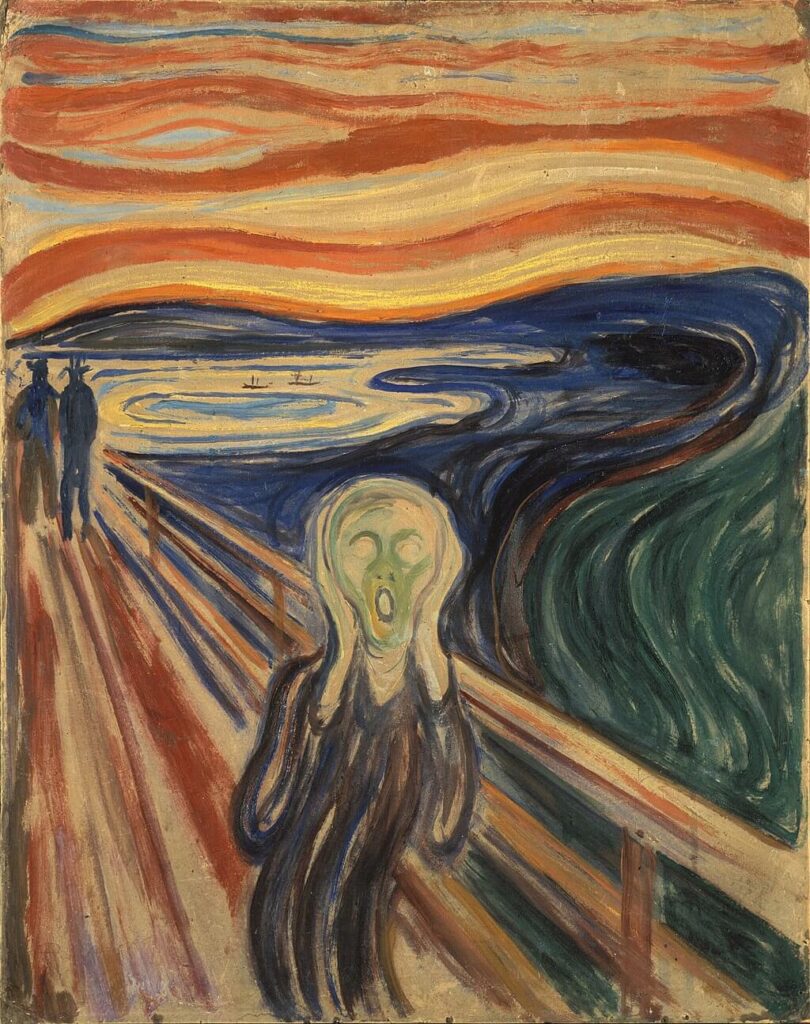
The Scream (1893), of which four versions exist (two paintings, two pastels), is not about mental illness in a nosographic sense. It portrays neither a psychotic patient nor a diagnosable panic attack.
Yet no other image has expressed with such force the sensation of the self dissolving.
Composizional Brilliance
The composition is brilliant in its simplicity: an androgynous figure with an elongated skull and hands pressed against its ears stands at the center of a bridge crossing a fjord.
The sky ignites with undulating streaks of red, orange, and yellow, while the landscape, trees, water, mountains, liquefies into sinuous curves, as if seen through distorting glass.
Color does not describe reality but reality’s effect on the nervous system.
The 1893 pastel version (now at the Munchmuseet) is particularly intense: pigments are applied with quick, almost feverish gestures. The lines do not delineate forms but vibrations.
The figure’s face has no defined human features: eyes, mouth, and nose are reduced to holes, as if the body were losing its material consistency.
Clilnical Lens
Rather than illustrating a psychiatric label, The Scream visualizes the physiology of alarm: derealization, autonomic surge, and overwhelming allostatic load.
The melting landscape echoes the perceptual distortions seen in acute anxiety or panic states, where reality loses its boundaries.
For clinicians, the work challenges the reduction of anxiety to symptom checklists, urging a more phenomenological understanding of what it feels like when the self approaches fragmentation.
It is a reminder that distress can reach clinical thresholds without ever fitting neatly into diagnostic categories.
Museum link: Edvard Munch, Public domain, via Wikimedia Commons Munchmuseet

4) Madonna: Eros, Thanatos, and Medical Anxieties
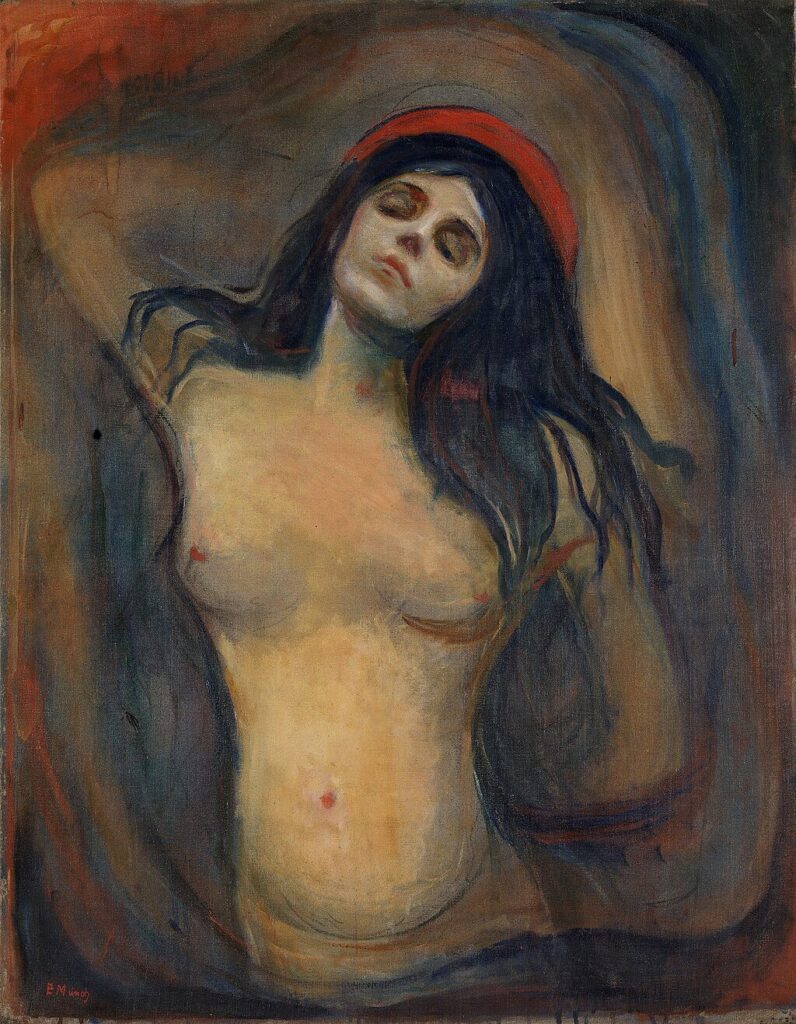
In Edvard Munch’s artistic work, the themes of eros and thanatos are intricately intertwined, creating a complex exploration of life and death forces.
In his piece “Madonna”, a nude female figure is depicted in an ecstatic, almost rapturous pose, reclining on a deep red bed. The use of the traditional Marian title “Madonna” is deliberately subverted here, blending together elements of ecstatic experience, fertility, and an undercurrent of danger.
In the lithograph versions of this work, the addition of the iconic sperm border makes the themes of desire and creation much more explicit and visually pronounced.
Medical Context: The Syphilis Epidemic
In the 1890s, syphilis was epidemic across Europe, with urban prevalence reaching 5–15%. Known as “the great imitator,” it manifested in stages (chancre, rash, neurological collapse) and carried profound moral stigma.
With no cure until Salvarsan (1910), the disease fueled anxieties about hereditary “degeneration” and sexual transgression.
Munch’s “Madonna” captures this era’s ambivalence: the female body as both sacred and dangerous, desire as life force and contagion. The red halo evokes fever as much as divinity.
For clinicians today, it remains a potent reminder that bodies are never purely medical—they are always morally interpreted, particularly in domains of sexuality and reproduction.
Visual Symbolism
The work showcases chromatic symbolism at its finest. The red is not realistic but psychological—it invades the space, suffocates, envelops.
The woman’s skin is milky white, almost translucent, evoking a fragile, threatened purity.
In the lithographic version, Munch added an inscription: “You are the woman I love—and who destroys me.”
Clinical Lens
Munch’s Madonna collapses binaries—healthy/sick, sacred/profane, desire/danger—exposing the body as a site of vulnerability and ambiguity.
The sensual posture, combined with undertones of threat and mortality, reflects the anxieties of his era around sexuality, syphilis, and hereditary “madness.”
Clinically, the painting opens a space to consider desire as a dimension of care, not merely a risk factor. It foregrounds the emotional and existential tensions that patients carry, reminding clinicians that the body is never purely medical but always symbolic, relational, and morally interpreted.
Museum links: Edvard Munch, Public domain, via Wikimedia Commons – Munchmuseet

5) Serial Imagery as Clinical Follow-Up
“ I do not paint what I see, but what I have seen.”
Munch returned obsessively to the same motifs across decades. “The Sick Child” exists in at least six painted versions (1885–1927), each subtly different in tone, texture, and emotional intensity.
This was not repetition but longitudinal observation—a visual follow-up of unresolved grief.
Clinically, this mirrors how we track chronic conditions over time: not as single events but as trajectories requiring serial engagement.
The 1885 version is raw, almost violent; the 1896 version more resolved but still aching; the 1927 version muted, resigned.
What changed was not the event (Sophie’s death in 1877) but Munch’s relationship to the memory—the slow, non-linear work of integration.
This has implications for practice. Many conditions—chronic pain, bereavement, PTSD—do not follow linear paths toward “closure.” They require repeated visits, adjusted narratives, sustained witness.
Munch’s serial practice models this: care as persistent presence, not cure. In clinic, not every pain is resolved, but every pain deserves recognition.
Sometimes the highest form of care is simply to remain and witness.
Conclusion: Munch, medicine, and narrative care
As medicine advances technologically and molecularly, Munch restores the human, narrative, embodied dimension.
Narrative medicine has shown how illness narratives improve listening, diagnosis, adherence, and alliance. Munch offers no solutions—only visual questions that re‑center the sickbed as a site of truth.
“My painting is a confession. And every confession is an act of healing—not for the speaker, but for the listener.”
Explore More: Art, Medicine, and the Humanities
- The Anatomy Lesson of Dr. Nicolaes Tulp
- The Medical Inspection by Henry de Toulouse-Lautrec
- The Doctor by Luke Fildes
- The Doctor Visit by Gabriel Metsu
- Frida Kahlo: The Anatomy of Suffering
Image use and attributions
Image via Wikimedia Commons Public Domain: “Melancholy”, “The Sick Child”, “Self-Portrait with the Spanish Flu”, “The Scream”, “Madonna”
Munchmuseet
FAQ: Edvard Munch and illness in art
What illnesses appear in Edvard Munch’s art?
Tuberculosis, anxiety, depression, and the 1918–19 influenza appear as biographical and symbolic forces.
Why is The Sick Child important?
It reframes pediatric illness and grief as lived experience, not medical spectacle.
What does The Scream represent in mental health terms?
A powerful visualization of anxiety, derealization, and autonomic overload without pathologizing the subject.
Did Munch depict his own illness?
Yes, most explicitly in Self‑Portrait with the Spanish Flu (1919).
How is Munch relevant to clinicians today?
His images support reflective practice, empathy, and narrative competence in care.