The Artist
Gabriel Metsu (1629-1667) was a Dutch painter. Born in Leiden, where he studied at the Guild of Saint Luke, he later moved to Amsterdam. His paintings depict everyday life scenes with meticulous attention to detail.
The Artwork
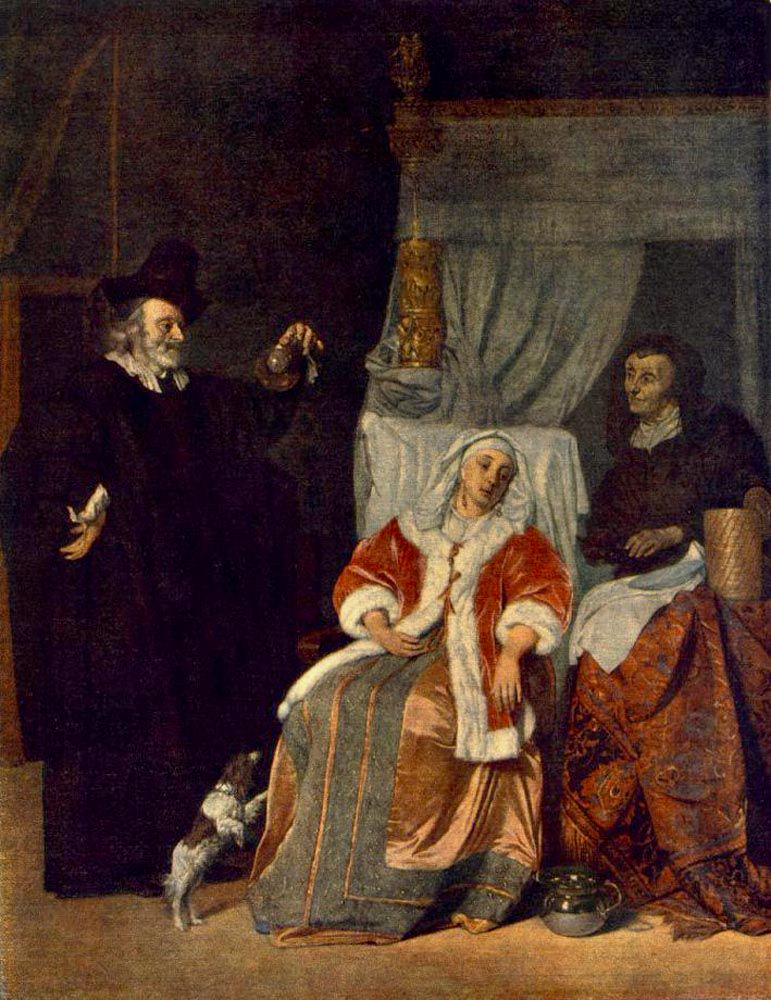
Multiple versions of “The Doctor’s Visit” are attributed to Metsu, with the most renowned one housed in London’s National Gallery.
The oil painting depicts a young woman seated in a weakened, ill state. A doctor stands beside her, leaning slightly forward—perhaps examining her or offering medicine. Another female figure, possibly a family member or servant, stands nearby observing. The bourgeois setting is suggested by various objects, including a pitcher, glass, and medical instruments. The sick woman occupies the central focus, with the entire composition drawing attention to her figure.
Soft lighting enhances the characters’ expressions while creating an intimate atmosphere, and the color palette consists primarily of warm tones.
The painting’s exceptional quality stems from its meticulous attention to detail in the rendering of fabrics and objects.
Seventeenth-Century Medicine
In the 17th century, while medicine began incorporating early scientific and anatomical discoveries, it remained largely rooted in medieval concepts, beliefs, and superstitions.
Physical and psychological aspects were viewed holistically—the body, morals, and spiritual elements were considered inseparable.
The “humoral theory” of Hippocrates and Galen dominated medical thought. Health was believed to depend on the balance of four humors: blood, yellow bile, black bile, and phlegm.
Physicians are mainly diagnosed through observation and symptom evaluation. Their limited diagnostic tools included urine analysis (uroscopy), pulse examination, and complexion assessment.
Treatment focused on restoring humoral balance through bloodletting, purges, and herbal remedies. Physicians prepared their own medicines or directed apothecaries to make decoctions and ointments. They often based treatments on astrological observations, believing in planetary influences on health, and regularly consulted horoscopes for guidance.
Women’s ailments were frequently attributed to “love sickness,” with excessive or unrequited love thought to cause humoral imbalances.
Religion heavily influenced medical practice—illness was viewed as either divine punishment or spiritual testing. Priests commonly worked alongside physicians in the healing process.
Physicians held a complex social position: respected yet viewed with skepticism.
Medical practice was divided between surgeon-barbers, who performed practical procedures and minor operations as craftsmen, and graduate physicians, who handled diagnoses and prescriptions.
Graduate physicians typically served wealthy and aristocratic families, with house calls symbolizing personal attention and the patient’s elevated social status.
Despite their status, the medical profession faced widespread skepticism—physicians were often regarded as greedy and ineffective, and their practice met with distrust.
Metsu’s painting serves as a valuable window into 17th-century medical practice, providing an authentic view of doctor-patient relationships, medical procedures, and healthcare’s social context during this era.