I went back to the Odyssey when Nolan’s film came out, for reasons that had nothing to do with medicine. I did not get far. Book I stopped me.
Odysseus, we are told almost in passing, once sailed to Ephyra to find a man named Ilus, son of Mermerus, and to ask him for a poison to smear on his bronze arrowheads. Ilus refused. Homer gives one reason: he feared the gods.
“He was then coming from Ephyra, where he had been to beg poison for his arrows from Ilus, son of Mermerus. Ilus feared the ever-living gods and would not give him any, but my father let him have some, for he was very fond of him.”
— Odyssey I, ≈ ll. 259–264
A dozen words or so, and inside them the whole architecture of a problem I spend a fair amount of time thinking about. A specialist holding knowledge that cuts both ways. Declining to release it. With no institution behind him and no theory to justify the refusal.
That is the thing about the Odyssey. We date Western medicine to the Hippocratic Corpus, fifth century BC, and for good reasons. But the poem is three centuries older and it already contains a functioning medical culture — one that lacks, entirely, any explanation of disease.
What is missing, and what is not
The absences are worth stating precisely, because they turn out to be the interesting part.
Disease in the Odyssey is nosos, undifferentiated. No clinical pictures, no humours, no systematic anatomy. Causation, where it appears at all, is an arrow shot by Apollo or Artemis: an external agent, but not a transmissible one. Nothing in the poem suggests that illness passes from person to person. Prognosis belongs to the seer rather than the healer. And there is no account, anywhere, of why a remedy works.
Now the other column. A named profession with a defined social status. A pharmacology with a classification, an antidote logic, and a professional taboo attached to it. A three-way etiology of death that includes a psychogenic category. A standardized regimen of recovery. Wound care performed, in the same breath, by technique and by incantation.
That combination is not an early stage of anything. It is a complete system that happens to be missing its theory, and it functioned in that condition for a very long time.
The healer as public craftsman
Book XVII. It is Eumaeus the swineherd who says it, which is itself worth a moment — the sociology of medicine is common knowledge here, not specialist knowledge. He lists the demioergoi, the men who work for the community and get called in from outside: the seer, the healer of ills (iatèr kakôn), the builder in wood, the inspired singer.
“Who is likely to invite a stranger from a foreign country, unless it be one of those who can do public service as a seer, a healer of hurts, a carpenter, or a bard who can charm us with his singing? Such men are welcome all the world over, but no one is likely to ask a beggar who will only worry him. You are always harder on Ulysses’ servants than any of the other suitors are, and above all on me, but I do not care so long as Telemachus and Penelope are alive and here.”
— Odyssey XVII, ≈ ll. 382–391
Read as a job description, it yields three things.
The healer is itinerant, and his competence is portable because it belongs to him rather than to a temple, a city, or a bloodline. He is recruited on reputation for skill. And he stands next to the seer without the slightest sense of contradiction.
That last point is the one most often mishandled. We tend to read the fifth-century separation of technique from divination as a discovery, as though someone had finally noticed that charms don’t work. Lloyd argued — convincingly, to my mind — that it was largely a professional manoeuvre. The author of On the Sacred Disease is not reporting a finding. He is attacking competitors. What the Odyssey preserves is the situation before that polemic, and in that situation the two are simply different tools.
The clearest instance is the boar hunt on Parnassus, Book XIX. Odysseus is gored in the thigh; the sons of Autolycus bind the wound skilfully — the adverb is there in the Greek, epistaménos — and then stop the dark blood with a charm. One sentence, two coordinated verbs, no tension whatsoever. Whoever composed that line saw no problem in it.
“The sons of Autolycus busied themselves with the carcass of the boar, and bound Ulysses’ wound; then, after saying a spell to stop the bleeding, they went home as fast as they could.”
— Odyssey XIX, ≈ ll. 455–458 [the Greek has dêsan epistaménôs, “they bound it expertly”, and epaoidê, “with an incantation”, governed by a single sentence; Butler’s paraphrase drops the adverb that carries the point]
The drug that is already double
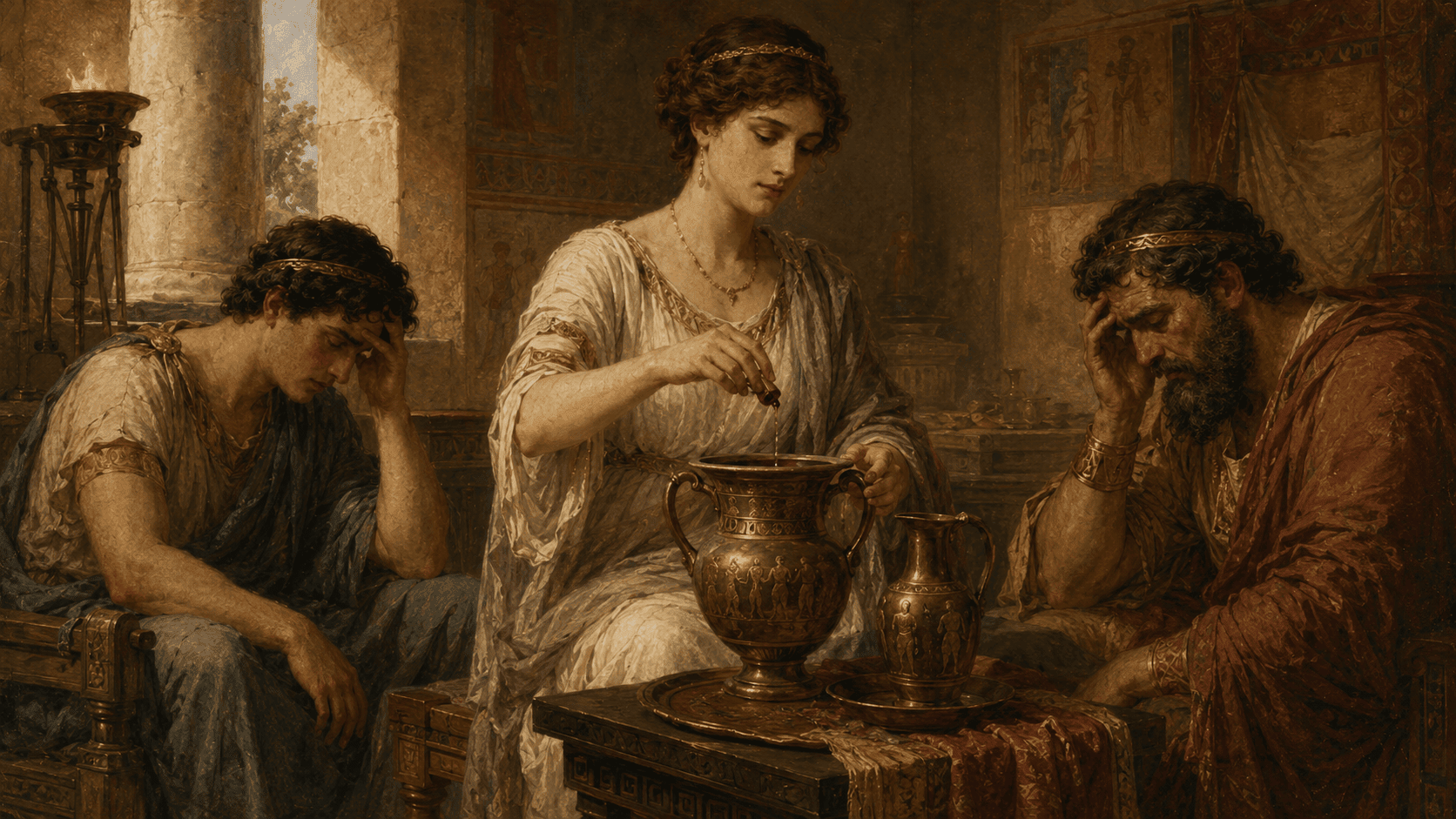
Helen, Book IV, drops something into the wine so that Telemachus and Menelaus will stop weeping. Homer says what it does: abolishes grief and anger so completely that a man would not weep to see his own parents killed in front of him. He also says, unusually, where it came from. Egypt — where the soil bears many drugs, some beneficial and some baneful, and where every man is a physician.
“Then Jove’s daughter Helen bethought her of another matter. She drugged the wine with an herb that banishes all care, sorrow, and ill humour. Whoever drinks wine thus drugged cannot shed a single tear all the rest of the day, not even though his father and mother both of them drop down dead, or he sees a brother or a son hewn in pieces before his very eyes. This drug, of such sovereign power and virtue, had been given to Helen by Polydamna wife of Thon, a woman of Egypt, where there grow all sorts of herbs, some good to put into the mixing bowl and others poisonous. Moreover, every one in the whole country is a skilled physician, for they are of the race of Paeeon.”
— Odyssey IV, ≈ ll. 219–232
Two things there repay attention. First, a Greek poem conceding medical superiority to a foreign tradition, flatly, without defensiveness. Second, the classification itself: esthlá and lygrá, good and baneful, applied to the same category of substance. Which one you get depends on the mixture and on the hand that mixes it. Not on the substance.
Circe completes the structure. Her drug goes into a kykeon — cheese, barley meal, honey, Pramnian wine, a food vehicle rather than a pure rite — and produces a transformation in which the body changes while the mind, the text is explicit about this, stays intact. Hermes supplies moly against it. Black root, white flower, given before exposure.
“When she had got them into her house, she set them upon benches and seats and mixed them a mess with cheese, honey, meal, and Pramnian wine, but she drugged it with wicked poisons to make them forget their homes, and when they had drunk she turned them into pigs by a stroke of her wand, and shut them up in her pigsties. They were like pigs — head, hair, and all, and they grunted just as pigs do; but their senses were the same as before, and they remembered everything.”
— Odyssey X, ≈ ll. 234–243
“As he spoke he pulled the herb out of the ground and showed me what it was like. The root was black, while the flower was as white as milk; the gods call it Moly, and mortal men cannot uproot it, but the gods can do whatever they like.”
— Odyssey X, ≈ ll. 302–306
Known toxin, specific antidote, prophylactic timing, an expert who holds the knowledge. A complete pharmacological structure of thought, in a culture with no pharmacology.
Whether moly was anything in particular is a separate question, and here I would counsel caution. Plaitakis and Duvoisin proposed in 1983 that it was the snowdrop, Galanthus nivalis, whose bulbs contain galantamine — a centrally acting anticholinesterase, and therefore a plausible antagonist to the anticholinergic delirium that mandrake or henbane would produce. The reading is elegant, and it has been cited steadily for forty years; a 2024 paper by Molina-Venegas and Verano revisits it more cautiously, as an early ethnobotanical complex rather than a single species. My objection to the strong version is simple. It assumes the poet is reporting a pharmacological event, when the text insists on the opposite: the plant is hard for mortals to dig, and only the gods can manage everything. Attractive neuropharmacology, dressed as philology. What survives the objection is the structure — and the structure is worth more than the identification ever was.
Three ways to die
Book XI, in the underworld. Odysseus asks his mother’s shade what killed her, and he offers her the two standard options: a long illness, dolichè noûsos, or the painless arrows of Artemis.
“But tell me, and tell me true, in what way did you die? Did you have a long illness, or did heaven vouchsafe you a gentle easy passage to eternity?”
— Odyssey XI, ≈ ll. 170–173 [Butler flattens the second option; the Greek names it explicitly — ê dolichè noûsos, ê Artemis iochéaira / hois aganoîs beléessin, “either a long disease, or Artemis the archer, coming upon you with her gentle shafts”]
Look at the question rather than the answer. It presupposes a classification the audience needs no help with — protracted somatic disease on one side, sudden unexplained death on the other, coded as divine. Anticleia takes neither. She died, she says, of longing for her son.
“As for my own end it was in this wise: heaven did not take me swiftly and painlessly in my own house, nor was I attacked by any illness such as those that generally wear people out and kill them, but my longing to know what you were doing and the force of my affection for you — this it was that was the death of me.”
— Odyssey XI, ≈ ll. 197–203
Not a metaphor. The text gives no signal that it should be read as one. A third cause, selected by exclusion of the other two.
For a clinician this is the most striking passage in the poem, and I have gone back and forth on how much weight it can carry. Probably less than one would like. Still, the discrimination is there: grief named as a way of dying, distinguished from disease and from sudden death, in a text with no physiology in it at all. Twenty-eight centuries later we have takotsubo cardiomyopathy and a reasonably solid literature on excess mortality among the recently bereaved. The mechanism is ours. The observation was already made.
There is a companion passage in Book XV, easy to miss. The island of Syrie, where no wretched disease comes upon men; when they grow old, Apollo and Artemis kill them with their gentle arrows. A utopia defined by the abolition of nosos with senescence left intact — something close to what we now call compression of morbidity, arrived at from the opposite direction entirely.
“You may have heard of an island called Syra that lies over above Ortygia, where the land begins to turn round and look in another direction. It is not very thickly peopled, but the soil is good, with much pasture fit for cattle and sheep, and it abounds with wine and wheat. Dearth never comes there, nor are the people plagued by any sickness, but when they grow old Apollo comes with Diana and kills them with his painless shafts.”
— Odyssey XV, ≈ ll. 403–411
The sequence is the argument
Practice first. Professional identity, the two-sidedness of the remedy, ethical restraint: all in position while the explanatory theory was still entirely absent, and none of the three waiting for it. Medicine organized itself socially and morally long before it could say why anything worked. The theory, when it eventually arrived, arrived into a house that was already built.
I am not sure this is only a historical observation.
We are in a structurally similar position with clinical AI — and I say that as someone who works with these models on outcome prediction and watches them outperform risk scores I was trained to trust. Capability is outrunning explanation. The standard reflex, that theory must come first and that we cannot deploy what we cannot fully explain, has the sequence backwards relative to how medicine has actually behaved for most of its existence.
Something else has to come first. The profession’s own account of who is competent, of what the tool does in both directions, and of what the people holding it will refuse to do with it.
Ilus had no pharmacology to justify his refusal.
He refused anyway.
References
Text. Greek: T.W. Allen, Homeri Opera III–IV, Oxford Classical Texts. English: R. Lattimore (1965) for literalness, E. Wilson (2018) for readability. Italian: G. Aurelio Privitera, Fondazione Valla / Mondadori, still the best facing-text edition.
A note on the quotations. The English passages above are given in Samuel Butler’s prose translation (1900), which is out of copyright; line numbers refer to the Greek text and are approximate, since Butler’s prose does not follow the verse line by line. Where Butler’s paraphrase suppresses a detail the argument depends on — epistaménos at XIX.456, the arrows of Artemis at XI.172–173 — the Greek is restored in square brackets.
Foundational.
- C. Daremberg, La médecine dans Homère, Paris 1865. Dated in its conclusions, indispensable as a catalogue of passages.
- H. Frölich, Die Militärmedicin Homers, Stuttgart 1879. The wound statistics of the Iliad — about 147 injuries, lethality near 80%. Nothing comparable exists for the Odyssey, which is itself the point.
- M.D. Grmek, Diseases in the Ancient Greek World, Johns Hopkins UP 1989. The methodological benchmark; explicit about what literary sources can and cannot support.
Magic, technique, and the word.
- G.E.R. Lloyd, Magic, Reason and Experience, Cambridge 1979.
- P. Laín Entralgo, The Therapy of the Word in Classical Antiquity, Yale 1970. Traces the line from the Homeric epode to Hippocratic persuasion.
Body and mind.
- R.B. Onians, The Origins of European Thought, Cambridge 1951.
- B. Snell, The Discovery of the Mind, 1953 (German original 1946) — and, against it, B. Williams, Shame and Necessity, California 1993, on the illegitimate inference from vocabulary to mental structure. Read the two together or neither.
Context and dating.
- M.I. Finley, The World of Odysseus, 2nd ed. 1977.
Moly, and the limits of retrodiagnosis.
A. Plaitakis, R.C. Duvoisin, “Homer’s moly identified as Galanthus nivalis L.: physiologic antidote to stramonium poisoning”, Clin Neuropharmacol 1983;6(1):1–6.
R. Molina-Venegas, J. Verano, J Ethnobiol Ethnomed 2024;20:11.
J. Scarborough, “The pharmacology of sacred plants, herbs and roots”, in Magika Hiera, Oxford 1991.
A. Cunningham, “Identifying disease in the past: cutting the Gordian knot”, Asclepio 2002;54:13–34, and P.D. Mitchell, Int J Paleopathol 2011;1(2):81–88. The two poles of the argument over whether modern diagnosis can be applied backwards at all. Worth reading before enjoying the moly literature too much.