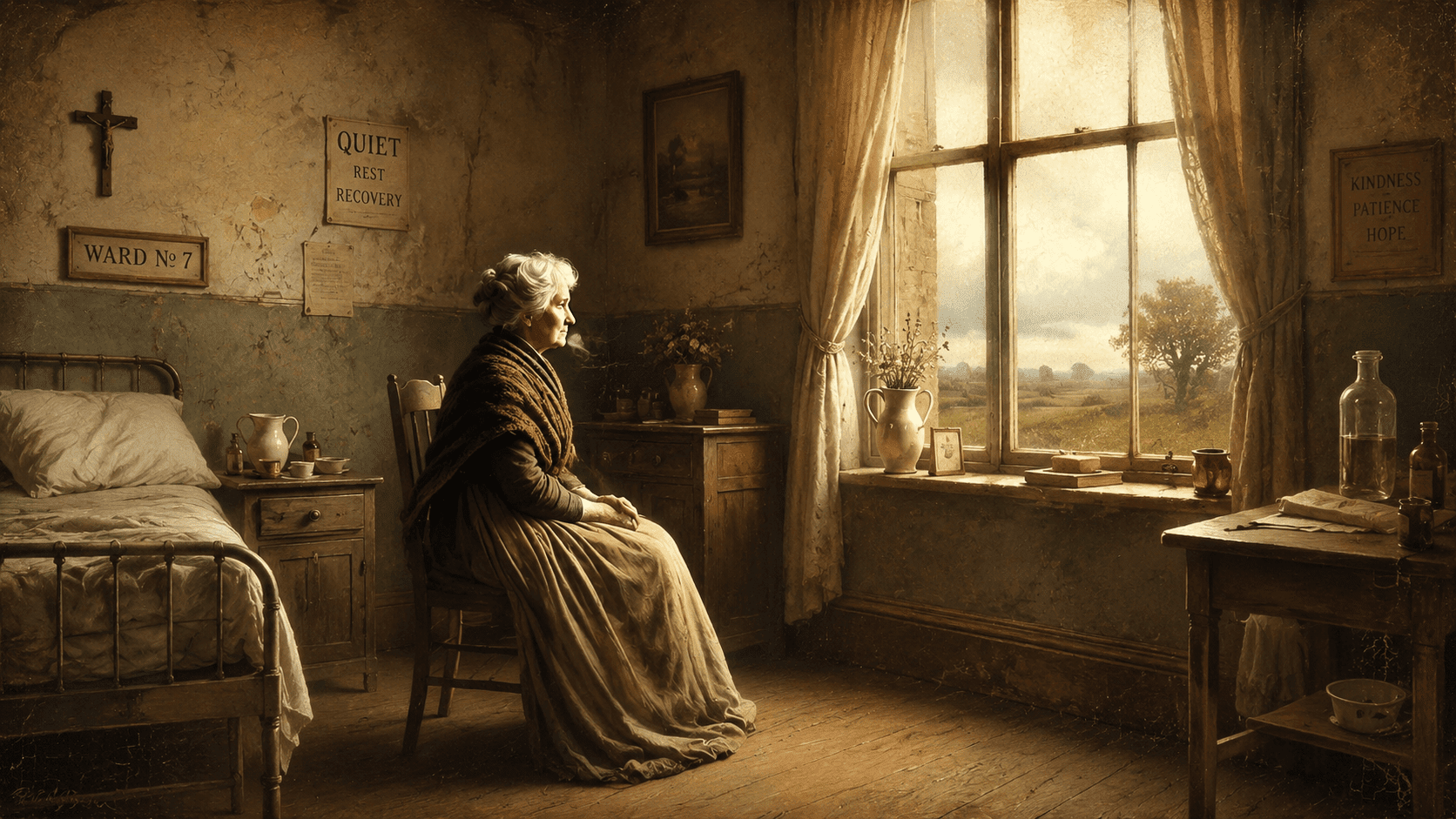
The Death of the Grandmother: A Moment of Truth, Fragility, and Revelation
Introduction
In the third volume of “À la recherche du temps perdu”, Marcel Proust portrays the gradual illness and death of the narrator’s grandmother. This episode stands as one of the emotional, philosophical, and narrative pinnacles of the entire work. Through his meticulous description of physical suffering and progressive deterioration, Proust creates not merely the agony of a beloved figure, but a profound meditation on illness, medicine, time, and the nature of identity.
The grandmother
Before analyzing the grandmother’s illness and death, we must grasp her essential role in the work. The grandmother represents more than just a beloved family member—she embodies a spiritual and intellectual archetype, emerging as one of the most profound presences throughout the novel.
Archetype of affective purity
Unlike the mother, the lovers (Gilberte, Albertine), or the friend (Saint-Loup), the grandmother demands nothing in return for her affection, which remains unconditional and non-possessive. Though the narrator senses this quality as a child, he only fully comprehends its significance at the moment of her loss.
«Je savais qu’elle m’aimait, mais je ne savais pas encore que cet amour-là ne reviendrait jamais plus.»
“I knew she loved me, but I didn’t yet know that this kind of love would never return again.”
Archetype of culture and discretion
The grandmother immerses herself in Ruskin’s writings, appreciates Wagner’s music, and maintains a sharp critique of social conventions driven by careerism, superficial socializing, and vanity.
«Ma grand’mère méprisait les titres, les invitations, elle vivait dans une sphère supérieure.»
“My grandmother despised titles, invitations, she lived in a higher sphere.”
The grandmother as a sacrificial figure
The grandmother neither complains, asks, nor rebels, even as her illness progresses toward death. She maintains a sacred dignity throughout. Though she suffers deeply, she conceals her pain to spare others from worry:
«Elle s’efforçait de sourire encore, pour que je ne souffre pas.»
“She still tried to smile, so that I would not suffer.”
The grandmother becomes a determining force of consciousness and identity
The narrator experiences the grandmother’s death as an irreplaceable void. Her memory resurfaces during crucial moments of literary awakening in “Temps retrouvé.” Through her death, the grandmother becomes an essential element of the narrator’s memory and artistic consciousness.
The discovery of the illness and the failure of medicine
The illness begins subtly, with faint signs noticeable only to watchful eyes. The narrator, combining clinical observation with deep affection, notices the physical changes in his grandmother and senses an irreversible process has begun. Though the grandmother herself recognizes her condition, she conceals it to protect her family: “The grandmother, despite feeling unwell, didn’t want to alarm anyone. She tried to smile, to appear serene, even though deep inside she knew something was wrong.”
Medicine enters the scene with Doctor Cottard, who prescribes a series of ineffective interventions (including leeches), along with a specialist who dismisses everything as “nervosisme.” In a passage of biting epistemological irony, Proust writes:
«La médecine étant un compendium des erreurs successives et contradictoires des médecins, en appelant à soi les meilleurs d’entre eux on a grande chance d’implorer une vérité qui sera reconnue fausse quelques années plus tard.»
“Medicine being a compendium of successive and contradictory errors of doctors, by calling upon the best among them one has a great chance of imploring a truth that will be recognized as false a few years later.”
The specialist defines nervousness as a brilliant impersonator: «Le nervosisme est un pasticheur de génie. Il n’y a pas de maladie qu’il ne contrefasse à merveille.» (“Nervousness is a genius pasticheur. There is no disease that it cannot counterfeit marvelously.”).
These observations reveal Proust’s scathing criticism of positivist medicine—not primarily for its technical limitations, but for its fundamental lack of human understanding.
The thermometer as a symbolic object
One of the most famous and poetic passages describes the mercury thermometer. Proust portrays this clinical instrument as a little witch or sibyl that delivers implacable truths without empathy:
«La petite sorcière n’avait pas tardé à jeter son horoscope. […] La petite prophétesse s’était arrêtée au même point, dans une immobilité implacable.»
“The little sorceress had not delayed in casting her horoscope. […] The little prophetess had stopped at the same point, in an implacable immobility.”
This description transforms a clinical object into a magical symbol that communicates a destiny doctors either cannot interpret or refuse to acknowledge. Illness emerges as a truth inscribed in the body yet overlooked by conventional medical discourse.
The moment of death
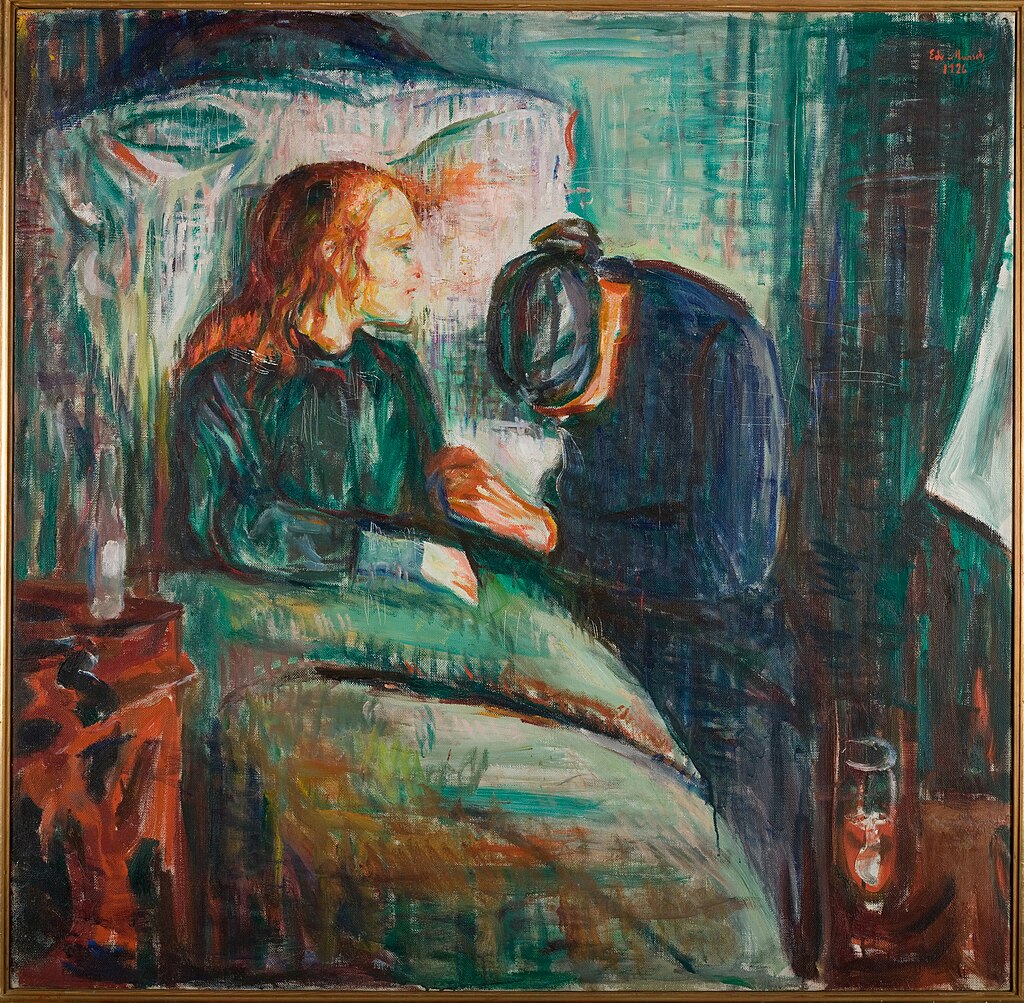
The death scene is restrained, without emphasis, but devastating:
«Le bruit de l’oxygène s’était tu, le médecin s’éloigna du lit. Ma grand’mère était morte.»
“The sound of oxygen had fallen silent, the doctor moved away from the bed. My grandmother was dead.”
Immediately after death, the grandmother’s face undergoes a transfiguration: it becomes younger, purified. Proust describes how she appears as she did when her parents were choosing her husband, her features radiating hope and innocence:
«Elle avait les traits […] brillantes d’une chaste espérance, d’un rêve de bonheur, même d’une innocente gaieté, que les années avaient peu à peu détruits.»
“She had features […] bright with a chaste hope, a dream of happiness, even an innocent gaiety, that the years had gradually destroyed.”
The body reveals an image of her that time had gradually erased. Death, paradoxically, becomes a moment of identity revelation—uncovering the true self that had been obscured by the passing years.
The impact on the narrator’s consciousness
The grandmother’s death marks a decisive end to the narrator’s emotional childhood. This profound loss triggers several far-reaching consequences:
- A visceral understanding of time’s irreversibility.
- The shattering of emotional illusions (the realization that nothing lasts forever).
- A deep crisis of confidence in both language and appearances.
- Recognition of the body’s mortality and society’s pretenses.
- The awakening of his literary vocation as a means to preserve memory.
Later, the narrator will see his grandmother’s features reflected in his mother’s face—a testament to how memory lives on through physical resemblance and inner perception.
Narrative techniques
The passages depicting the grandmother’s illness and death showcase Proust’s exceptional artistic prowess. In portraying this tragic event, he employs several sophisticated narrative techniques:
- Perceptual shift: Rather than presenting the illness as a sudden, clear occurrence, Proust reveals it through a gradual process of understanding based on subtle changes in gestures, facial expressions, and behavior.
- Poetic objectification: Ordinary objects transform into powerful symbols—notably the thermometer, which becomes a witch or prophetess capable of revealing truths that doctors cannot recognize.
- Internal focalization: All events are filtered exclusively through the narrator’s consciousness, revealing his dismay, pain, confusion, and helplessness.
- Manipulation of narrative time: Brief moments expand into extensive, meaning-rich descriptions. Proust creates a divergence between real time and psychological time, producing a deceleration that suspends expectation and extends the perception of suffering.
Parallels with other authors
The portrayal of illness as revelation echoes throughout contemporary European literature:
- Tolstoy (The Death of Ivan Ilyich): suffering strips away bourgeois pretensions, revealing essential truths.
- Thomas Mann (The Magic Mountain): the sanatorium becomes a liminal space where time suspends, allowing deep existential contemplation.
- Virginia Woolf (On Being Ill): illness emerges as both a subjective experience and an unacknowledged language within literature.
- Mikhail Bulgakov (A Young Doctor’s Notebook): the doctor exists in a vulnerable state between technical knowledge and human limitations, confronting mortality’s inevitability.
For these authors, as for Proust, illness transcends its biological dimensions to become a threshold revealing existential truth.
Conclusion
The grandmother’s death in the Recherche represents one of literature’s most profound portrayals of illness as both crisis and revelation. Through this suffering, the narrator undergoes a transformative experience that leads him to comprehend the redemptive power of memory and writing. Medicine appears in this narrative not just as powerless, but as tragically blind to what body and soul wordlessly express. From this silence emerges literature itself.