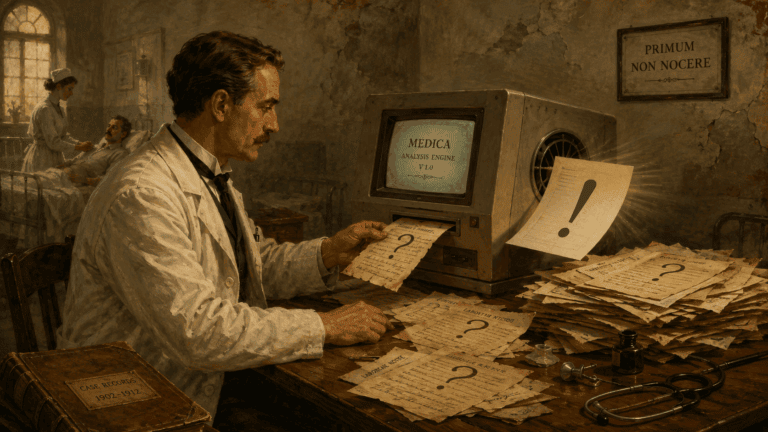
Doctor in a vintage hospital ward feeds a medical report marked with a question mark into an old computer, which returns the same sheet with a green exclamation mark.

How Well Can a Local 30B Model Answer Medical Questions? Benchmarking Meta Muse Glimmer on an RTX 3090

August 20, 2026 by Michele Danilo Pierri

A reproducible 300-question evaluation across medical exams, biomedical literature, multilingual question answering, and clinical calculation Meta released Muse Glimmer on 10 August 2026: thirty billion parameters, open weights, built for agentic work on consumer hardware.[1,2] I tested a quantized version five days later on a single NVIDIA RTX 3090 — partly because it was the…

Read more
Early 20th-century doctor looks perplexed at a bedside table crowded with medicine vials and bottles in an old hospital ward.

From Chart to Variable: Extracting Computable Clinical Features from the EHR

August 16, 2026 by Michele Danilo Pierri

Vasoactive-Inotropic Score as a Worked Example Introduction: The Data Is There. The Variable Is Not. Every conversation about clinical AI opens on the same premise: hospitals are sitting on enormous quantities of data. True enough, and almost useless as a starting point. An electronic health record is a transactional system, built for documentation, for billing,…

Read more
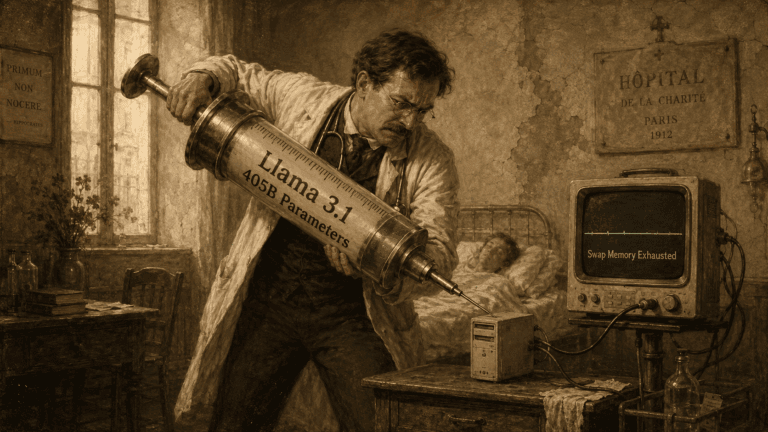
distressed early 20th-century doctor struggles to inject an enormous syringe labeled “Llama 3.1 405B Parameters” into a tiny desktop PC

The Model Runs, the User Waits: The Paradox of Large Local LLMs

August 3, 2026 by Michele Danilo Pierri

Hunting for the largest language model you can run on a personal computer has turned into a discipline of its own. Forums, repositories and social feeds circulate configurations that load models of 70, 120, even several hundred billion parameters, using consumer GPUs, generous amounts of system RAM and increasingly aggressive quantisation. The results are frequently…

Read more
Helen mixes a mysterious calming substance into wine as the grieving Telemachus and Menelaus sit beside her in an ancient Greek palace, inspired by Book IV of Homer’s Odyssey.

Medicine Before Theory: What the Odyssey Already Knew

July 27, 2026 by Michele Danilo Pierri

I went back to the Odyssey when Nolan’s film came out, for reasons that had nothing to do with medicine. I did not get far. Book I stopped me. Odysseus, we are told almost in passing, once sailed to Ephyra to find a man named Ilus, son of Mermerus, and to ask him for a…

Read more
A puzzled early 20th-century doctor examines a medical chart with the patient’s name erased while the patient lies in a modest hospital ward.

DICOM anonymization

July 19, 2026 by Michele Danilo Pierri

Deleting the patient name from a DICOM file feels like anonymization. It is not. A cardiac CT study I once pulled for a teaching file had a blank PatientName, a scrubbed PatientID, and a perfectly readable date of birth sitting three tags down in a private block the vendor never documented. The header looked clean….

Read more
A distressed early 20th-century doctor sits at a wooden desk, comparing a perfectly completed optical answer sheet with a disordered medical chart covered in handwritten notes and clinical tracings.

Open-Weight Medical LLMs

July 14, 2026 by Michele Danilo Pierri

There is a specific moment, familiar to anyone who has gone down this road, when you finish downloading a model with “Med” in its name and realise you have no idea whether it is actually any good. The name promises domain expertise. The model card promises benchmarks. Neither tells you what happens when you ask…

Read more
A man in early 20th-century clothing flips through a calendar and stops at July 1, 2026, in a modest hospital ward lit by warm, soft light.

AI & Digital Health: Quarterly Review 2026Q2

July 1, 2026 by Michele Danilo Pierri

Article authored by Michele D. Pierri, MD Cardiac Surgeon & Medical Technology Researcher Last updated: July 2026 Reading time: 5 minutes Ten patients. Zero recurrences. That’s the headline buried inside a small New England Journal of Medicine report that, frankly, deserved more attention than it got. In April, a Johns Hopkins team used personalized “digital…

Read more
Historical medical illustration showing a medieval physician examining patients in a hospital ward, with a large mural of Dante’s Inferno behind him, connecting disease, clinical observation, and medieval visions of suffering.

Dante’s Inferno as a Clinical Gaze

June 21, 2026 by Michele Danilo Pierri

SummaryDante Alighieri’s Inferno is a theological poem, yes, but it is also, almost incidentally, a forensic catalogue of medieval disease and healthcare. This article reads the poem through the lens of medical history: how Dante represents specific pathologies (dropsy, scabies and possibly leprosy, neurological deformity, hypothermia, traumatic mutism), how he mimics diagnostic observation, and how…

Read more