The Anatomy of Suffering: Frida Kahlo through the Lens of Medical History
Introduction: Why Frida Kahlo is the Patron Saint of Narrative Medicine
In the intersection of art and clinical science, few figures loom as large as Frida Kahlo (1907–1954). While often celebrated for her surrealist aesthetics and her role in Mexican Modernism, Kahlo’s work serves as one of the most significant visual archives in the history of medicine. For the medical historian, her canvases are not merely “paintings”—they are clinical case studies, surgical records, and a masterclass in the phenomenology of chronic pain.
This article explores Kahlo’s unique position as both a frustrated medical student and a lifelong “professional patient,” analyzing how her knowledge of anatomy and the medical landscape of the early 20th century shaped a new iconography of the human body.
I. The Education of a Physician Interrupted
To understand the medical accuracy in Kahlo’s work, one must look at her youth. In 1922, Frida was one of only 35 girls accepted into the Escuela Nacional Preparatoria, Mexico’s most prestigious secondary school. Her goal was clear: she wanted to become a doctor.
At the school, she focused on biology, botany, and anatomy. Her sketches from this period show a precocious understanding of the skeletal system and organic structures. However, the trajectory of her life was irrevocably altered on September 17, 1925. A tram accident resulted in a steel handrail piercing her abdomen and exit through her vagina, causing:
- Triple fractures of the spine.
- Fractures of the clavicle, ribs, and pelvis.
- Eleven fractures in her right leg and a crushed foot.
- Dislocation of the shoulder.
From that moment on, the woman who wished to study medicine became its subject. Her subsequent 32 surgeries and years of confinement transformed her bedroom into a laboratory where the subject of study was her own deteriorating physiology.
II. Medical Context: Orthopedics and Surgery in Post-Revolutionary Mexico
Kahlo’s medical journey coincided with a transformative era in global medicine. The 1920s through the 1950s saw the transition from traditional surgical practices to highly mechanized, industrial medicine.
- The Rise of Radiology: X-rays were becoming a primary diagnostic tool. Kahlo was fascinated by her own radiographs, often using the “transparency” of the body in her paintings (showing internal organs through the skin) much like a clinical X-ray.
- Orthopedic Limitations: This was the “age of the corset.” Without the advanced spinal fusion techniques or biocompatible titanium implants we have today, patients with spinal trauma were subjected to months of immobilization in plaster casts (escayolas) or heavy steel braces.
- The Industrialization of Care: During her time at the Henry Ford Hospital in Detroit, Kahlo witnessed the American medical model—efficient but cold and mechanical. This contrast between the “mechanical” and the “organic” became a central theme in her medical paintings.
III. Clinical Analysis of Key Works
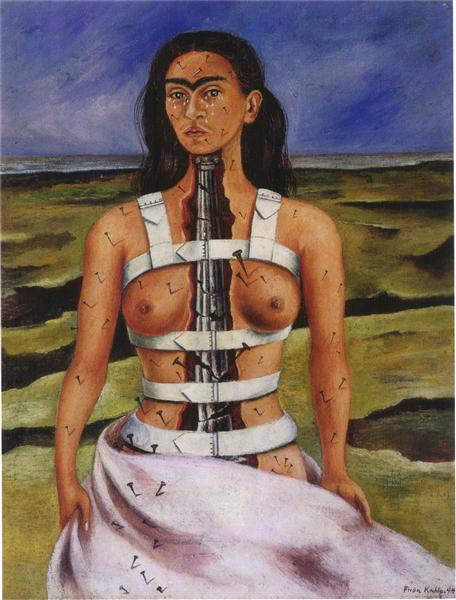
1. The Broken Column (1944): The Iconography of Spinal Trauma
The Broken Column is perhaps the most significant artistic representation of chronic neuropathic pain in history.
- Medical Content: At the center of the painting, Kahlo replaces her spine with a crumbling Ionic column. This choice is medically poignant: a column provides structural integrity but, once cracked, threatens the collapse of the entire edifice. The column is broken in several places, corresponding to the locations of her actual vertebral fractures.
- Technique and Meaning: She depicts her torso held together by a white orthopedic corset. The canvas is an anatomical cross-section; the skin is “zipped” open to reveal the structural failure within.
- Clinical Significance: The nails driven into her skin represent the allodynia and constant sensory irritation associated with spinal nerve damage. For a medical professional, this painting illustrates the patient’s internal perception of their anatomy—not as a cohesive whole, but as a fragmented structure failing under gravity.
Source: WikiArt — Museo Dolores Olmedo — Used for educational/editorial purposes
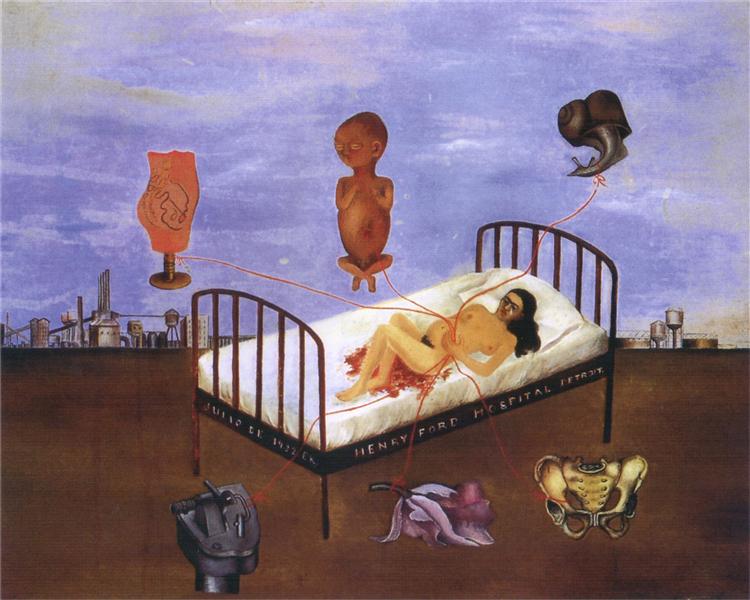
2. Henry Ford Hospital (1932): Obstetric Trauma and Industrial Coldness
Painted after a traumatic miscarriage in Detroit, this work is a “lithographic” clinical report.
- Medical Content: Kahlo depicts herself on a bed floating in a desolate industrial landscape. Six umbilical-like veins connect her to objects of clinical significance:
- The Male Fetus: A representation of “Dieguito,” her lost son.
- The Pelvic Bone: A medically accurate rendering of the female pelvis, showing the deformities that prevented a natural birth.
- The Snails: Symbolic of the “slow,” agonizing nature of the failed pregnancy.
- The Autoclave: A piece of hospital equipment used for sterilization, representing the dehumanizing, mechanical nature of modern obstetrics.
- Clinical Significance: This work is a rare historical document of obstetric grief and the limitations of early 20th-century gynecology in treating patients with pelvic trauma.
Source: Wikimedia Commons — Dolores Olmedo Collection — Used for educational/editorial purposes
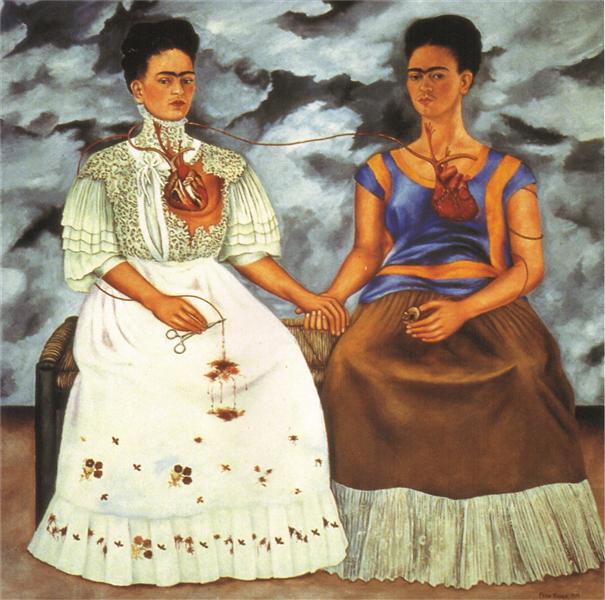
3. The Two Fridas (1939): Anatomy and Haemostasis
This double self-portrait is a masterclass in cardiovascular symbolism.
- Medical Content: The two versions of Frida are linked by a single vein connecting two hearts. The “European” Frida on the left has a heart that is surgically “opened”—an anatomical dissection showing the internal chambers.
- Technique: She holds a hemostat (surgical clamp) in her hand, attempting to stop the flow of blood from a severed vein. This shows her sophisticated knowledge of haemostasis.
- Meaning: The blood dripping onto her white dress signifies a “hemorrhage of the soul,” but the use of a clinical tool like the hemostat suggests the patient’s desperate attempt to self-medicate or “suture” her own emotional wounds.
Source: Wikimedia Commons — Museo de Arte Moderno, Mexico City — Used for educational/editorial purposes
4. Without Hope (1945): Inanition and Forced Nutrition
In her later years, Kahlo suffered from extreme weight loss and lack of appetite.
- Medical Content: The painting shows a “forced feeding” apparatus. A large wooden structure (resembling an easel but acting as a funnel) pours a grotesque slurry of animal carcasses and offal into her mouth.
- Clinical Significance: This addresses the psychological trauma of enteral nutrition and the loss of bodily autonomy. In the history of medicine, this work serves as a reminder that “life-saving” interventions can often feel like violations to the patient.
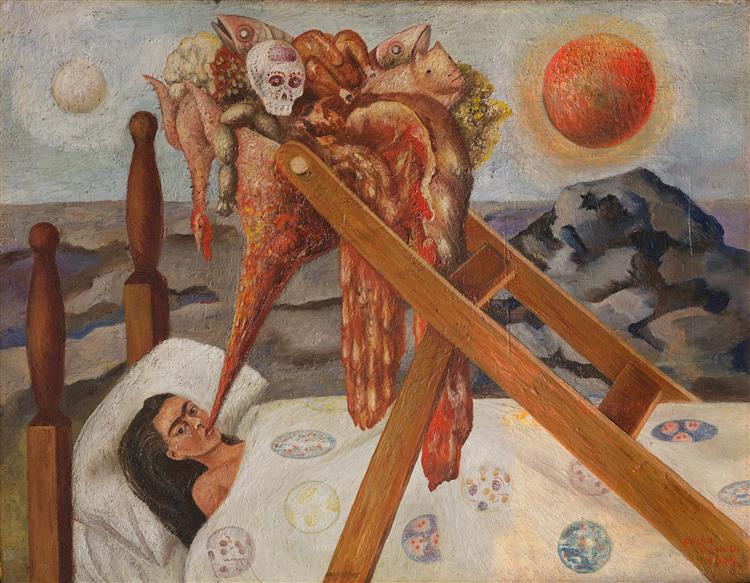
Source: WikiArt — Used for educational/editorial purposes
IV. The Legacy: Kahlo and the “Medical Humanities”
Frida Kahlo’s contribution to the history of medicine goes beyond the documentation of her own ailments. She is a pioneer of Narrative Medicine.
Today, medical schools around the world use Kahlo’s paintings to teach Visual Thinking Strategies (VTS). By observing her work, students learn to:
- Identify non-verbal cues of pain: The stoic expression in her paintings vs. the ravaged body.
- Understand the “Patient’s Voice”: Recognizing that a medical chart (the “objective” view) is incomplete without the patient’s subjective experience of their “brokenness.”
- Historical Empathy: Viewing the evolution of orthopedic and surgical tools through the eyes of the one who had to wear them.
Conclusion: The Artist as Anatomist
Frida Kahlo did not become a doctor in the traditional sense, but she became an anatomist of the human condition. Her work bridged the gap between the sterile, objective world of the clinic and the visceral, subjective world of the sufferer.
For the student of medical history, Kahlo’s oeuvre remains a vital record of early 20th-century trauma surgery and a timeless testament to the resilience of the human spirit in the face of physiological collapse. She reminds us that behind every “broken column” or “severed vein” in a medical textbook, there is a human story that demands to be seen.
Q&A: Understanding Frida Kahlo Through Medicine and Art
Basic Comprehension Questions
Q: What was Frida Kahlo’s original career aspiration before her tragic accident?
A: Frida Kahlo wanted to become a doctor. In 1922, she was one of only 35 girls accepted into the Escuela Nacional Preparatoria, Mexico’s most prestigious secondary school, where she focused on biology, botany, and anatomy in preparation for medical studies.
Q: What injuries did Kahlo sustain in the 1925 tram accident?
A: The accident was catastrophic. A steel handrail pierced her abdomen and exited through her vagina. She suffered triple fractures of the spine, fractures of the clavicle, ribs, and pelvis, eleven fractures in her right leg, a crushed foot, and shoulder dislocation. She underwent 32 surgeries throughout her life as a result.
Q: Why is The Broken Column (1944) considered medically significant?
A: It’s one of the most significant artistic representations of chronic neuropathic pain in history. The crumbling Ionic column replacing her spine corresponds to her actual vertebral fractures, while the nails driven into her skin represent allodynia and constant sensory irritation associated with spinal nerve damage.
Intermediate Analysis Questions
Q: How did Kahlo’s medical education influence her artistic technique?
A: Her anatomical training is evident in her precise rendering of skeletal structures, organs, and medical instruments. She used techniques like “transparency” (showing internal organs through skin, similar to X-rays) and anatomical cross-sections, transforming her canvases into visual medical records.
Q: What does Henry Ford Hospital (1932) reveal about early 20th-century obstetric medicine?
A: The painting documents the limitations of gynecology in treating patients with pelvic trauma. It shows obstetric grief and the dehumanizing, mechanical nature of modern obstetrics through symbols like the autoclave and the medically accurate rendering of her deformed pelvis that prevented natural birth.
Q: What is the cardiovascular symbolism in The Two Fridas (1939)?
A: The painting demonstrates sophisticated knowledge of anatomy and haemostasis. Two versions of Frida are connected by a vein linking two hearts. One heart is surgically “opened” showing internal chambers, and she holds a hemostat (surgical clamp) attempting to stop blood flow—a metaphor for trying to “suture” emotional wounds using clinical tools.
Advanced Critical Thinking Questions
Q: How does Kahlo’s work bridge the gap between objective medical records and subjective patient experience?
A: Kahlo’s paintings provide what medical charts cannot: the phenomenology of suffering. While medical records document fractures and procedures objectively, her art reveals the patient’s internal perception—the body as fragmented, failing, violated. This dual perspective is why she’s considered a pioneer of Narrative Medicine.
Q: What historical medical context shaped Kahlo’s treatment and artistic response?
A: Kahlo lived through a transformative era (1920s-1950s) when medicine was becoming industrialized. She experienced the rise of radiology, the limitations of orthopedic care (plaster casts and steel braces instead of modern spinal fusion), and the contrast between Mexican and American medical models. These experiences of “mechanical” versus “organic” care became central themes in her work.
Q: Why is Kahlo called “the Patron Saint of Narrative Medicine”?
A: Kahlo transformed her medical experience into a visual archive that communicates the lived reality of chronic illness. Medical schools worldwide now use her paintings to teach Visual Thinking Strategies, helping students identify non-verbal pain cues, understand the patient’s voice, and develop historical empathy—core competencies of Narrative Medicine.
Discussion Questions
Q: How does Without Hope (1945) challenge our understanding of “life-saving” medical interventions?
A: The painting depicts forced feeding as grotesque and violating, showing a slurry of animal carcasses being funneled into her mouth. It addresses the psychological trauma of enteral nutrition and loss of bodily autonomy, reminding us that interventions meant to save lives can feel like violations to patients, raising questions about medical paternalism and patient dignity.
Q: What makes Kahlo an “anatomist of the human condition”?
A: While she never became a doctor, Kahlo used her anatomical knowledge to dissect not just physical bodies but the human experience of suffering, trauma, and resilience. She bridged the sterile, objective clinical world with the visceral, subjective world of the patient, creating a unique medical-artistic language that speaks to both clinicians and sufferers.
Q: How might modern medical students benefit from studying Kahlo’s work?
A: Students can learn to see beyond clinical data to the patient’s subjective experience, recognize how historical context shapes medical practice, understand the psychological impact of chronic pain and invasive procedures, and develop empathy by witnessing how one patient documented her decades-long medical journey through art.