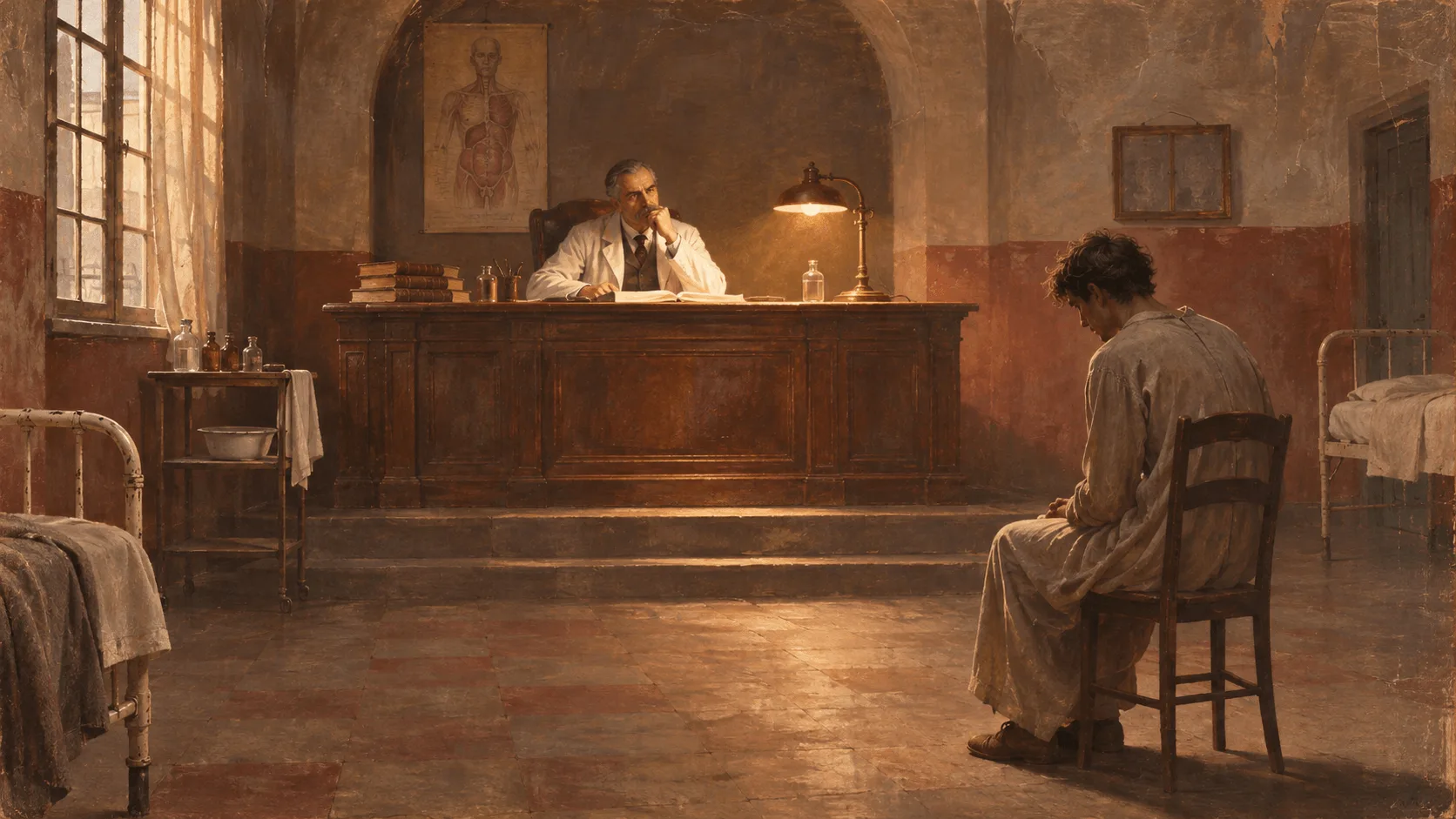
Rereading Leo Tolstoy’s The Death of Ivan Ilyich: a reflection on illness, the authority of medicine, and how hard it is to face another person’s suffering.
Some books we keep going back to, and each time they give us something we had missed before. The text has not changed, obviously. We have, and we bring to it a few more years of experience and a slightly different way of looking at things.
The Death of Ivan Ilyich, the short novella Leo Tolstoy published in 1886, is one of those books for me.
I have mentioned it more than once when writing about literature, history and medicine. Reading it again, though, I came away convinced that it deserved a piece of its own. Tolstoy’s account of an illness that advances, and of a man who slowly realises he is going to die, is reason enough. What struck me most this time, however, was something else: how precisely he portrays the people around the patient (doctors, relatives, friends, colleagues).
Almost a century and a half later, the novella still asks questions that have no easy answer.
How does a doctor behave when the illness in front of them has no name yet? What happens when professional competence turns into an authority that cannot afford to look uncertain? Why does illness turn a respected man into someone others would rather avoid? And why is a patient so often most alone at the very moment they most need other people?
These questions run through the whole story, and anyone who practises medicine will feel them more sharply than most readers.
Tolstoy, however, is not only putting the doctor on trial. His target is broader and more uncomfortable: our difficulty in acknowledging the vulnerability of others and, behind it, our own.
An ordinary life, a death that disturbs
Ivan Ilyich Golovin is a Russian judge. He is a respectable man with a satisfactory career, a recognised place in society and a life that conforms, more or less exactly, to what his circle considers proper.
He is not an exceptional character. That is the point: his sheer ordinariness is what makes him interesting.
His days revolve around work, family, social obligations, small pleasures and the usual frictions of married life. Appearances matter to him a great deal, and so do the furnishing of his home, his respectability and the conventions of his milieu.
Everything seems to follow a predictable order.
Then, almost without his noticing, something changes.
A discomfort in his side, a sensation that will not go away, an odd taste in his mouth. The symptoms are mild at first and Ivan barely pays attention. While arranging his new home he had also fallen from a stepladder and struck his side, but Tolstoy is careful not to draw a clear causal line between that accident and the illness that follows.
Discomfort becomes pain. His mood darkens. Irritability and anxiety set in, and he finds it harder and harder to keep up his old habits.
Little by little, the illness stops being a problem located somewhere in the body and starts to fill his whole existence.
His family is not especially understanding at first. Ivan’s behaviour is read mostly as a sign that his character is getting worse. His complaints upset the peace of the house, the quarrels multiply, and in the end his wife insists that he see a famous doctor.
This is where Tolstoy builds one of the finest scenes ever written about the relationship between doctor and patient.
The judge before the doctor
We are in Chapter IV. Ivan Ilyich goes to the doctor with one specific concern: he wants to know whether his condition is serious.
The consultation goes somewhere else entirely.
The scene is worth reading in full, because what it says lies not in any single line but in the way the whole encounter is drawn.
He went. Everything happened as he had expected, as it always did. There was the waiting, the doctor’s display of importance, so familiar to him — the same importance he himself assumed in court — the percussion, the auscultation, the questions demanding predetermined and plainly useless answers, and the solemn air that seemed to say: entrust yourselves to us and we shall put everything right; we know exactly how to proceed, always in the same way, with everyone.
It was exactly like being in court. The attitude Ivan Ilyich had adopted towards defendants was precisely the attitude the famous doctor now adopted towards him.
The doctor explained that certain signs suggested a particular abnormality somewhere inside the body; if further investigations failed to confirm it, however, another possibility would have to be considered. And if that were the case, then … and so on.
For Ivan Ilyich only one question mattered: was his condition dangerous or not? But the doctor ignored that inappropriate question. From his perspective, it was an idle matter, not worth discussing. The task was simply to weigh probabilities: a floating kidney, chronic catarrh, or a disease of the caecum.
It was not Ivan Ilyich’s life that was being considered, but a dispute between the floating kidney and the caecum. And this dispute, in Ivan Ilyich’s presence, the doctor brilliantly resolved in favour of the caecum, adding that an examination of the urine might provide further evidence, in which case the matter would be reconsidered.
It was exactly what Ivan Ilyich himself had done thousands of times, and with equal brilliance, when dealing with defendants. The doctor too delivered his conclusions brilliantly and looked over his spectacles at the accused with a triumphant, almost cheerful expression.
From the doctor’s conclusions Ivan Ilyich gained the impression that things were going badly and that the doctor, and perhaps everybody else, did not care in the least, whereas for him it was a dreadful matter. The impression hurt him deeply, arousing great pity for himself and profound irritation towards this doctor who was indifferent to something so important.
But he said nothing. He stood up, put the money on the table and, with a sigh, asked:
“We patients probably often ask you inappropriate questions. But, in general, is this a dangerous illness or not?”
The doctor looked at him sternly through his spectacles, as though to say: “Defendant, if you do not keep within the limits of the questions put to you, I shall be obliged to order you removed from the courtroom.”
“I have already told you what I considered necessary and appropriate,” the doctor replied. “Further investigations may clarify the rest.”
And the doctor bowed.
I can think of few sharper portraits of the imbalance of power that a professional relationship can hide.
Ivan recognises the behaviour at once, because he has practised it for years. The doctor’s authority, the ritual of the examination, the way the questions are framed, the weighing of rival hypotheses, even that final bow: all of it reminds Ivan of how he himself administers justice.
The reversal is complete.
The judge, used to questioning and judging others, is now the defendant. The man who normally decides which questions are relevant faces a professional who has decided that the one question Ivan cares about is not.
And it is hardly a sophisticated question.
Ivan simply wants to know whether his illness is serious.
The doctor answers by discussing which organ might be at fault.
Both are talking about the same clinical condition. They are not talking about the same thing.
When the doctor does not know, but cannot admit it
There is another side to this scene.
Ivan Ilyich’s doctor does not actually know the diagnosis.
He lists possibilities, weighs hypotheses and orders further tests. The clinical picture is uncertain and stays that way until the end: Tolstoy never tells us what his protagonist is dying of.
It would be easy to put this down to the limits of nineteenth-century medicine. It would also be a reductive reading, and not a very interesting one.
What matters is not how much the doctor knows, but how he behaves in front of what he does not know.
He cannot afford to look uncertain. His social role requires him to have answers, or at least to give a convincing impression of having them.
Professional authority turns into something close to a duty of omniscience.
Hence the sense of performance: the doctor sets out an elaborate chain of reasoning, frames hypotheses, separates one possibility from another and delivers his conclusions with complete assurance.
We need not assume that he is consciously making up a diagnosis, or that he means to deceive his patient. Tolstoy gives us no real grounds for that.
The problem is subtler.
The doctor may well believe his reasoning is sound. What he seems unable to do is share with the patient the uncertainty that reasoning inevitably carries.
The uncertainty is admitted in technical language and hidden in the human relationship.
None of this belongs only to the past.
In medicine today, too, saying “I don’t know” can feel like a confession of weakness (I suspect most clinicians have felt that pressure at some point). A working hypothesis is then presented as a conclusion, a probability as a certainty, a reassurance as if it were an answer.
Yet knowing one’s limits is not the opposite of competence. It is part of it.
A competent doctor is not someone who always has an answer. It is someone who can tell what is known from what can only be hypothesised, explain what the uncertainty means, and keep guiding the patient while a definite diagnosis is still out of reach.
This does not mean, of course, unloading every doubt onto patients or dodging the responsibility to decide.
It means not confusing authority with infallibility.
Ivan Ilyich could probably have accepted that the doctor could not yet reach a diagnosis. What he cannot accept is having his worry treated as beside the point.
His question, after all, is not really about the organ. It is about his future.
That difference is the whole story.
The history behind the scene: the power of professions
The parallel between judge and doctor becomes more interesting still once we place it in the Russia of the second half of the nineteenth century.
In 1864, under Alexander II, a major judicial reform reshaped the Russian court system: new procedures, more open proceedings, adversarial elements and a different role for legal professionals.
Ivan Ilyich belongs to that world of officials and judges whose sense of self rests on career, expertise and institutional recognition.
Tolstoy sets side by side two forms of professional authority which, for all that they operate in different fields, share specialised languages, procedures and hierarchies.
The judge must administer justice according to the rules of the court. The doctor must read symptoms through the knowledge of their discipline.
Both, though, run the risk of caring more about the correctness of the procedure than about the person it is being applied to.
This is not an attack on technical competence. Setting rigorous scientific medicine against some vaguely defined “humane” medicine would make little sense.
The danger comes when expertise becomes self-sufficient: when the professional assumes that doing the job properly discharges every responsibility towards the person in front of them.
Seen this way, Tolstoy’s scene is less a criticism of one doctor than of power itself, whenever professional status comes to matter more than the human being.
That Ivan has spent years exercising exactly this kind of power over others is what makes the scene so uncomfortable to read.
When illness changes a person’s character
Ivan Ilyich’s illness changes more than his body.
Slowly, it changes the way he relates to other people.
The respectable, sociable man who once cared so much about convention becomes irritable, suspicious, hard to approach. He complains, loses his temper, finds fault with his family and overreacts to trivial annoyances.
Tolstoy describes the change with a realism that is almost clinical.
Constant pain takes over his thoughts. Uncertainty feeds his fear. Reassurance does not convince him. His attention turns more and more towards what his body is telling him.
He listens to his sensations, tracks every change in the pain, keeps interpreting what is happening to him and looks for confirmation, for reassurance.
The world outside matters less and less.
It is a pattern familiar from many experiences of illness, above all when suffering drags on and the future becomes uncertain.
One aspect, however, tends to be overlooked.
People who suffer can be hard to live with. They are not always patient, grateful or reasonable; they can be aggressive, unfair, exasperating, and they may push away the very people whose help they need most.
The people around them may end up seeing little else.
This is what happens to Ivan.
His wife reads his irritability as a flaw of character. The quarrels become more frequent. His presence disturbs the household and slowly turns into a source of tension.
A vicious circle sets in: suffering strains relationships, and strained relationships make the suffering worse.
None of this means that every unpleasant behaviour of a sick person must be excused, or that relatives and carers have no right to admit they are exhausted.
It means recognising that illness is never confined to an organism. It gets into relationships, shifts their balance and can badly undermine a person’s place in society.
Ivan Ilyich loses more than his health.
He loses his place in the world.
The patient as an unwelcome presence
Tolstoy opens the novella with the news of Ivan Ilyich’s death.
It is a masterly choice.
Before we even meet the protagonist, we meet his colleagues, who learn of his death and start working out what it means for their careers.
A man has died, and the first thought is of transfers, promotions and new openings.
Tolstoy does not need to spell out their selfishness. He just shows how smoothly a colleague’s death is absorbed into the ordinary business of life.
The same attitude runs through the story of Ivan’s illness.
Gradually, he becomes an awkward presence.
His wife has to deal with the prescriptions, the family has to adjust its habits, and his friends do not know how to behave. Everyone carries on, as far as they can, as before.
Ivan’s illness no longer allows him to do the same.
Between those who suffer and those who watch there is a deep asymmetry.
For relatives and friends, illness is one more problem on top of everyday responsibilities. For Ivan it has become his whole existence.
The others can put it out of their minds for a while, distract themselves, go out, go back to work. He cannot.
That difference alone is enough to make illness an experience of growing isolation.
It is all the more painful because Ivan has always been a man fully at home in society, with a role, relationships, habits and a recognised position.
Now he can no longer play the part he was given.
Illness has broken the rules of the orderly, respectable world he tried so hard to live in.
In the society Tolstoy describes, even suffering seems expected to observe the conventions.
Pain, physical dependence, fear and bodily decline become embarrassing, almost improper.
The patient is no longer just someone who needs help.
He is a constant reminder of a truth the others would rather not look at.
The shared lie
Which brings me to what I consider one of the novella’s deepest themes: the patient’s loneliness.
Ivan is not physically alone.
He has a wife, children, colleagues, friends and servants. Doctors look after him. He receives visits, prescriptions and attention.
And yet his loneliness is almost total.
The problem is not that people are absent, but that he cannot share with them what he is going through.
Tolstoy describes a kind of collective lie.
Everyone goes on acting as if Ivan were simply ill, as if following the doctor’s orders and waiting to get better were all that was needed. Nobody seems willing to say out loud what he feels with growing clarity: first that he might be dying, then that he is.
The pretence becomes almost unbearable.
Not because he necessarily wants to be told he will die, but because he wants to be able to talk about his fear without having to play along with a normality that no longer exists.
The need could not be more human.
He wants someone to recognise what is happening to him.
Here the novella touches one of the most delicate questions in the therapeutic relationship.
We know how much hope matters, especially in serious illness. Hope, however, should not become an obligation to stay optimistic.
Helping someone to hope is one thing; quietly preventing them from talking about death is quite another.
A patient may want to recover and, at the same time, need to face the possibility that they will not.
They may ask for reassurance and still be looking for someone willing to hear their fears.
The two needs do not contradict each other.
Communicating a prognosis takes tact, timing and attention to what the person actually wants to know. Not everyone wants the same information, at the same moment or in the same detail.
But when optimism becomes a convention everyone is expected to observe, the patient risks losing even the chance to speak honestly.
Ivan is surrounded by people who look after his illness.
Almost none of them is willing to stay with him in the knowledge that he is dying.
Pain is never only pain
It is hard to read these pages without thinking of a concept developed many decades later, in the second half of the twentieth century, by Cicely Saunders, one of the founders of modern palliative medicine: total pain.
The term describes suffering in which physical, psychological, social and spiritual dimensions interact and feed into one another.
Attributing to Tolstoy a clinical theory formulated long after his death would, of course, be anachronistic. Turning Ivan Ilyich into a case to be classified by modern categories would be just as reductive.
Still, the literary description comes surprisingly close to that layered understanding of suffering.
Ivan’s physical pain is real, persistent and more and more disabling.
But the sensation itself is not all that torments him.
There is the fear of what the pain means, the uncertainty, the loss of his role, the distance from others, the feeling of having become a burden and the impossibility of sharing any of it.
One detail says a great deal: after the consultation, the pain seems to take on a new and more menacing meaning for Ivan.
Its intensity has not necessarily changed. What it stands for has.
Suffering cannot be understood apart from the history, fears and relationships of the person who suffers.
This is one of the most valuable things literature has to offer medicine.
Not as a substitute for scientific knowledge, but as a reminder of a part of human experience that no diagnostic test can fully capture.
Gerasim: the man without expertise who understands
Into this world of convention and pretence steps a remarkable character: Gerasim.
He is a young servant of peasant stock who helps Ivan with his daily needs.
He has no medical training, holds no position of authority and offers no explanation of the illness.
Yet he manages what neither the doctors nor the family seem able to do.
He acknowledges Ivan’s suffering without embarrassment and without trying to cover it up.
He helps with the most intimate bodily needs, the ones the judge finds most humiliating. He holds Ivan up when he cannot move, raises his legs to ease the pain and sits with him through the night.
Above all, he does not lie.
Gerasim feels no need to pretend the illness is a passing condition that is bound to clear up.
He knows Ivan is dying, and looking after him seems to him the natural thing to do.
When he explains himself, the thought is very simple: we shall all die one day, so why not help one another?
Few answers in the book carry more weight.
In the setting of Tolstoy’s Russia, the contrast also has a social side.
Serfdom had been abolished in 1861, but the countryside and the educated classes were still divided by deep economic, cultural and social differences.
Gerasim belongs to the peasant world that Tolstoy, especially in his later years, often saw as keeping a moral spontaneity the privileged classes had lost.
We should not, of course, mistake this literary portrait for a sociological description of the Russian peasantry.
Gerasim is also a moral ideal.
The contrast Tolstoy builds is no less powerful for that.
The judge has social prestige. The doctor has specialist knowledge. The servant has something both of them seem to have lost: the ability to see another person’s vulnerability without pretending.
There is one more thing worth noticing.
Gerasim does not stop at compassion. He turns it into concrete acts.
Touching, washing the body, giving support, simply being there: these become forms of care that give back to Ivan some of the dignity the illness has taken from him.
I find it hard not to think of how often these tasks are undervalued in the professional hierarchies of medicine.
Diagnosis and therapeutic decisions carry recognised prestige. The daily care of the suffering body, indispensable as it is, can end up being treated as secondary.
Tolstoy turns that hierarchy upside down.
The character with the lowest social standing is the one who understands most deeply what the patient needs.
Not because knowledge is useless, but because knowledge alone is not enough.
The need to be comforted
There is a particularly moving moment between Ivan and Gerasim.
The judge, worn out by suffering, longs to be treated like a sick child.
He wants to be stroked, comforted, held. He wants someone to be tender with him without making him keep up the image of an important and respectable man.
And he is ashamed of wanting it.
He is an adult, a judge, a man used to being respected. He cannot bring himself to admit so basic a need.
Illness, however, has torn down the defences his social identity relied on.
What is left is the plain human need to be reassured, acknowledged and loved.
Gerasim is the only one who lets him step out of his role, at least in part.
He does not humiliate him or judge him, and Ivan’s dependence does not seem to trouble him.
His care does not take the illness away. It makes the suffering less lonely.
The point bears repeating: not all care is cure.
When an illness cannot be removed, the way a person lives through it can still be changed, and changed a great deal.
A criticism that also applies to Ivan
It would be a mistake, though, to read The Death of Ivan Ilyich simply as the story of a man abandoned by insensitive doctors and relatives.
Tolstoy is far more complex than that, and far less indulgent towards his protagonist.
Ivan has spent most of his life following exactly the social conventions that are now suffocating him.
He has prized prestige, career, appearances and the formal correctness of relationships.
He has exercised his professional authority while keeping the distance needed to avoid any personal involvement with the people he had to judge.
And even once he is ill, he goes on taking part in the pretence himself.
In one telling scene, longing to weep and be comforted, he runs into a colleague and ends up discussing legal matters with him in the most formal terms.
He cannot get out of the role he has played all his life.
His loneliness, then, is not only the product of other people’s indifference.
It is also the result of a way of living that put respectability before honest human relationships.
Illness does not suddenly create the falseness of that world.
It makes it unbearable.
This may well be Tolstoy’s harshest judgement in the whole novella.
Ivan realises that what he has devoted his life to — professional success, social standing, propriety — cannot hold him up when he has to face death.
And he starts to question not only the meaning of his illness, but the meaning of the life he has led.
In the end, the real trial is no longer about the diseased organ.
It is about his existence.
A story born from a real death
The character of Ivan Ilyich did not come entirely out of Tolstoy’s imagination, and this is worth remembering.
One of his models was Ivan Ilyich Mechnikov, a prosecutor attached to the court in Tula, who died on 2 July 1881.
Tolstoy knew him and heard about the circumstances of his death. According to the memoirs of the writer’s sister-in-law, Tatyana Kuzminskaya, Mechnikov’s widow had spoken of her dying husband’s thoughts on the uselessness of the life he had lived. Kuzminskaya passed those words on to Tolstoy, and they played a part in the genesis of the novella.
The fictional character is not, of course, the same as the historical man. Tolstoy reworked the biographical starting point thoroughly and gave it a moral, universal significance.
For anyone interested in the history of medicine, though, there is a fascinating connection.
Ivan Ilyich Mechnikov was the brother of Ilya Ilyich Mechnikov, the biologist and immunologist who in 1908 would share the Nobel Prize in Physiology or Medicine with Paul Ehrlich for their work on immunity.
Behind one of literature’s best-known portraits of illness and of a failed medical encounter, in other words, there is a family tie to one of the leading figures of modern scientific medicine.
The link does not justify any causal connection between the immunologist’s research and the content of the novella. It remains a telling historical detail, and it helps to place the work in its context.
By the time Tolstoy wrote The Death of Ivan Ilyich, between 1885 and 1886, he had already been through a deep spiritual crisis.
He had questioned the value of success, wealth, social conventions and his own life. Thinking about death had become central to his work.
This is why reducing the novella to an indictment of bad medicine would be wrong.
Tolstoy is questioning an entire way of conceiving existence.
What remains for those who practise medicine today?
Reading The Death of Ivan Ilyich as a doctor means facing questions that go well beyond reconstructing a clinical history.
The first is about knowledge and power.
Medicine needs expertise, procedures, tools and decisions based on the best available evidence. Competence, however, should not harden into an authority that cannot admit its own limits.
Ivan Ilyich’s doctor shows how easily confidence in professional language can be mistaken for the ability to give the patient an answer that means something.
The second is about the nature of illness.
What the doctor sees as a diagnostic and therapeutic problem may be, for the patient, a crisis that involves identity, relationships, the future and the meaning of life.
The two views are not incompatible. They simply do not always coincide.
The third is about loneliness.
A patient can receive every medical intervention they need and still feel abandoned. They can be surrounded by people trying to help and find nobody willing to hear what they are really afraid of.
Finally, there is what Gerasim teaches.
Presence, listening and the willingness to stay with someone through their suffering are not alternatives to scientific competence. They belong to a form of care that diagnosis and treatment alone cannot exhaust.
It would be too easy, however, to conclude that Tolstoy is just telling us to be more empathetic.
His story asks something more troubling.
Why do we find it so hard to acknowledge other people’s suffering?
Perhaps because serious illness confronts us not only with the vulnerability of the person who is ill, but with our own.
The doctor can take refuge in technical language, the relative in daily chores, the friend in social conventions. The patient, too, may try to keep playing the part they have always played.
These are different ways of keeping at arm’s length a reality none of us can control.
And this may be Tolstoy’s greatest achievement: showing how painful the distance can be between knowing about an illness and understanding the person who has it.
The novella ends with an inner change in Ivan. At the very last moment, pity for his son and his wife seems to break, if only for an instant, his complete absorption in his own suffering.
I would rather not turn this into a comforting celebration of pain as a path to moral growth. Suffering does not necessarily make us better, and it has no educational value in itself.
The ending belongs to Tolstoy’s own philosophical and spiritual vision, and it deserves to be taken with all its complexity.
One very human insight remains all the same: even when illness has destroyed every certainty, our relationship with others can still change the meaning of what we are going through.
Rereading these pages, I keep coming back to the consultation.
Ivan Ilyich walks into the doctor’s office with a question about his life. He walks out with a few diagnostic hypotheses, some prescriptions and the feeling that nobody has understood what he wanted to know.
The doctor has done his job.
From the patient’s point of view, the encounter has failed.
This, I think, is the question the novella leaves to those of us who practise medicine today:
When a patient speaks to us about their illness, are we really sure we are listening to the question they are asking?
References and further reading
Literary text
- Tolstoy, L. N. The Death of Ivan Ilyich (1886), especially Chapter IV. The Russian original, with a parallel public-domain English translation by Louise and Aylmer Maude, is available in the University of Minnesota’s scholarly study edition.
Historical and literary context
- Jahn, G. R. (ed.). The Death of Ivan Ilich: An Electronic Study Edition of the Russian Text. University of Minnesota Libraries Publishing, 2020. See especially the introduction on the writing and publication of the novella.
- NobelPrize.org. The Nobel Prize in Physiology or Medicine 1908.
Medicine and the interpretation of suffering
- Lucas, V. The Death of Ivan Ilyich and the concept of ‘total pain’. Clinical Medicine. 2012;12(6):601–602. doi:10.7861/clinmedicine.12-6-601.
Related reading on this site
- Narrative Medicine: Close Reading, Clinical Empathy, and the Art of Listening to Patients.
- “A Young Doctor’s Notebook” by Mikhail Bulgakov.
- The Death of the Grandmother in Proust’s “À la recherche du temps perdu”.
- Frida Kahlo: The Anatomy of Suffering.
- “The Doctor” by Luke Fildes.
- Doctor Grenvil in Giuseppe Verdi’s La Traviata.