micheledpierri.com: statistics, data analysis and coding

Nexus of Statistics, Data analysis, Coding, Art and Medicine

Menu
  • Home
  • Courses
    • Python Foundation
    • Statistics
    • Data Analysis
    • Machine Learning
  • Blog
    • All Pages
    • Health Informatics
    • Programming
    • Art
  • Illustrations
  • About
  • Contact
Menu
Home / Art

Category: Art

Explore the fascinating intersection of art and medicine through paintings, illustrations, and visual representations of physicians, medical procedures, and healthcare throughout history.

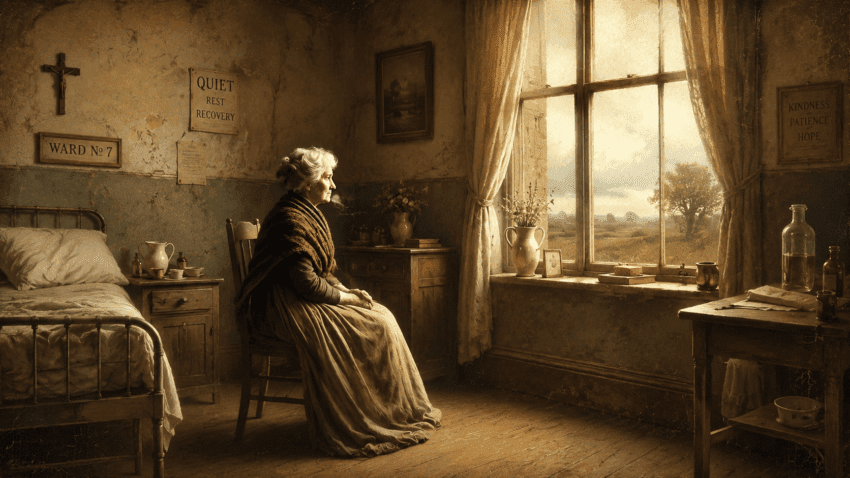
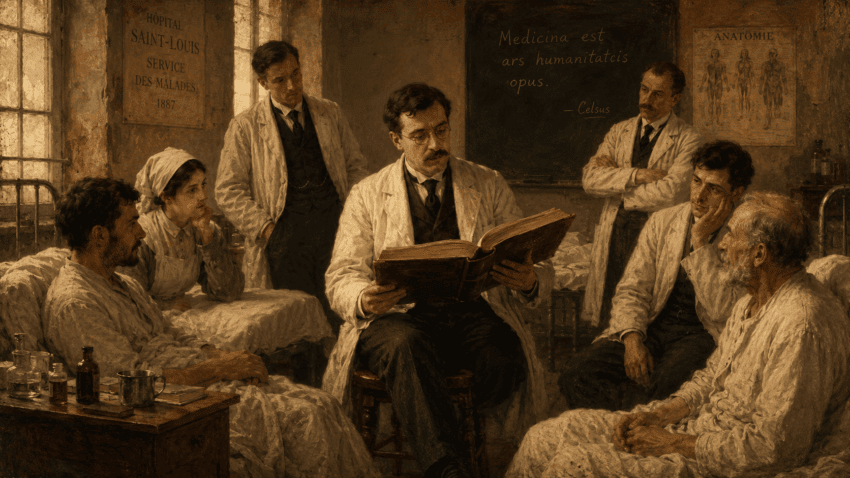
A doctor reads from a large medical book in an early 20th-century hospital ward, surrounded by attentive patients and fellow physicians.

Narrative Medicine: Close Reading, Clinical Empathy, and the Art of Listening to Patients

Posted on August 8, 2026August 16, 2026 by Michele Danilo Pierri

1. Introduction: Why Narrative Medicine Matters Now

In an era defined by algorithmic diagnostics, electronic health records, and the quantification of care, medicine faces a paradox: as its technical capacity has expanded to unprecedented heights, the therapeutic relationship — the conversation between patient and clinician — has frequently contracted. Patients report feeling unheard. Physicians report feeling burned out. Diagnostic errors persist not from lack of data but from failures of attention. Against this backdrop, narrative medicine has emerged not as a romantic retreat from science but as a rigorous, evidence-informed discipline that restores the human story to its proper place at the centre of clinical practice.

The term “narrative medicine” names a discipline that — in the formulation of its chief architect, Rita Charon — is “medicine practised with narrative competence.” That competence entails the ability to recognise, absorb, interpret, and be moved by the stories patients tell of their illnesses; to understand illness as an event in someone’s life trajectory; and to reflect, with critical precision, on the stories clinicians themselves construct. Far from being optional ornamentation on a scientific core, narrative competence turns out to be implicated in the accuracy of diagnosis, the depth of empathy, and the resilience of practitioners themselves.

This interpretive reading of the body is not a modern invention. Long before clinical semiotics was formalised, literature had already practised it: Dante’s Inferno, for instance, reads the damned as a precise catalogue of disease, transforming the poet’s gaze into something remarkably close to a clinician’s.

This post offers a comprehensive introduction to narrative medicine clinical practice for clinicians, researchers, and medical educators with an interest in the intersections of data, science, and the human dimension of healthcare. We move from historical origins through theoretical foundations, examine the evidence base, read canonical literary and artistic works through a narrative medicine lens, distinguish the field from the broader territory of medical humanities, and close with practical tools clinicians can adopt immediately.


2. Origins: Rita Charon and the Columbia Programme

The story of narrative medicine as a formal discipline begins with an internist and literary scholar named Rita Charon. Charon arrived at Columbia University’s College of Physicians and Surgeons in the 1990s carrying two doctoral degrees — one in medicine, one in English literature — and a persistent intuition that something in the medical encounter was being systematically missed. Her concern was not sentimental: it was epistemological. She believed that the modes of attention and interpretation trained by literary study were directly transferable to clinical encounters, and that physicians who lacked those modes were not merely less humane but less accurate.

In 2000, Charon published a landmark paper in JAMA titled “Narrative Medicine: A Model for Empathy, Reflection, Profession, and Trust,” articulating for the first time a coherent programme. Three years later she founded the Programme in Narrative Medicine at Columbia, the first of its kind. The programme trained physicians, nurses, social workers, and chaplains in close reading, reflective writing, and the analysis of narrative structure. It drew its curriculum from literary theory — particularly from the work of Mikhail Bakhtin on dialogism and from narratologists such as Gérard Genette — and from medical ethics and philosophy.

What distinguished Charon’s project from earlier work in literature and medicine (which had been practised informally for decades) was its insistence on rigour. Narrative medicine was not bibliotherapy — the therapeutic use of reading. It was a discipline with defined methods, teachable skills, and, crucially, outcomes that could be measured. The programme has since trained hundreds of healthcare professionals and spawned postgraduate certificates, master’s degrees, and doctoral programmes at Columbia and at affiliated institutions worldwide.

The intellectual genealogy of the field is worth tracing briefly. Charon drew on Arthur Kleinman’s distinction between disease (the biological pathology) and illness (the patient’s experienced suffering), a distinction Kleinman elaborated in The Illness Narratives (1988). She drew on Eric Cassell’s The Nature of Suffering (1991), which argued that medicine’s failure to engage with personhood — with biography, with meaning — caused suffering beyond the biological. And she drew on phenomenological philosophy, particularly Edmund Husserl and Maurice Merleau-Ponty, which insisted that bodily experience was the irreducible foundation of human knowledge. Together, these sources supported the central claim: that the patient’s narrative is not background information but primary clinical data.


3. The Four Core Elements: Attention, Representation, Affiliation, Action

Charon and her colleagues articulate narrative medicine around four cardinal concepts: attention, representation, affiliation, and action. These are not sequential steps but mutually reinforcing capacities, each of which can be cultivated through practice.

Attention

Attention is the disciplined act of receiving — of opening oneself to the full complexity of what a patient presents. In literary close reading, attention means noticing what a text does formally: its rhythm, its silences, its metaphors, its shifts in tense or person. In the clinical encounter, it means noticing not just the content of what a patient says but the form in which they say it: the hesitation before naming a symptom, the passive construction used when describing a traumatic event, the moment when the patient’s gaze drops away. Attention in this sense is active and trained, not passive and instinctive. It requires the clinician to suspend premature closure — the drive to pattern-match and categorise — and to remain, for longer than is comfortable, in a state of receptive uncertainty.

Representation

Representation is the act of making what has been attended to into an external form — a written note, a narrative account, a parallel chart (discussed below). For Charon, the act of writing is not merely documentation but transformation: in writing about a patient encounter, the clinician moves from raw perception to structured meaning, and in doing so discovers what they noticed and what they missed, what moved them and what they avoided. Representation is where the work of close reading rejoins the work of clinical documentation, and where the parallel chart becomes a tool of both self-knowledge and quality improvement.

Affiliation

Affiliation is the outcome of sustained attention and honest representation: a genuine sense of connection with the patient, grounded not in sentimentality but in the recognition that the patient’s suffering is particular, not generic. In Charon’s formulation, affiliation is the emotional and ethical correlate of narrative competence. It is what prevents the clinician from treating the patient as a case and insists on treating them as a person. Crucially, affiliation is not the same as identification: the clinician does not need to have had the same experience as the patient to be affiliated with them. What is required is the imaginative capacity to understand — not fully, but seriously — a life that is not one’s own.

Action

Action is the translation of narrative competence into changed clinical behaviour: a different question asked, a diagnosis reconsidered, a conversation opened that had been avoided, a care plan altered in response to what the patient has actually said rather than what the clinician expected to hear. Action is the test of narrative medicine’s claim to clinical utility. If close reading and reflective writing produce only private insight, they remain valuable but limited. Their full potential is realised when they alter the clinician’s behaviour in ways that improve the quality of care.


4. The Evidence Base: Empathy, Burnout, and Diagnostic Accuracy

Sceptics sometimes characterise narrative medicine as an appealing idea in search of evidence. The evidence, while still accumulating, is more substantial than critics acknowledge.

On empathy, a 2001 study by Halpern demonstrated that emotional attunement — closely related to narrative competence — was associated with improved patient outcomes across multiple measures. More directly, a 2011 randomised controlled trial by Winkel and colleagues, published in Patient Education and Counseling, found that narrative medicine training significantly improved empathy scores in medical students compared to controls, with effects sustained at six-month follow-up. DasGupta and Charon’s own work has consistently shown improvements in perspective-taking and tolerance of ambiguity following narrative medicine seminars.

On clinician burnout, the evidence is suggestive and important. Burnout in medicine is partly a consequence of the erosion of meaning — the sense that clinical work has been reduced to procedure and throughput. Narrative medicine addresses this directly by restoring the clinician’s sense of the meaning of their work. Studies at Columbia and at Thomas Jefferson University have shown that narrative medicine workshops reduce emotional exhaustion and increase personal accomplishment scores on the Maslach Burnout Inventory. A 2019 systematic review by Milota, van Thiel, and van Delden, published in Medical Teacher, found consistent positive effects on reflective capacity and on measures of professional identity across diverse narrative medicine curricula.

On diagnostic accuracy, the connection is more inferential but theoretically compelling. Jerome Groopman’s How Doctors Think (2007) — discussed in detail below — documents how cognitive biases, including premature closure and anchoring, account for a substantial proportion of diagnostic errors. Narrative competence addresses these biases directly: by training clinicians to maintain attention to disconfirming detail and to remain open to revision, it targets the cognitive habits that make errors most likely. Research by Smith and colleagues has shown that physicians who score higher on measures of narrative competence are more likely to elicit complete patient histories and to identify psychosocial factors relevant to diagnosis.

These findings should be interpreted carefully: narrative medicine research faces the general challenges of educational intervention studies, including difficulty blinding, variability in implementation, and the problem of measuring outcomes that unfold over years rather than weeks. But the direction of evidence consistently supports the field’s core claims, and the methodological maturity of the literature has grown considerably since the early 2000s.


5. Narrative Medicine Through Literary and Artistic Works

Narrative medicine gains much of its intellectual depth from sustained engagement with literary and artistic works that explore illness, suffering, and the medical encounter. Six works in particular illuminate different dimensions of narrative medicine clinical practice and have become central to its pedagogical canon.

Leo Tolstoy, The Death of Ivan Ilyich (1886)

Tolstoy’s novella remains the most powerful literary exploration of what Charon calls the “narrative situation of illness.” Ivan Ilyich Golovin, a successful judge, develops an illness that his physicians never diagnose with confidence and that none of his colleagues or family members are able to acknowledge honestly. The novella’s central indictment is not of medicine’s technical failures but of its narrative ones: the physicians who attend Ivan Ilyich are interested in the disease, not the man; they deliver verdicts in the language of probability and prognosis while remaining utterly silent on the questions that actually consume their patient — why is this happening to me, and what does it mean?

The key passage for narrative medicine is Ivan Ilyich’s recognition that “what he longed for most was to be pitied and wept over as a sick child is caressed and comforted.” The longing is not for cure but for witness — for the acknowledgement that his suffering is real and that it matters to someone. Gerasim, the peasant servant who alone is straightforward with Ivan Ilyich, represents the therapeutic power of honest attention. He does not diagnose or treat; he simply holds the dying man’s legs through the night because it eases the pain. In doing so he performs, intuitively, what narrative medicine formalises as affiliation. Tolstoy’s novella stands as a reminder that technical excellence and narrative failure are not mutually exclusive — and that the second can hollow out the first.

This indictment takes different forms across literary traditions. Where Tolstoy’s physicians fail through scientific detachment, Proust’s celebrated Dr Cottard fails through vanity: a socially ambitious, at times absurd figure whose diagnostic reputation masks a striking poverty of human attention — a portrait explored elsewhere on this site.”

Virginia Woolf, On Being Ill (1926)

Woolf’s essay is a masterpiece of illness phenomenology, written from the inside. Her central provocation is a question: why, given that illness is among the most universal of human experiences, has it generated so little literature? “Considering how common illness is, how tremendous the spiritual change that it brings, how astonishing, when the lights of health go down, the undiscovered countries that are then disclosed, what wastes and deserts of the soul a slight attack of influenza brings to view” — why has this territory been left unmapped?

For narrative medicine, Woolf’s essay performs two related functions. First, it gives language to experiences that patients typically lack words for: the altered temporality of illness, the estrangement from the healthy body, the strange clarity of perception that fever sometimes brings. Second, it implicitly diagnoses the physician’s epistemological problem: if the clinician has not attended to the literature of illness, they have no map for the territory their patients inhabit. Woolf’s essay is, in this sense, a corrective to professional habituation — a reminder that illness is not a deviation from the norm of health but a distinct, complex country with its own geography, and that the physician who has never ventured into that country, even through the proxy of literature, is navigating it blind.

Franz Kafka, The Metamorphosis (1915)

Gregor Samsa’s transformation into a giant insect is one of literature’s most persistent metaphors for the experience of chronic illness. What Kafka renders with extraordinary precision is not the biology of transformation but its social consequences: the withdrawal of recognition, the restructuring of family relationships around the sick member’s incapacity, the gradual erosion of the ill person’s subjectivity in the eyes of those around them. Gregor’s family members pass through stages — shock, accommodation, resentment, guilt — that closely parallel the documented emotional trajectories of families confronting chronic or terminal illness.

For clinical practice, The Metamorphosis is a study in what Arthur Frank has called the failure of the “restitution narrative”: when cure is not available, the social structures that organise illness break down, and both patient and family are left in a narrative void. The story is a reminder that the patient’s illness story is always also a family story — and that the clinician who attends only to the individual patient misses the broader systemic context in which that patient’s suffering unfolds. Reading Kafka carefully can help clinicians recognise the systemic dimensions of their patients’ crises that a disease-centred history will never surface.

The same logic of somatised suffering runs through contemporary fiction as well: Murakami’s bodies, where insomnia, anorexia and the amputated shadow stand in for wounds that never reach clinical language.

Anton Chekhov: The Physician-Writer

Chekhov occupies a unique position in the narrative medicine canon because he wrote from both sides of the consultation room. Trained as a physician and practising throughout his adult life — dying of tuberculosis at forty-four — Chekhov brought to his fiction a clinical precision that was inseparable from his literary technique. His stories — “Ward No. 6,” “A Boring Story,” “The Bishop,” among many others — are studies in observation and restraint, in what he famously described as writing “without commentary.”

For narrative medicine, Chekhov’s method is itself an object of instruction. His refusal to judge, his insistence on showing rather than telling, his attention to the gap between what characters say and what they feel — these are literary virtues that translate directly into clinical ones. “Ward No. 6” in particular, with its portrayal of a physician who gradually identifies with his patient to the point of becoming one himself, raises the problem of affiliation taken to pathological extremes. The clinician’s challenge is to be moved without being overwhelmed; to be present without losing the reflective distance necessary for good judgment. Chekhov dramatises this challenge with a clarity that no clinical textbook has matched. His dual identity — as physician and as writer — also makes him the emblematic figure for the kind of integrative attention that narrative medicine seeks to cultivate.

Oliver Sacks: The Neurological Case History as Literature

Oliver Sacks represents a different kind of intervention: the physician who borrows the tools of literary narrative to transform the case history into a form of humanistic inquiry. In The Man Who Mistook His Wife for a Hat (1985), Awakenings (1973), and his later autobiographical work, Sacks consistently positioned the patient not as a bundle of symptoms but as a person navigating the meaning of a profoundly altered existence.

Sacks was explicit about his method. He described himself as a “clinical neurologist and romantic naturalist,” and his prose style — dense with literary and cultural allusion, attentive to the phenomenology of experience, deliberately unhurried — was a formal argument for a different kind of medical attention. For narrative medicine, Sacks’s most important contribution may be his insistence on what he called the “existential dimension” of neurological illness: that diseases of the brain are always simultaneously diseases of the self, and that understanding them requires attending to the patient’s experience of selfhood rather than merely to the pathology of the underlying neural mechanisms. His case histories enact precisely the movement from representation to affiliation that Charon’s framework prescribes. They also demonstrate, with unusual clarity, that rigorous clinical observation and humanistic narrative are not competing but complementary modes of knowledge.

Jerome Groopman, How Doctors Think (2007)

Groopman’s work occupies a different register — more journalistic than literary, more oriented toward cognitive science than phenomenology — but it connects powerfully to narrative medicine’s concerns. Through a series of extended case studies, Groopman demonstrates how physicians’ thinking goes wrong: premature closure (accepting the first plausible diagnosis and stopping), anchoring (over-weighting the initial impression), availability bias (over-diagnosing conditions recently prominent in the physician’s experience), and attribution error (assigning symptoms to a pre-existing condition without adequate investigation).

What is striking from a narrative medicine perspective is that virtually all the cognitive errors Groopman documents are failures of attention to the patient’s narrative. The physician who anchors closes off the patient’s story before it is complete; the physician who commits attribution error fails to hear the plot twist that contradicts the working hypothesis. Groopman’s implicit prescription — slow down, listen more carefully, ask open questions — is indistinguishable from narrative medicine’s explicit training programme. Reading How Doctors Think alongside Charon’s theoretical work reveals that cognitive science and narrative theory, approached from different angles, converge on the same clinical insight: the quality of a physician’s listening determines the quality of their diagnosis.

Visual Art: Rembrandt and the Anatomy Lesson

Narrative medicine extends beyond literature into visual art, and few works repay close reading as richly as Rembrandt van Rijn’s The Anatomy Lesson of Dr Nicolaes Tulp (1632). The painting depicts a public dissection in Amsterdam: Dr Tulp demonstrates the musculature of the forearm of a recently executed criminal to seven observers. The composition is remarkable for its distribution of attention: six of the seven observers look not at the body being dissected but at the viewer, the book, or each other; only Dr Tulp gazes at the cadaver and at his own demonstrating hand.

For narrative medicine, the painting raises the question that Charon considers foundational: who is the patient in this scene? The cadaver — Adriaan Adriaanszoon, also known as “Aris Kindt” — is the object of scientific attention, but he is also a person with a biography, a story that ended violently on a scaffold. The anatomy lesson performs, literally and symbolically, the gesture that narrative medicine seeks to reverse: the body reduced to object, the story suppressed in the service of knowledge. Reading the painting closely — attending to the cadaver’s face, to the pallor that Rembrandt renders with such precision, to the space between the clinical act and the human life it consumes — is itself an exercise in the kind of attention narrative medicine cultivates. Using visual art in teaching narrative medicine has the additional advantage of making the interpretive process visible: students who disagree about what a painting means are enacting precisely the dialogic, multiple-perspective engagement that Bakhtin theorised and that clinical encounters require.


6. Narrative Medicine vs Medical Humanities: Related but Distinct

Narrative medicine is sometimes treated as synonymous with medical humanities, but the distinction matters — both intellectually and for institutional purposes. Medical humanities is the broader field: it encompasses history of medicine, ethics, philosophy, sociology, anthropology, literature, and visual arts, and its goals range from cultural critique to professional formation to the improvement of clinical practice. It is a multi-disciplinary domain united by the conviction that humanistic inquiry can enrich medical education and practice.

Narrative medicine is a discipline within this broader field, but distinguished by its specificity of method and its direct claim on clinical practice. Where medical humanities may ask “what does the history of the asylum tell us about the social construction of mental illness?”, narrative medicine asks “how does close reading this poem about dementia change the way you listen to your patient with Alzheimer’s disease in the clinic this afternoon?” The difference is not one of value but of proximate aim: medical humanities is primarily oriented toward understanding; narrative medicine is primarily oriented toward changing clinical behaviour.

The methodological core of narrative medicine — close reading, reflective writing, the analysis of narrative structure — is borrowed from literary studies in a way that is more precisely specified and more pedagogically worked-out than most medical humanities programmes. And narrative medicine’s claim to clinical utility is stronger: it is not primarily an enrichment activity but a skills training programme, one that can be evaluated against clinical outcomes. Charon has consistently resisted the assimilation of narrative medicine into the looser category of medical humanities precisely because that assimilation tends to dilute the methodological rigour that makes the field distinctive.

That said, the fields are deeply complementary. The historical depth that medical humanities brings — the understanding of how concepts of disease, body, and care have varied across cultures and periods — provides essential context for the narrative medicine practitioner. And narrative medicine’s clinical focus gives medical humanities a practical anchor that helps justify its place in crowded medical curricula. The two fields are best understood as nested: narrative medicine is a rigorously specified method within the expansive territory that medical humanities claims as its domain.


7. How Clinicians Can Practice It: Tools for Everyday Use

Narrative medicine is not confined to graduate programmes or academic hospitals. Its core practices can be adopted by any clinician willing to invest time and reflective attention. Three tools are particularly accessible and evidence-supported.

The Parallel Chart

The parallel chart is perhaps narrative medicine’s most distinctive clinical tool. Alongside the official medical record — formal, structured, written for institutional purposes — the parallel chart is a private document in which the clinician records their own narrative of the encounter: what they noticed that they could not record in the EMR, what the patient said that moved them, what they found difficult, what they remain uncertain about. The parallel chart is not a diary; it is a disciplined reflective exercise, and its format — close attention to detail, narrative structure, honest accounting of emotional response — mirrors the practices of close reading.

The clinical purpose is manifold. It preserves information that institutional documentation suppresses (the patient’s exact words, the affective texture of the encounter) but that may be clinically relevant later. It provides a space for the clinician to notice and process their own responses, reducing the risk that unprocessed emotion will distort future clinical judgment. And it serves, over time, as a record of the clinician’s developing narrative competence — a log of the quality of their attention that no EMR can provide.

Close Reading in Clinical Teaching

Close reading as a pedagogical method is directly applicable to clinical education. A narrative medicine seminar typically begins with a short text — a poem, a short story excerpt, a painting — presented to the group without biographical or contextual framing. Participants are asked not to summarise or contextualise but to attend closely to the text’s specific features: its structure, its imagery, its voice, its silences. Discussion unfolds through careful attention to what the text actually does, rather than what one expects it to do.

This practice of disciplined attention is then transferred to the clinical context: the patient’s story, the physical examination, the clinical note become texts to be read with the same precision. In medical schools that have integrated narrative medicine — Columbia, Harvard, UC San Francisco, King’s College London among them — close reading sessions are included in the formal curriculum alongside biomedical science. Evaluations consistently show improvements in students’ reported empathy, their tolerance of ambiguity, and their willingness to engage with patients’ psychosocial contexts.

Reflective Writing

Reflective writing in narrative medicine differs from the general reflective practice advocated in medical education in its attention to craft. Where standard reflective practice asks “what happened, what did I feel, what would I do differently?”, narrative medicine reflective writing asks clinicians to attend to the formal dimension of their own narratives: whose perspective is privileged, what is left out, what metaphors are used, what the structure of the account reveals about the writer’s assumptions.

Charon recommends a specific exercise called the “narrative of the clinical encounter”: immediately after seeing a patient, the clinician writes a brief account of the encounter in whatever form emerges naturally. The account is then read aloud in a small group (in training settings) or analysed privately, with attention to the narrative choices the writer made. Over time, this practice develops what Charon calls “narrative humility” — an awareness of the partiality of one’s own perspective and the inevitability of narrative construction in clinical knowledge. It is a practice with no expensive equipment requirement and no institutional permission needed: it requires only a few minutes and the willingness to be honest with oneself.

Grand Rounds and Case Conferences

Narrative medicine’s methods can also be integrated into existing institutional structures without requiring a dedicated curriculum. Grand rounds presentations can be expanded to include the patient’s narrative alongside the clinical history; case conferences can include time for reflective discussion of the interpersonal and affective dimensions of a case, not merely its diagnostic and therapeutic aspects. These are modest structural changes, but when implemented consistently they shift the culture of clinical education toward the values of attention, representation, and affiliation — making narrative competence a recognised professional virtue rather than a private eccentricity.


8. Conclusion: Listening as Clinical Practice

The argument of narrative medicine is, at its core, straightforward: the stories patients tell are data, and the capacity to receive and interpret those stories is a clinical skill that can and must be trained. In an era when medicine is under pressure — from technology, from system constraints, from the burden of documentation — this argument can seem naively humanistic. In fact, it is hard-headedly practical. The physician who listens well diagnoses more accurately. The clinician who writes reflectively burns out less quickly. The healthcare system that takes patient narratives seriously makes fewer errors and generates more trust.

This post is part of a broader investigation, on this site, into the intersections of data science, artificial intelligence, and medical humanities. In previous posts we have explored how quantitative methods can illuminate questions of human significance, and how the humanities offer resources for thinking about the limits of quantification. Narrative medicine sits precisely at this intersection: it uses the rigorous methods of literary analysis to generate clinical knowledge that quantitative methods alone cannot produce. It is neither anti-scientific nor anti-technological; it is, rather, a reminder that the most advanced clinical tool remains the disciplined human ear.

For clinicians reading this, the invitation is immediate and concrete: choose one patient today, listen to their opening words without interrupting, notice the form of what they say and not merely its content, and write a paragraph — not in the EMR but privately — about what you noticed. That paragraph is the beginning of a parallel chart, and the beginning of a practice that the evidence suggests will make you a better physician and a more resilient one.

Ivan Ilyich, the judge who died alone in Tolstoy’s novella, did not recover. But he died, in Tolstoy’s rendering, with something that had been absent throughout his illness: the experience of being genuinely seen. That experience — of being a person rather than a case, of one’s suffering mattering to another human being — is not a luxury at the margins of clinical care. It is, narrative medicine argues, very close to its centre.


References and Further Reading

  • Cassell, E. J. (1991). The Nature of Suffering and the Goals of Medicine. Oxford University Press.
  • Charon, R. (2001). “Narrative Medicine: A Model for Empathy, Reflection, Profession, and Trust.” JAMA, 286(15), 1897–1902.
  • Charon, R. (2006). Narrative Medicine: Honoring the Stories of Illness. Oxford University Press.
  • Frank, A. W. (1995). The Wounded Storyteller: Body, Illness, and Ethics. University of Chicago Press.
  • Groopman, J. (2007). How Doctors Think. Houghton Mifflin.
  • Halpern, J. (2001). From Detached Concern to Empathy: Humanizing Medical Practice. Oxford University Press.
  • Kleinman, A. (1988). The Illness Narratives: Suffering, Healing, and the Human Condition. Basic Books.
  • Milota, M. M., van Thiel, G. J. M. W., & van Delden, J. J. M. (2019). “Narrative medicine as a medical education tool: A systematic review.” Medical Teacher, 41(7), 802–810.
  • Sacks, O. (1985). The Man Who Mistook His Wife for a Hat. Summit Books.
  • Tolstoy, L. (1886). The Death of Ivan Ilyich. Trans. R. Pevear & L. Volokhonsky. Vintage.
  • Woolf, V. (1926). On Being Ill. Hogarth Press.
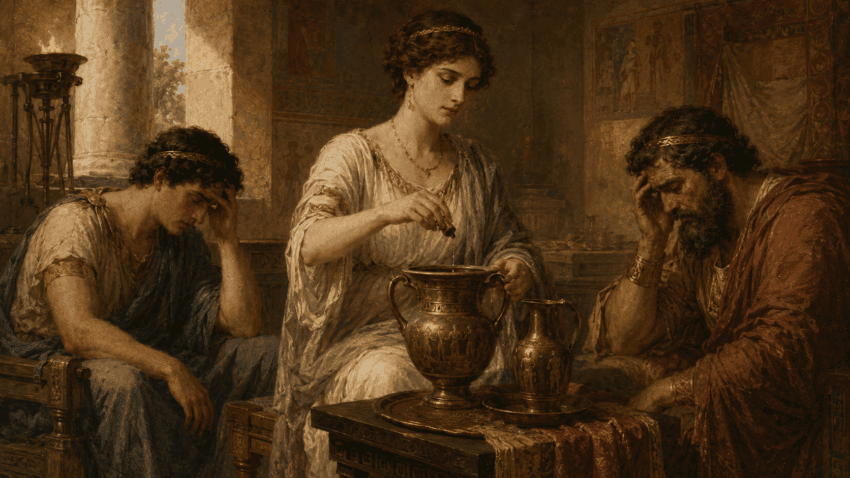
Helen mixes a mysterious calming substance into wine as the grieving Telemachus and Menelaus sit beside her in an ancient Greek palace, inspired by Book IV of Homer’s Odyssey.

Medicine Before Theory: What the Odyssey Already Knew

Posted on July 27, 2026August 9, 2026 by Michele Danilo Pierri

I went back to the Odyssey when Nolan’s film came out, for reasons that had nothing to do with medicine. I did not get far. Book I stopped me.

Odysseus, we are told almost in passing, once sailed to Ephyra to find a man named Ilus, son of Mermerus, and to ask him for a poison to smear on his bronze arrowheads. Ilus refused. Homer gives one reason: he feared the gods.

“He was then coming from Ephyra, where he had been to beg poison for his arrows from Ilus, son of Mermerus. Ilus feared the ever-living gods and would not give him any, but my father let him have some, for he was very fond of him.”

— Odyssey I, ≈ ll. 259–264

A dozen words or so, and inside them the whole architecture of a problem I spend a fair amount of time thinking about. A specialist holding knowledge that cuts both ways. Declining to release it. With no institution behind him and no theory to justify the refusal.

That is the thing about the Odyssey. We date Western medicine to the Hippocratic Corpus, fifth century BC, and for good reasons. But the poem is three centuries older and it already contains a functioning medical culture — one that lacks, entirely, any explanation of disease.

What is missing, and what is not

The absences are worth stating precisely, because they turn out to be the interesting part.

Disease in the Odyssey is nosos, undifferentiated. No clinical pictures, no humours, no systematic anatomy. Causation, where it appears at all, is an arrow shot by Apollo or Artemis: an external agent, but not a transmissible one. Nothing in the poem suggests that illness passes from person to person. Prognosis belongs to the seer rather than the healer. And there is no account, anywhere, of why a remedy works.

Now the other column. A named profession with a defined social status. A pharmacology with a classification, an antidote logic, and a professional taboo attached to it. A three-way etiology of death that includes a psychogenic category. A standardized regimen of recovery. Wound care performed, in the same breath, by technique and by incantation.

That combination is not an early stage of anything. It is a complete system that happens to be missing its theory, and it functioned in that condition for a very long time.

The healer as public craftsman

Book XVII. It is Eumaeus the swineherd who says it, which is itself worth a moment — the sociology of medicine is common knowledge here, not specialist knowledge. He lists the demioergoi, the men who work for the community and get called in from outside: the seer, the healer of ills (iatèr kakôn), the builder in wood, the inspired singer.

“Who is likely to invite a stranger from a foreign country, unless it be one of those who can do public service as a seer, a healer of hurts, a carpenter, or a bard who can charm us with his singing? Such men are welcome all the world over, but no one is likely to ask a beggar who will only worry him. You are always harder on Ulysses’ servants than any of the other suitors are, and above all on me, but I do not care so long as Telemachus and Penelope are alive and here.”

— Odyssey XVII, ≈ ll. 382–391

Read as a job description, it yields three things.

The healer is itinerant, and his competence is portable because it belongs to him rather than to a temple, a city, or a bloodline. He is recruited on reputation for skill. And he stands next to the seer without the slightest sense of contradiction.

That last point is the one most often mishandled. We tend to read the fifth-century separation of technique from divination as a discovery, as though someone had finally noticed that charms don’t work. Lloyd argued — convincingly, to my mind — that it was largely a professional manoeuvre. The author of On the Sacred Disease is not reporting a finding. He is attacking competitors. What the Odyssey preserves is the situation before that polemic, and in that situation the two are simply different tools.

The clearest instance is the boar hunt on Parnassus, Book XIX. Odysseus is gored in the thigh; the sons of Autolycus bind the wound skilfully — the adverb is there in the Greek, epistaménos — and then stop the dark blood with a charm. One sentence, two coordinated verbs, no tension whatsoever. Whoever composed that line saw no problem in it.

“The sons of Autolycus busied themselves with the carcass of the boar, and bound Ulysses’ wound; then, after saying a spell to stop the bleeding, they went home as fast as they could.”

— Odyssey XIX, ≈ ll. 455–458 [the Greek has dêsan epistaménôs, “they bound it expertly”, and epaoidê, “with an incantation”, governed by a single sentence; Butler’s paraphrase drops the adverb that carries the point]

The drug that is already double

Helen, Book IV, drops something into the wine so that Telemachus and Menelaus will stop weeping. Homer says what it does: abolishes grief and anger so completely that a man would not weep to see his own parents killed in front of him. He also says, unusually, where it came from. Egypt — where the soil bears many drugs, some beneficial and some baneful, and where every man is a physician.

“Then Jove’s daughter Helen bethought her of another matter. She drugged the wine with an herb that banishes all care, sorrow, and ill humour. Whoever drinks wine thus drugged cannot shed a single tear all the rest of the day, not even though his father and mother both of them drop down dead, or he sees a brother or a son hewn in pieces before his very eyes. This drug, of such sovereign power and virtue, had been given to Helen by Polydamna wife of Thon, a woman of Egypt, where there grow all sorts of herbs, some good to put into the mixing bowl and others poisonous. Moreover, every one in the whole country is a skilled physician, for they are of the race of Paeeon.”

— Odyssey IV, ≈ ll. 219–232

Two things there repay attention. First, a Greek poem conceding medical superiority to a foreign tradition, flatly, without defensiveness. Second, the classification itself: esthlá and lygrá, good and baneful, applied to the same category of substance. Which one you get depends on the mixture and on the hand that mixes it. Not on the substance.

Circe completes the structure. Her drug goes into a kykeon — cheese, barley meal, honey, Pramnian wine, a food vehicle rather than a pure rite — and produces a transformation in which the body changes while the mind, the text is explicit about this, stays intact. Hermes supplies moly against it. Black root, white flower, given before exposure.

“When she had got them into her house, she set them upon benches and seats and mixed them a mess with cheese, honey, meal, and Pramnian wine, but she drugged it with wicked poisons to make them forget their homes, and when they had drunk she turned them into pigs by a stroke of her wand, and shut them up in her pigsties. They were like pigs — head, hair, and all, and they grunted just as pigs do; but their senses were the same as before, and they remembered everything.”

— Odyssey X, ≈ ll. 234–243

“As he spoke he pulled the herb out of the ground and showed me what it was like. The root was black, while the flower was as white as milk; the gods call it Moly, and mortal men cannot uproot it, but the gods can do whatever they like.”

— Odyssey X, ≈ ll. 302–306

Known toxin, specific antidote, prophylactic timing, an expert who holds the knowledge. A complete pharmacological structure of thought, in a culture with no pharmacology.

Whether moly was anything in particular is a separate question, and here I would counsel caution. Plaitakis and Duvoisin proposed in 1983 that it was the snowdrop, Galanthus nivalis, whose bulbs contain galantamine — a centrally acting anticholinesterase, and therefore a plausible antagonist to the anticholinergic delirium that mandrake or henbane would produce. The reading is elegant, and it has been cited steadily for forty years; a 2024 paper by Molina-Venegas and Verano revisits it more cautiously, as an early ethnobotanical complex rather than a single species. My objection to the strong version is simple. It assumes the poet is reporting a pharmacological event, when the text insists on the opposite: the plant is hard for mortals to dig, and only the gods can manage everything. Attractive neuropharmacology, dressed as philology. What survives the objection is the structure — and the structure is worth more than the identification ever was.

Three ways to die

Book XI, in the underworld. Odysseus asks his mother’s shade what killed her, and he offers her the two standard options: a long illness, dolichè noûsos, or the painless arrows of Artemis.

“But tell me, and tell me true, in what way did you die? Did you have a long illness, or did heaven vouchsafe you a gentle easy passage to eternity?”

— Odyssey XI, ≈ ll. 170–173 [Butler flattens the second option; the Greek names it explicitly — ê dolichè noûsos, ê Artemis iochéaira / hois aganoîs beléessin, “either a long disease, or Artemis the archer, coming upon you with her gentle shafts”]

Look at the question rather than the answer. It presupposes a classification the audience needs no help with — protracted somatic disease on one side, sudden unexplained death on the other, coded as divine. Anticleia takes neither. She died, she says, of longing for her son.

“As for my own end it was in this wise: heaven did not take me swiftly and painlessly in my own house, nor was I attacked by any illness such as those that generally wear people out and kill them, but my longing to know what you were doing and the force of my affection for you — this it was that was the death of me.”

— Odyssey XI, ≈ ll. 197–203

Not a metaphor. The text gives no signal that it should be read as one. A third cause, selected by exclusion of the other two.

For a clinician this is the most striking passage in the poem, and I have gone back and forth on how much weight it can carry. Probably less than one would like. Still, the discrimination is there: grief named as a way of dying, distinguished from disease and from sudden death, in a text with no physiology in it at all. Twenty-eight centuries later we have takotsubo cardiomyopathy and a reasonably solid literature on excess mortality among the recently bereaved. The mechanism is ours. The observation was already made.

There is a companion passage in Book XV, easy to miss. The island of Syrie, where no wretched disease comes upon men; when they grow old, Apollo and Artemis kill them with their gentle arrows. A utopia defined by the abolition of nosos with senescence left intact — something close to what we now call compression of morbidity, arrived at from the opposite direction entirely.

“You may have heard of an island called Syra that lies over above Ortygia, where the land begins to turn round and look in another direction. It is not very thickly peopled, but the soil is good, with much pasture fit for cattle and sheep, and it abounds with wine and wheat. Dearth never comes there, nor are the people plagued by any sickness, but when they grow old Apollo comes with Diana and kills them with his painless shafts.”

— Odyssey XV, ≈ ll. 403–411

The sequence is the argument

Practice first. Professional identity, the two-sidedness of the remedy, ethical restraint: all in position while the explanatory theory was still entirely absent, and none of the three waiting for it. Medicine organized itself socially and morally long before it could say why anything worked. The theory, when it eventually arrived, arrived into a house that was already built.

I am not sure this is only a historical observation.

We are in a structurally similar position with clinical AI — and I say that as someone who works with these models on outcome prediction and watches them outperform risk scores I was trained to trust. Capability is outrunning explanation. The standard reflex, that theory must come first and that we cannot deploy what we cannot fully explain, has the sequence backwards relative to how medicine has actually behaved for most of its existence.

Something else has to come first. The profession’s own account of who is competent, of what the tool does in both directions, and of what the people holding it will refuse to do with it.

Ilus had no pharmacology to justify his refusal.

He refused anyway.

References

Text. Greek: T.W. Allen, Homeri Opera III–IV, Oxford Classical Texts. English: R. Lattimore (1965) for literalness, E. Wilson (2018) for readability. Italian: G. Aurelio Privitera, Fondazione Valla / Mondadori, still the best facing-text edition.

A note on the quotations. The English passages above are given in Samuel Butler’s prose translation (1900), which is out of copyright; line numbers refer to the Greek text and are approximate, since Butler’s prose does not follow the verse line by line. Where Butler’s paraphrase suppresses a detail the argument depends on — epistaménos at XIX.456, the arrows of Artemis at XI.172–173 — the Greek is restored in square brackets.

Foundational.

  • C. Daremberg, La médecine dans Homère, Paris 1865. Dated in its conclusions, indispensable as a catalogue of passages.
  • H. Frölich, Die Militärmedicin Homers, Stuttgart 1879. The wound statistics of the Iliad — about 147 injuries, lethality near 80%. Nothing comparable exists for the Odyssey, which is itself the point.
  • M.D. Grmek, Diseases in the Ancient Greek World, Johns Hopkins UP 1989. The methodological benchmark; explicit about what literary sources can and cannot support.

Magic, technique, and the word.

  • G.E.R. Lloyd, Magic, Reason and Experience, Cambridge 1979.
  • P. Laín Entralgo, The Therapy of the Word in Classical Antiquity, Yale 1970. Traces the line from the Homeric epode to Hippocratic persuasion.

Body and mind.

  • R.B. Onians, The Origins of European Thought, Cambridge 1951.
  • B. Snell, The Discovery of the Mind, 1953 (German original 1946) — and, against it, B. Williams, Shame and Necessity, California 1993, on the illegitimate inference from vocabulary to mental structure. Read the two together or neither.

Context and dating.

  • M.I. Finley, The World of Odysseus, 2nd ed. 1977.

Moly, and the limits of retrodiagnosis.

A. Plaitakis, R.C. Duvoisin, “Homer’s moly identified as Galanthus nivalis L.: physiologic antidote to stramonium poisoning”, Clin Neuropharmacol 1983;6(1):1–6.

R. Molina-Venegas, J. Verano, J Ethnobiol Ethnomed 2024;20:11.

J. Scarborough, “The pharmacology of sacred plants, herbs and roots”, in Magika Hiera, Oxford 1991.

A. Cunningham, “Identifying disease in the past: cutting the Gordian knot”, Asclepio 2002;54:13–34, and P.D. Mitchell, Int J Paleopathol 2011;1(2):81–88. The two poles of the argument over whether modern diagnosis can be applied backwards at all. Worth reading before enjoying the moly literature too much.

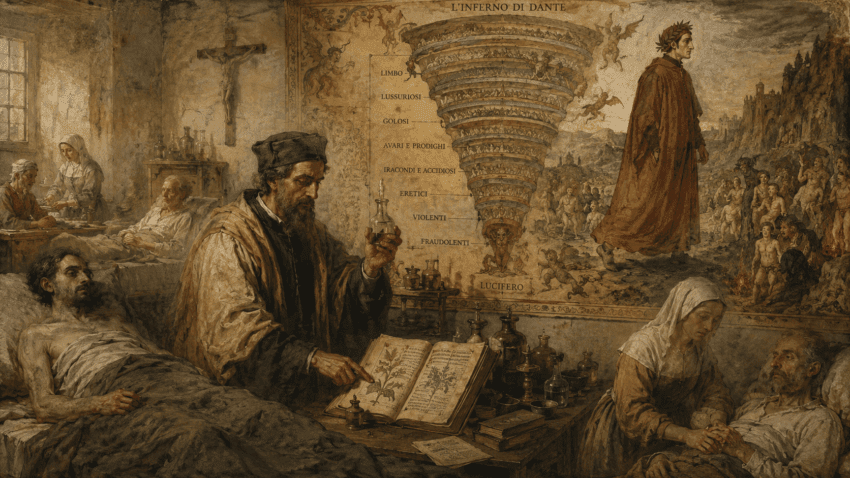
Historical medical illustration showing a medieval physician examining patients in a hospital ward, with a large mural of Dante’s Inferno behind him, connecting disease, clinical observation, and medieval visions of suffering.

Dante’s Inferno as a Clinical Gaze

Posted on June 21, 2026August 9, 2026 by Michele Danilo Pierri

Summary
Dante Alighieri’s Inferno is a theological poem, yes, but it is also, almost incidentally, a forensic catalogue of medieval disease and healthcare. This article reads the poem through the lens of medical history: how Dante represents specific pathologies (dropsy, scabies and possibly leprosy, neurological deformity, hypothermia, traumatic mutism), how he mimics diagnostic observation, and how his text preserves early traces of public health thinking, from miasma theory and summer hospitals to quarantine imagery and the dread of mass burial. Original Italian passages appear alongside English translations throughout, so the reader moves from Malebolge’s stench to the frozen lake of Cocytus more or less as one would move through a fourteenth-century anatomical theatre.


Introduction: The Body as Witness

When Dante descends into Hell in the spring of 1300, he brings with him a theologian’s moral map, certainly, but also the observational habits of someone steeped in the medical knowledge of his day. The Inferno is full of bodies: broken, swollen, scratched, twisted, frozen. Each punishment carries a moral charge, a manifestation of sin. And yet the language describing these bodies is precise, almost clinical, and it betrays a familiarity with humoral theory, surgical practice and the ordinary reality of disease in medieval Italy.

For a historian of medicine, the poem turns into an odd kind of primary source. It records how late-medieval people recognised illness by sight. It names the institutions where the sick were gathered. It encodes widespread beliefs about how environment and stench produced epidemics. And, more tentatively, it reflects a world already organising itself around isolation, contagion and environmental risk, however crude that organisation still was. What follows is divided into three parts: the interpretation of pathology, the act of diagnosis, and the evidence for early public health. None of these categories is watertight; Dante mixes them freely, as poets do.


1. Illness as Divine Punishment: The Medical Semiotics of Sin

In the Inferno, damnation is written on the body. What is striking is that the signs Dante chooses are recognisable clinical pictures, sometimes accurate enough that physicians have retroactively tried to diagnose the damned.

1.1 Dropsy and the Falsifiers of Coin: Maestro Adamo (Inf. XXX)

Among the most medically detailed portraits is Maestro Adamo, counterfeiter of florins, condemned to the tenth bolgia. He shows severe anasarca:

La grave idropesì, che sì dispaia
le membra con l’omor che mal converte,
che ’l viso non risponde a la ventraia,
faceva lui tener le labbra aperte
come l’etico fa, che per la sete
l’un verso ’l mento e l’altro in sù rinverte.
(Inf. XXX, 52–57)

(The heavy dropsy, which so mismatches the limbs with ill-converted humors that the face does not correspond to the belly, made him hold his lips apart like a consumptive does, thirst twisting one lip toward the chin, the other upward.)

Dante is working explicitly within the humoral model here: dropsy arises when the body’s “omor” (phlegm, a cold, wet humor) fails to convert properly and pools in the peritoneal cavity, producing a drum-like abdomen over wasted legs. The reference to “etico” (hectic fever, often tuberculosis) ties the hydropic’s unquenchable thirst to the wasting diseases of the period. There is a kind of poetic justice in the choice of punishment: the man who falsified the right measure of coinage now carries an excess of corrupted fluid in his own body.

1.2 Dermatoses, Scabies and Leprosy: The Alchemists’ Plague (Inf. XXIX)

In the same bolgia, Dante meets the alchemists, their skin ravaged by an itching so violent it turns into a desperate, almost mechanical dance:

e sì traevan giù l’unghia la scabbia,
come coltel di scardova le scaglie
o d’altro pesce che più larghe l’abbia.
(Inf. XXIX, 82–84)

(and they dragged their nails over the scabs, just as a knife scales a bream or some other fish with larger scales.)

“Scabbia” is clinically specific enough, but the image of crusts torn off like fish scales, the pus, the relentless scratching, suggests something more severe than ordinary scabies. Possibly leprosy. The word “lebbra” doesn’t appear in this exact passage, but it lingers in the background of the canto: Capocchio, another falsifier, complains using a proverb that only makes sense if leprosy was a familiar sight to Dante’s readers (“poi ch’al lebbroso pria che l’avemaria / non si può far, se non con una limaccia”, Inf. XXIX, 124–126: since one cannot make a leper before the Ave Maria, except with a slug). Leprosy carried heavy moral stigma in this culture. The flaking, scab-covered skin of the damned mirrors their sin of altering surfaces, whether of metals or of one’s own identity.

1.3 Neurological Deformity: The Diviners’ Twisted Necks (Inf. XX)

The diviners, augurs and fortune-tellers walk with their heads rotated a full 180 degrees, so their tears run down their backs:

ché da le reni era tornato ’l volto,
e in dietro venir li convenia,
perché ’l veder dinanzi era lor tolto.
(Inf. XX, 13–15)

(for their faces were turned toward their loins, and they had to come backwards because seeing forward was denied them.)

This reads, medically, as a permanent torticollis or something close to cervical dystonia, a neurological insult that locks the neck muscles beyond voluntary control. A medieval observer would have taken a contorted body as the outward sign of an inwardly perverted will; that is the logic at work. The diviners claimed to see the future, so now their heads face permanently backward and their walk is forever retrograde. It is a pre-modern way of treating neurological deficit not as mechanical failure but as a physical cipher for disordered reason. Whether Dante had a specific clinical case in mind or was simply extrapolating from common deformities he had observed remains, frankly, unclear.

1.4 The Frozen Lake: Clinical Hypothermia in the Cocito (Inf. XXXII–XXXIII)

The traitors sit immersed in ice, and their symptoms read like a textbook case of progressive hypothermia. First comes thermoregulatory shivering:

mettendo i denti in nota di cicogna
(Inf. XXXII, 36)

(chattering their teeth to the tune of storks)

Then the freezing of tears, sealing the eyes and trapping anguish inside the skull:

lo pianto stesso lì pianger non lascia,
e ’l duol che truova in su li occhi rintoppo,
si volge in entro e fa crescer l’ambascia.
(Inf. XXXIII, 46–48)

(the very weeping there does not let them weep, and the pain that finds an obstacle on the eyes turns inward and increases the anguish.)

Pallor, shivering, then ice-locked tears, then rigid and livid flesh: the sequence tracks the physiology of cold death reasonably well, a fate well known to shepherds, soldiers on winter campaigns, the urban poor. Dante turns a common cause of death into an eternal moral congelation.

1.5 Suicides and the Body Torn Apart (Inf. XIII)

The suicides, transformed into thorny trees, can speak only when a branch snaps. The wound releases words and blood together:

sì de la scheggia rotta usciva insieme
parole e sangue; ond’io lasciai la cima
cadere, e stetti come l’uom che teme.
(Inf. XIII, 43–45)

(so from the broken splinter came forth at once words and blood; I let the tip fall and stood like a man afraid.)

In humoral medicine, body and soul were axiomatically one. Suicide was a violent dissociation of that unity, so the punishment inverts it: the soul is locked inside a plant body that cannot speak without being fractured. The bleeding speech externalises something close to what we’d now call the traumatic aftermath of self-violence, though it would be a stretch to call this a clinical diagnosis in any strict sense. It is closer to a metaphor for the medico-philosophical bond between body and soul, one that speaks directly to how medieval culture saw self-inflicted death: as the ultimate pathology of the will.


2. Diagnosis and the Clinical Gaze in Hell

Dante doesn’t just catalogue diseases. He behaves like an observer who inspects, compares and names what he sees. His eye is semiotic: it reads bodies for signs, the way a clinician reads a chart.

2.1 The ‘Spedali’ of the Marshes: Early Nosocomial Observation (Inf. XXIX, 46–49)

To convey the overwhelming stench of the tenth bolgia, Dante reaches for a remarkably concrete image:

Qual dolor fora, se de li spedali
di Valdichiana tra ’l luglio e ’l settembre
e di Maremma e di Sardigna i mali
fossero in una fossa tutti ’nsembre…
(Inf. XXIX, 46–49)

(What pain would there be if all the sick from the hospitals of Valdichiana between July and September, and from Maremma and Sardinia, were gathered together in one ditch…)

These “spedali” weren’t hospitals in any modern sense. They were seasonal shelters where malaria patients (the “malarici”) were concentrated during the hottest months. Valdichiana, the Maremma, the Sardinian lowlands: all notorious for mala aria and endemic tertian and quartan fevers. By 1300, then, specific sites already existed where the sick were collected, observed and, at least in principle, kept apart from the healthy. It’s an early, embryonic nosocomial system, one that already linked pathology to season and place, even if no one would have called it that at the time.

2.2 Dante’s Diagnostic Eye: The Semiotics of the Body

Throughout the Inferno, Dante practises something close to medical inspection. He notes skin colour (livid, pallid, flushed), the pattern of breathing, the pulse of veins, the manner of walking, the response to pain. Maestro Adamo’s belly distends “a guisa di lëuto” (like a lute, Inf. XXX, 49), his lips gape asymmetrically from thirst, and the description is precise enough that it could almost have come from a dissection manual, or from a bedside observation note. This is the semeiotica of the Middle Ages: a science of reading the exterior as a map of interior imbalance.

Nowhere in Hell does a physician appear as a character. And yet the poet himself becomes the diagnosing eye, guided by reason (Virgil) and by faith. The clinical gaze that would later define the anatomical theatre finds an early, unintentional echo in these stinking circles, where every body functions as a text waiting to be read.


3. Public Health in the City of Dis: Miasmas, Isolation and Burial

The most surprising medical inheritance in the Inferno may not be the pathology of individuals at all, but the collective imagery: environmental risk, isolation, burial practices. Fragments of a worldview that would later crystallise into something resembling public health policy.

3.1 The Stench of Malebolge and Miasmatic Theory

From the moment Dante enters Lower Hell, the sensory assault never lets up. The air itself is pathogenic:

lo tristo fiato e lo sprazzo e ’l lezzo
che suol venir de le marcite membre
(Inf. XXIX, 50–51)

(the foul breath and the splash and the stench that usually come from rotting limbs)

He has to cover his nose with his hands, filtering the air through his own clothing, and this isn’t simply theatrical disgust. In pre-microbial epidemiology, stench (puzzo, lezzo) was thought to cause pestilence directly, the miasmatic vehicle through which putrefaction entered the body via respiration. The Inferno’s moral geography doubles as a map of environmental contamination: the deeper one goes, the heavier the air, the closer to the source of universal corruption.

3.2 Quarantine Avant la Lettre: The Summer Hospitals

Return to the spedali mentioned above. Their function was seasonal and selective: the mali of the marshes were gathered into specific buildings during July through September, exactly when the miasma rising from stagnant water was thought most dangerous. Concentrating the sick in a defined place served two purposes at once, rudimentary care and, arguably more importantly, separation from the healthy. These spedali weren’t lazarettos. But they look like a clear antecedent: an early, if imprecise, intuition that concentrating disease might limit its spread, even when the underlying mechanism was framed in miasmatic rather than contagious terms.

3.3 Open Tombs and Epidemic Fear (Inf. IX–X)

The city of Dis is ringed by walls, towers and devils who refuse entry, the image of a fortress-city under lockdown. Inside, the heretics lie in open, burning sepulchres:

La gente che per li sepolcri giace
potrebbesi veder? già son levati
tutt’i coperchi, e nessun guardia face.
(Inf. X, 7–9)

(The people lying in the tombs could be seen? Already all the lids are lifted, and no guard is keeping them.)

To a fourteenth-century reader, uncovered graves were inseparable from the panic of mass death. Chronicles of famine and plague describe hurriedly opened pits, bodies thrown in without proper rites, the earth itself violated. Dante’s image of Arles and Pola, where “i sepulcri tutt’ il loco varo” (the tombs make the whole place uneven, Inf. IX, 115–117), evokes the landscape of necropolises born of epidemics. And the fact that the tombs stand open while the city itself is fiercely guarded produces a striking image of quarantine: the contagion, moral or physical, is contained and terrifyingly visible at once.

3.4 Stagnant Waters as Sources of Disease (Inf. VII–VIII)

The Styx, a fetid marsh where the wrathful are submerged, is described explicitly as a source of miasma:

Quelli è ’l palude che ’l gran puzzo spira,
che cinge la città dolente intorno.
(Inf. VII, 109–110)

(That is the marsh that exhales the great stench, which girds the dolorous city round about.)

Swamps and stagnant water were the primary environmental culprits in the epidemiology of the period. The Maremma, the Valdichiana, the Sardinian lowlands, the very places named for the spedali, were paradigmatic examples of how “bad air” rising from marshland induced fevers. By placing the Styx as a ring around inner Hell, Dante reinforces a link between corrupted water, corrupted air and corrupted souls; the same collective fear, incidentally, that drove land-reclamation projects and urban planning across late-medieval Tuscany.


Conclusion: The Poem as a Health Archive

Read as a medical document, the Inferno shows a world standing right at the threshold of modern epidemiology. Its bodies are diagnosed in a language borrowed from humoral pathology and surgical observation. Its hospitals, primitive as they were, hint at a fledgling public health consciousness, one that links season, place and disease and practises a rough form of isolation. Its landscapes of stench, marsh and open grave carry a miasmatic terror that would dominate European thinking for centuries afterward.

Dante did not set out to write a medical treatise; that much is obvious. And yet, as this reading suggests, the Commedia embeds an extraordinary amount of health-related data. For the medical historian, the Inferno works as a kind of archive, not just of the diseases that afflicted medieval communities, but of how those communities saw, named, separated and moralised the sick. Within Hell’s circles, the medicine of the Middle Ages stays permanently on display, and it still has something to say to anyone willing to read it that way.

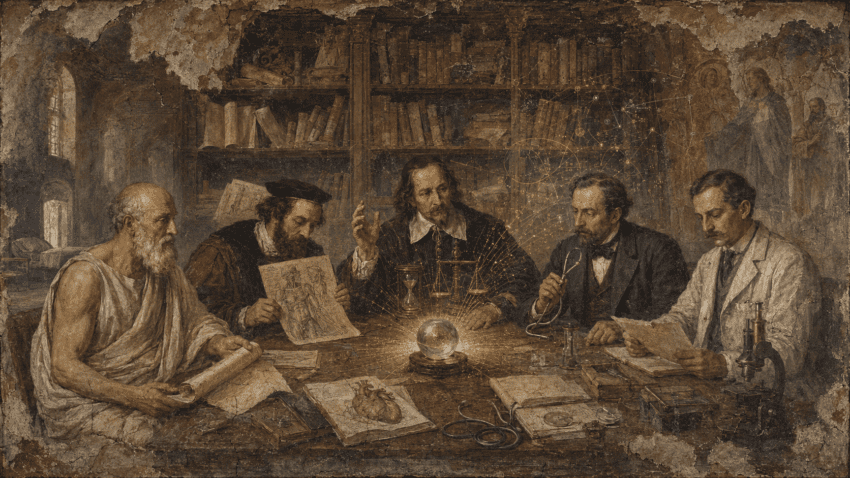
a solemn council / meeting of physicians, gathered around a large wooden table, each doctor representing a different era of medical “seeing”.

From Hippocrates to Artificial Intelligence

Posted on May 27, 2026August 9, 2026 by Michele Danilo Pierri

I am a cardiac surgeon. My work is rooted in the operating room, in clinical decisions, and in the care of individual patients. At the same time, I have become deeply interested in medical data, statistics, coding, and artificial intelligence. My fascination with the history of medicine, however, has remained just as strong. At first glance, these interests may appear distant: ancient medical texts on one side, machine learning pipelines on the other. Yet the more I have studied the history of medicine, the more that separation has dissolved.

Medicine has always been technological.

Not only because it uses instruments, but because every era has developed new ways of seeing. The Hippocratic physician used observation as a technology of attention. Vesalius used dissection and illustration to reopen the human body to direct evidence. Harvey used experiment and quantitative reasoning to transform the heart from a symbolic organ into a pump. Morgagni connected symptoms to anatomical lesions. Virchow moved disease into the cell. Laennec made the body audible through the stethoscope. Lister and Koch made infection visible through the logic of germs. Modern clinicians use laboratory data, imaging, risk scores, electronic records, medical coding, and now artificial intelligence.

Each era had its own way of making the invisible visible.

This is why the great books of medicine are not simply historical monuments. They are records of changing perception. They show how physicians learned to look differently: at the patient, at the body, at disease, at evidence, and eventually at data.

Today, when we apply code, statistics, and machine learning to medicine, we are not abandoning the medical tradition. We are entering a new phase of it.

Thesis: the history of medicine can be read as a history of technologies of perception—instruments and methods that repeatedly change what counts as evidence, and therefore what can be seen.

In what follows, I sketch a compressed itinerary from Hippocratic bedside observation to digital medicine, ending with artificial intelligence as another instrument of visibility—powerful, but not self-justifying.

Medicine as a History of Seeing

Historical eraDominant instrument or methodWhat became visible
Hippocratic medicineBedside observationThe clinical course of disease
Classical and medieval medicineCompilation, commentary, classificationMedical knowledge as an organized tradition
Renaissance anatomyDissection and anatomical illustrationThe structure of the human body
Early modern physiologyExperiment and quantitative reasoningThe dynamic function of organs
Pathological anatomyAutopsy and clinicopathological correlationThe anatomical seat of disease
Clinical medicineBedside examination, auscultation, teaching hospitalThe patient as a clinical pattern
Cellular pathologyMicroscope and histologyDisease at the cellular level
Microbiology and antisepsisCulture, staining, germ theory, surgical hygieneInvisible infectious agents
Modern internal medicineLaboratory data, imaging, textbooks, evidenceThe measurable patient
Digital medicineElectronic health records, coding, statistics, AIPatterns, predictions, trajectories, and hidden phenotypes

To read the rest of this essay, keep three recurring moves in mind:

  • A new interface (a tool, a method, a representational technology).
  • A new object of knowledge (what becomes visible: lesion, cell, microbe, trajectory).
  • A new risk of reduction (what is lost when the new object becomes the whole story).

The Hippocratic Tradition: Seeing the Patient

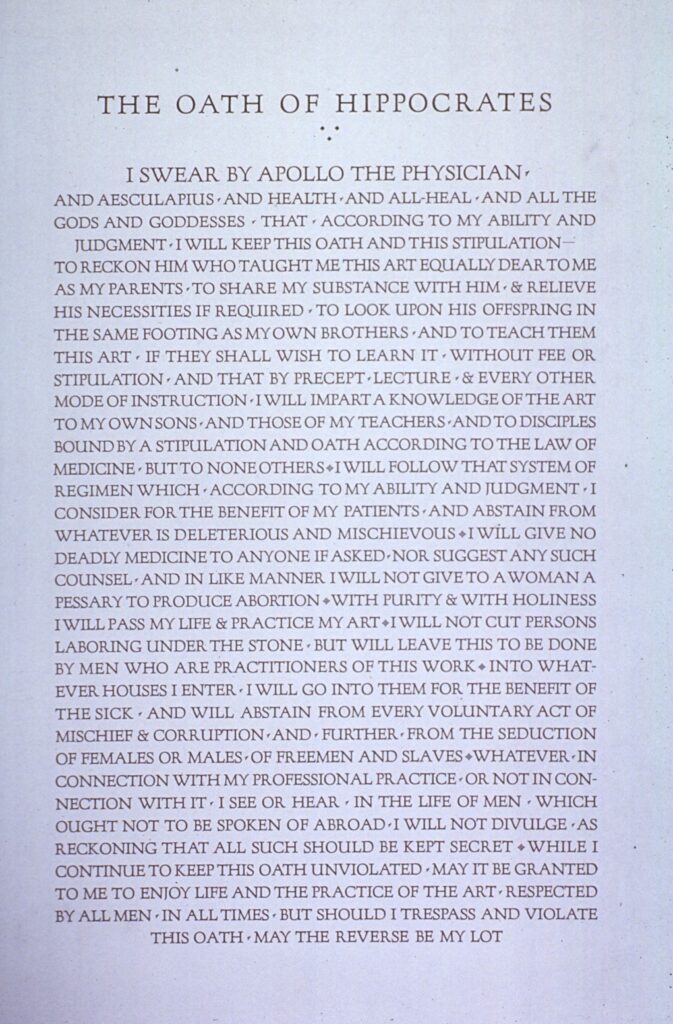
The Hippocratic Oath is probably the most recognizable medical text in Western history. Its authorship and precise date remain uncertain; attributing it to Hippocrates as a single identifiable author is, at best, a useful convention. Still, its symbolic weight is considerable: it presents medicine not merely as a technical practice, but as a moral profession governed by obligations toward patients, teachers, colleagues, and the wider community of physicians. The Oath is commonly dated to the classical Greek period, though its exact origin continues to be debated. (einsteinmed.edu)

The Oath of Hippocrates

Yet the Oath alone does not capture Hippocratic medicine. The broader Hippocratic Corpus includes writings on prognosis, epidemics, environment, diet, and clinical observation. Illness becomes, in these texts, something that can be observed, described, compared, and followed over time. Medicine here begins to separate itself from magical or purely religious explanations of disease.

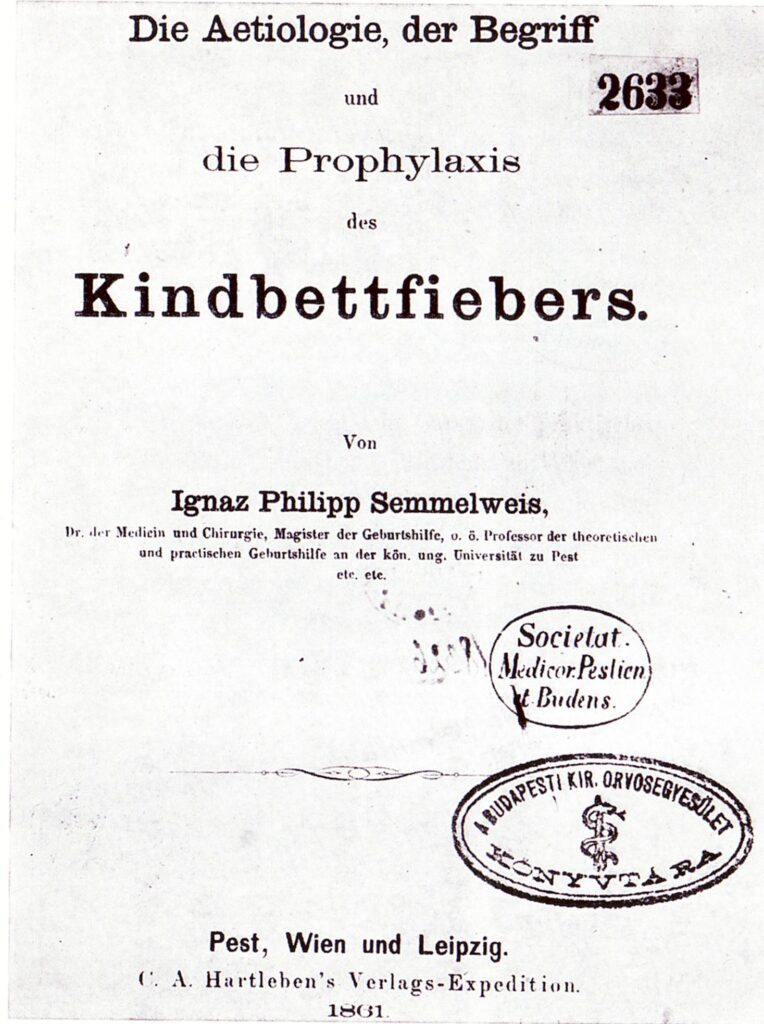
What preceded that separation is worth looking at directly: the Homeric poems already describe a working medical culture — wound care, drug knowledge, practitioners with recognised standing — with no theory of disease behind any of it.

This is the first great transformation of medical vision: the patient becomes a temporal phenomenon. Disease is not only a state; it is a course. The physician must watch, remember, compare, and anticipate.

In that sense, the Hippocratic physician already thinks in trajectories.

Celsus, Dioscorides, Galen, and Avicenna: Seeing Medicine as Organized Knowledge

Aulus Cornelius Celsus’ De Medicina, written in the first century CE, is one of the most important surviving Latin medical texts from antiquity. It covers general medicine, pharmacology, surgery, and bone disease, preserving one of the great organized accounts of ancient medical knowledge. Celsus is also associated with the classical signs of inflammation: redness, swelling, heat, and pain. (historyofinformation.com)

In De Materia Medica, Dioscorides organized medicinal substances derived from plants, minerals, and animals. For centuries, this kind of writing shaped the way physicians and healers thought about therapy: treatment was inseparable from careful observation of the natural world.

Galen then created one of the most powerful medical systems in history. His works integrated anatomy, physiology, humoral theory, therapeutics, and philosophy into a structure coherent enough to dominate European and Islamic medicine for centuries. Even when later physicians corrected him, they typically did so by first arguing with him. His importance lies not only in what he got right, but in the intellectual architecture he provided.

Avicenna’s Canon of Medicine, completed in the early eleventh century, became one of the most influential medical textbooks ever written. Through Latin translation it entered European medical education and remained authoritative for centuries. (biodiversitylibrary.org)

This era teaches a lesson that is easy to overlook. Before medicine can become experimental, it must become transmissible. Knowledge has to be collected, ordered, taught, and criticized.

In modern terms, this is the age of medical databases before databases existed.

Vesalius: Seeing the Body

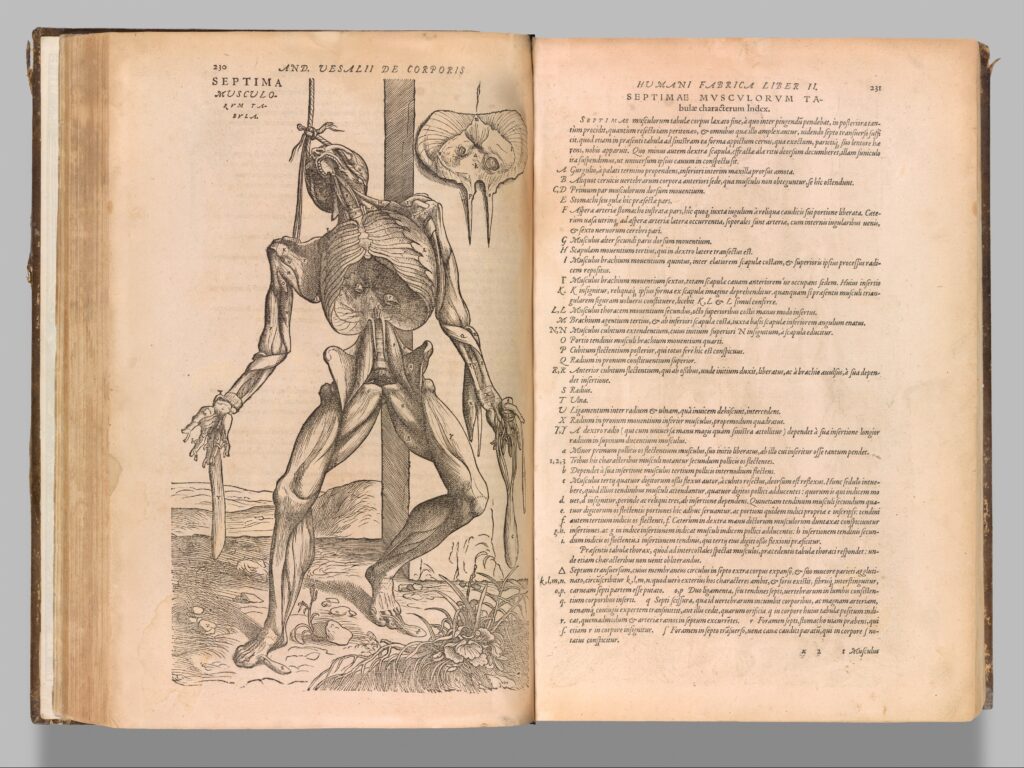
The publication of Andreas Vesalius’ De humani corporis fabrica libri septem in 1543 marks one of the decisive moments in the history of medicine. The work was not simply an anatomical atlas. It changed the authority structure of medical knowledge. The National Library of Medicine presents Vesalius’ Fabrica as a landmark of historical anatomy, notable for its detailed anatomical woodcuts and its insistence on direct engagement with the dissected body. (nlm.nih.gov)

Andreas Vesalius' De humani corporis fabrica libri septem
http://www.metmuseum.org/Collections/search-the-collections/358129

For centuries, anatomy had been mediated through ancient authorities, Galen above all. Vesalius did not merely add new details. He placed the human body itself back at the center of medical truth.

The intellectual gesture was radical: when the text and the body disagree, the body must be observed again.

This is one of the deep roots of modern medicine. The physician is no longer only a reader of inherited knowledge. He becomes an observer, a dissector, a verifier. Vesalius transformed anatomy into a visual and empirical science.

In the history of medical seeing, this is the moment when the body becomes an object of direct evidence.

Harvey: Seeing Function

In 1628, William Harvey published Exercitatio Anatomica de Motu Cordis et Sanguinis in Animalibus, commonly known as De Motu Cordis. The work demonstrated the circulation of blood and the pumping function of the heart, and it is widely regarded as one of the foundational texts of modern physiology. (PMC)

Harvey’s importance is not only cardiovascular. It is methodological.

He did not simply describe the heart. He reasoned about it quantitatively. He asked how much blood the heart could eject per beat, whether the older Galenic model was physically plausible, and how venous valves behaved under pressure. He used observation, experiment, calculation, and mechanical reasoning together, in a way that still feels unmistakably modern.

For a cardiac surgeon, Harvey is not a remote historical figure. He belongs to the conceptual ancestry of hemodynamics, cardiac output, venous return, and circulatory physiology. I find it striking, when reviewing post-bypass hemodynamic data, that the fundamental framework we use is still recognizably Harveyan, nearly four centuries later.

Vesalius taught medicine to see structure. Harvey taught medicine to see function.

Boerhaave and the Teaching Hospital: Seeing the Clinical Pattern

Herman Boerhaave is often associated with the rise of clinical teaching in early eighteenth-century Leiden. The text in the original list, Observationes Medicae, is less representative of his historical role than Institutiones medicae and Aphorismi de cognoscendis et curandis morbis, published in 1708 and 1709 respectively. Britannica lists these among his principal works and emphasizes their wide use during and after his lifetime. (britannica.com)

Boerhaave’s significance lies in the transformation of medicine into a teachable clinical discipline. The patient was no longer only an individual case, nor only an illustration of a theoretical system. The patient became part of a reproducible educational method.

The hospital became a classroom. The bedside became a site of disciplined observation. The clinical case became a unit of knowledge.

This shift still shapes how medicine is practiced and taught today, even when we no longer trace it back to Leiden. Modern ward rounds, case presentations, morbidity and mortality conferences, and clinical reasoning exercises all preserve something of this tradition, often without anyone in the room being aware of it.

Morgagni: Seeing the Lesion

Giovanni Battista Morgagni’s De sedibus et causis morborum per anatomen indagatis, published in 1761, is one of the foundational works of pathological anatomy. Its central move was to correlate clinical histories with post-mortem anatomical findings. Disease was no longer only a general disturbance of the body. It had a seat. It could be localized. (sciencedirect.com)

This changed clinical reasoning profoundly.

Symptoms became clues pointing toward internal lesions. Autopsy became a method for verifying diagnosis. The clinic and the dissecting room became connected.

Modern imaging still operates inside this Morgagnian framework. CT, MRI, echocardiography, angiography, PET, and ultrasound all continue to ask a very old question in technologically new ways:

Where is the lesion?

Morgagni taught medicine to connect the story of the patient with the geography of the body.

Jenner: Seeing Prevention

Edward Jenner’s An Inquiry into the Causes and Effects of the Variolae Vaccinae, published in 1798, belongs to another great transformation: prevention becomes one of medicine’s most powerful instruments. Jenner’s work on cowpox and smallpox vaccination did not rest on modern immunology, which did not yet exist as a discipline, but it opened the path toward vaccination, public health, and the idea that disease could be prevented before it appeared. (resource.nlm.nih.gov)

This is a different kind of medical vision. The physician is no longer looking only at the sick body. He is looking at future disease.

Vaccination changes the temporal structure of medicine. The target is not only the present lesion, but the avoided event. A prevented death, a prevented epidemic, a prevented complication: these are invisible successes. And precisely because they are invisible, they tend to be undervalued, both clinically and politically.

Modern risk prediction, screening, population health, and artificial intelligence all inherit this preventive logic, whether or not we acknowledge it explicitly.

Laennec: Hearing the Invisible

René Laennec’s De l’auscultation médiate, published in 1819, introduced the stethoscope and transformed thoracic examination. The body became audible in a new way. Sounds from the chest could now be correlated with internal pathology, particularly diseases of the heart and lungs. (ajconline.org)

The stethoscope did not replace clinical judgment. It extended it. It created a new interface between the physician and the hidden body.

Auscultation also changed the ritual of the clinical encounter. The physician listened not only to the patient’s words, but to the patient’s organs. There is something worth preserving in that gesture, I think, even as we accumulate ever more sophisticated imaging data and remote monitoring systems.

In modern technological medicine, we tend to assume that instruments distance us from the patient. Laennec reminds us that instruments can also create new forms of intimacy.

Virchow: Seeing the Cell

Rudolf Virchow’s correct landmark text is Die Cellularpathologie in ihrer Begründung auf physiologische und pathologische Gewebelehre, published in 1858. Virchow’s concept of cellular pathology made the cell the fundamental unit of disease. (christies.com)

After Morgagni, disease had an organ.

After Virchow, disease had a cellular substrate.

This transition is more consequential than it might initially appear. The lesion was no longer only visible to the naked eye at autopsy. It could be microscopic, requiring instruments, staining, histological preparation, and trained interpretation. Medicine moved down in scale, and the tools had to follow.

This shift still underlies pathology, oncology, hematology, inflammatory disease, transplantation medicine, and much of contemporary biomedical reasoning. What Virchow established in the mid-nineteenth century, we are still elaborating and extending.

Virchow taught medicine that the most important lesion may be invisible until technology changes the scale of vision.

Semmelweis, Lister, and Koch: Seeing Infection

The nineteenth century transformed medicine’s understanding of infection. The process was neither smooth nor linear.

Ignaz Semmelweis’ work on puerperal fever showed that hand hygiene could dramatically reduce maternal mortality, though his ideas were resisted during his lifetime with a stubbornness that remains, in retrospect, difficult to fully account for. Joseph Lister’s On the Antiseptic Principle in the Practice of Surgery, published in 1867, applied antiseptic principles to surgical practice and helped transform surgery from a frequently lethal intervention into a safer therapeutic discipline. (PMC)

Ignaz Semmelweis' work on puerperal fever

Robert Koch’s work on tuberculosis, presented in 1882, made the tubercle bacillus visible and helped establish a new model of infectious causation. The consequences for microbiology, public health, and the etiological understanding of disease were far-reaching. (germanhistory-intersections.org)

Before germ theory, infection was often explained through miasma, constitutional weakness, bad air, or poorly defined contamination. After microbiology, disease could be linked to specific organisms, specific routes of transmission, and specific preventive measures.

For any surgeon, this is not simply history. It is the foundation of the operating room. Every sterile field, every preoperative antibiotic, every isolation protocol traces back, however indirectly, to this era.

Claude Bernard: Seeing Experimentally

Claude Bernard’s Introduction à l’étude de la médecine expérimentale, published in 1865, is one of the great methodological texts of modern medicine. Bernard helped define medicine as an experimental science, not merely an accumulation of clinical impressions. (sciencedirect.com)

His contribution is epistemological.

Observation is necessary, but not sufficient. The physician-scientist must formulate hypotheses, design experiments, control conditions, interpret results, and remain alert to the difference between association and causation. These are not trivial demands; they become harder, not easier, when the datasets grow large.

This remains directly relevant to modern medical data science. A machine learning model can identify patterns with high statistical confidence. But medicine still needs to ask whether those patterns are meaningful, causal, generalizable, and clinically useful. These are not algorithmic questions. They require human judgment.

Bernard reminds us that better data do not automatically produce better reasoning.

Osler, Harrison, and the Modern Clinical Textbook

William Osler’s The Principles and Practice of Medicine, first published in 1892, and Harrison’s Principles of Internal Medicine, first published in 1950, belong to a different category from Vesalius, Harvey, Morgagni, or Virchow. They are not books of a single discovery. They are architectures of clinical knowledge. (archive.org)

Osler represents the humanistic and bedside tradition of modern clinical medicine. Harrison represents the increasingly pathophysiological, laboratory-based, and systematic organization of internal medicine. Later editions of Harrison explicitly reflect the transformation of medicine through molecular genetics, imaging, robotics, bioinformatics, and information technology. (accessmedicine.mhmedical.com)

William Osler's The Principles and Practice of Medicine

These books show that modern medicine is not only a collection of discoveries. It is also a teaching system. A good textbook does not merely contain knowledge. It trains a way of thinking.

Mukherjee: Seeing Disease as Biography

Siddhartha Mukherjee’s The Emperor of All Maladies: A Biography of Cancer, published in 2010, is not a foundational scientific treatise in the same sense as Harvey’s or Virchow’s work. It is something different: a modern narrative history of cancer as a biological, clinical, scientific, social, and human phenomenon. It won the Pulitzer Prize for General Nonfiction. (Wikipedia)

Its place in a list of medical classics is defensible only if we understand the list broadly, and I think we should.

Modern medicine does not only need discoveries. It also needs memory, and narratives capable of connecting laboratory science, clinical practice, patient suffering, public policy, and cultural imagination. Cancer is not only a cellular disease. It is also a historical experience, a therapeutic battlefield, a social fear, and, for many patients I have known, an entirely personal catastrophe.

Mukherjee’s book reminds us that medicine must see not only mechanisms, but lives.

From Medical Texts to Medical Data

The history of medicine can be read as a history of changing visibility.

The Hippocratic physician saw the course of disease. Vesalius saw the anatomical body. Harvey saw circulation. Morgagni saw the lesion. Virchow saw the cell. Koch saw the microbe. Osler saw the clinical patient. Harrison saw the patient through pathophysiology, laboratory medicine, and organized internal medicine.

Today, digital medicine asks us to see something else: patterns distributed across data.

Electronic health records, ICD codes, laboratory time series, imaging datasets, operative notes, discharge summaries, wearable sensors, and genomic information are producing a new kind of medical object. Not simply the patient at the bedside, not simply the organ, not simply the cell, but the patient as a trajectory through complex systems of data.

This is where coding and artificial intelligence enter the story. Medical coding is not just administrative work. It is one of the ways medicine translates clinical reality into structured information. Machine learning, at its best, is a method for detecting patterns that are too complex, too distributed, or too subtle for ordinary clinical perception.

In practice, this “trajectory view” shows up in concrete clinical tasks. We use models (formal or informal) to recognize syndromes and phenotypes that are not single lesions but composite patterns—think of heterogeneous entities such as sepsis, ARDS, or HFpEF. We try to anticipate events before they declare themselves (AKI, decompensation, readmission risk). And we increasingly use NLP to extract latent structure from free text—operative notes, discharge summaries, and the narrative fragments that still carry clinical meaning after coding has done its work.

But the lesson of history is clear: every new way of seeing also creates new risks. Texts can become dogma. Anatomy can reduce the patient to a body. Pathology can reduce disease to a lesion. Laboratory medicine can reduce illness to numbers. Artificial intelligence can reduce clinical reality to patterns without meaning.

The task is not to reject technology. The task is to keep technology inside medicine.

Conclusion: Artificial Intelligence as Another Chapter in an Old Story

The future of medicine will not replace the history of medicine. It will extend it.

Artificial intelligence is not the opposite of clinical tradition. It is one more instrument in the long human effort to see disease more clearly, act earlier, and understand the patient more completely. Whether it will fulfill that potential remains, as of now, genuinely uncertain.

The great books of medicine matter because they remind us that medicine has never been static. It has always changed when physicians found new ways to observe, represent, measure, classify, and interpret disease.

From the Oath to the anatomical atlas, from the autopsy table to the microscope, from the stethoscope to the laboratory, from the textbook to the electronic health record, medicine has always been a dialogue between human judgment and technical mediation.

The challenge today is the same as it was in every previous era: not simply to see more, but to see better. And above all, to remember that behind every new instrument of vision there remains the same object of medicine: the patient.


Key takeaways

  • Medicine’s history can be read as a sequence of technologies of perception: new instruments and methods that make new aspects of disease visible.
  • These shifts repeatedly reorganize medical authority: from inherited texts to direct observation, from anatomy to experiment, from lesions to cells, from germs to statistics.
  • Digital medicine extends this trajectory by treating the patient as a data-rich path through time (EHRs, codes, labs, imaging, text), not only as a bedside encounter.
  • AI can be understood as a new perceptual instrument for medicine: powerful at detecting distributed patterns, but always in need of clinical interpretation and ethical constraint.
A doctor in a railwais stations in rural russia

Doctor Zhivago and the Reality of Medicine in Revolutionary Russia

Posted on May 4, 2026August 9, 2026 by Michele Danilo Pierri

Doctor Zhivago turns the daily work of a physician into a lens for what care becomes when institutions break. War medicine, infectious disease, rural scarcity. Through these threads Pasternak delivers a lesson that still cuts close to contemporary, technology-driven healthcare: clinical judgment and ethical independence carry the most weight precisely when the system around them collapses.


1. Introduction and author background

Doctor Zhivago is more than a historical or political novel. In its pages medicine works as an ethical and epistemological anchor in a world that is coming apart. Boris Pasternak (1890–1960) places a physician at the center of one of the most turbulent stretches of modern history: late Tsarist Russia, the Great War, the October Revolution, the Civil War.

Pasternak was no clinician. He moved, however, in an intellectual milieu shaped by science, philosophy, and a stubborn realism. His protagonist, Yuri Zhivago, is deliberately doctor and poet at once: two complementary ways of approaching reality, clinical observation on one side, humanistic interpretation on the other.

For a medical reader the choice matters. Zhivago is not a revolutionary leader, not a political theorist. He is a clinician forced to practice under extreme constraints, material, social, ethical. Through him Pasternak quietly puts a question on the table: what does medicine become when institutions fail and ideology tries to override biological reality?


2. A medical-oriented synopsis (without retelling the whole plot)

Rather than walking through the storyline, it is more useful (especially on a medical blog) to follow the clinically relevant trajectory of Yuri Zhivago.

Zhivago trains as a physician in pre-revolutionary Russia, in a period when medicine is moving from late 19th-century bedside empiricism toward an early scientific modernity. As war and revolution unfold he is repeatedly displaced. Urban hospitals, then wartime settings. Then academic life, then rural isolation. Across each shift, he keeps practicing, often under coercion and scarcity.

What he actually does is recognizable to any reader with a clinical background:

  • treating traumatic injuries and the complications of violence,
  • managing infectious diseases,
  • coping with malnutrition and exposure,
  • improvising care with whatever is at hand.

Medicine in Doctor Zhivago is never told as a story of progress or heroism. It is persistent, adaptive, frequently powerless. The physician survives not because events are controllable. He survives because suffering keeps surfacing, and someone still has to respond.


3. Medical scenes and clinical situations

3.1 War medicine and field care

The wartime sections expose Zhivago to ballistic trauma, amputations, sepsis, shortages of anesthesia and antiseptics. Clinical decisions are dictated by triage, not by optimization. There is no illusion of “best practice” here, only survival medicine. The psychological burden is constant. The physician operates under moral pressure, negotiating between what should be done and what can actually be done.

A particularly striking dimension is the strain placed on medical neutrality. The novel shows the erosion of the clinician’s protected role under armed groups and shifting authority. Instead of treating “neutral care” as a given, it documents how easily that principle breaks once coercion enters the clinical space.

3.2 Rural and isolated medical practice

Later, in remote rural areas (the Urals in particular), medicine reverts to its essentials:

  • clinical observation,
  • basic physical examination,
  • empirical decision-making.

No laboratory medicine. No imaging. A pharmacological arsenal that ranges from limited to symbolic. The doctor–patient relationship becomes direct and personal, stripped of institutional mediation. It is medicine that is pre-technological but not pre-scientific. The reasoning is still there. The tools are gone.

3.3 The body as counter-ideology

One of the strongest medical dimensions of the novel is the role of the suffering body. Pain, disease, hunger, death. They keep undoing political rhetoric. Ideological promises dissolve in front of biological vulnerability.

In this sense the physician is not merely a caregiver. He is a witness to an irreducible reality: the body does not obey slogans. The point is as clinical as it is philosophical.


Historical box (Russia 1900–1920): what “medicine under scarcity” realistically meant

  • Antisepsis existed, but implementation was uneven, especially outside major centers and during war.
  • No antibiotics: bacterial infections and wound complications could be lethal even when the “right” decision was made.
  • Anesthesia and analgesia were limited by supply chains, training, and infrastructure; surgery was possible but high-risk.
  • Diagnostics were mostly clinical: history and physical examination carried the weight, with few tests available.
  • Logistics were a clinical variable: transport disruption, cold exposure, malnutrition, and crowding changed outcomes as much as “medical skill”. </aside>

4. What Doctor Zhivago suggests about medicine of its time

4.1 Historical plausibility of clinical practice

The medicine described in the novel is broadly consistent with what was historically plausible in Russia between 1900 and 1920. Antisepsis is known, but applied unevenly. Antibiotics do not exist yet. Surgery is possible but risky. Diagnosis leans heavily on clinical reasoning. Zhivago sits at the intersection between classical bedside medicine and the first stirrings of modern clinical science.

4.2 Implicit medical ethics

Zhivago’s practice keeps pointing back to a few recurring principles:

  • individual responsibility,
  • moral resistance to ideological capture,
  • loyalty to the patient rather than to the institution.

In modern terms it anticipates a core ethical idea, namely that care must remain independent from political pressure. The novel does not romanticize the clinician as “pure”. It does insist, with some firmness, that medicine loses its meaning when it becomes only an instrument of power.

A caveat is worth stating. The text obviously does not provide a structured ethical framework, and reading too much theory into a literary work would be a stretch. Still, the orientation is clear enough.


5. Conclusion: why it still matters for technology-driven medicine

Read from today, with medicine increasingly shaped by technology, data, and algorithms, Doctor Zhivago offers a useful corrective:

  • medicine can function without technology,
  • it cannot function without judgment,
  • and it cannot survive if it becomes fully subordinated to ideology.

In an era of artificial intelligence, predictive models, and automated decision support, Zhivago stands for the irreducible human core of clinical practice. When systems fail, when data vanish, when infrastructures degrade, medicine returns to its most basic form: one human being interpreting another’s suffering.

For a blog focused on medical technology, the novel is a useful counterbalance. Progress matters. Clinical meaning still comes first.


References

  • “Between Killing and Curing: Doctors in Literary Depictions of the Russian Revolution and Civil War.” Synapsis: A Health Humanities Journal (Nov 26, 2024). https://medicalhealthhumanities.com/2024/11/26/between-killing-and-curing-doctors-in-literary-depictions-of-the-russian-revolution-and-civil-war/
  • “Tragic hero of the Russian Revolution.” Irish Medical Times (Apr 21, 2008). https://www.imt.ie/lifestyle/literature/tragic-hero-of-the-russian-revolution-21-04-2008/
  • “Doctor Zhivago | Novel, Themes & Russian Revolution.” Encyclopaedia Britannica (Feb 6, 2026). https://www.britannica.com/topic/Doctor-Zhivago-novel
Surreal historical medical illustration of a woman holding an anatomical heart, surrounded by a hospital bed, childbirth imagery, anatomical charts, medicine bottles, flowers, and distant factory smokestacks in a muted vintage palette.

Frida Kahlo: The Anatomy of Suffering

Posted on January 25, 2026August 8, 2026 by Michele Danilo Pierri

The Anatomy of Suffering: Frida Kahlo through the Lens of Medical History

Introduction: Why Frida Kahlo is the Patron Saint of Narrative Medicine

In the intersection of art and clinical science, few figures loom as large as Frida Kahlo (1907–1954). While often celebrated for her surrealist aesthetics and her role in Mexican Modernism, Kahlo’s work serves as one of the most significant visual archives in the history of medicine. For the medical historian, her canvases are not merely “paintings”—they are clinical case studies, surgical records, and a masterclass in the phenomenology of chronic pain.

This article explores Kahlo’s unique position as both a frustrated medical student and a lifelong “professional patient,” analyzing how her knowledge of anatomy and the medical landscape of the early 20th century shaped a new iconography of the human body.


I. The Education of a Physician Interrupted

To understand the medical accuracy in Kahlo’s work, one must look at her youth. In 1922, Frida was one of only 35 girls accepted into the Escuela Nacional Preparatoria, Mexico’s most prestigious secondary school. Her goal was clear: she wanted to become a doctor.

At the school, she focused on biology, botany, and anatomy. Her sketches from this period show a precocious understanding of the skeletal system and organic structures. However, the trajectory of her life was irrevocably altered on September 17, 1925. A tram accident resulted in a steel handrail piercing her abdomen and exit through her vagina, causing:

  • Triple fractures of the spine.
  • Fractures of the clavicle, ribs, and pelvis.
  • Eleven fractures in her right leg and a crushed foot.
  • Dislocation of the shoulder.

From that moment on, the woman who wished to study medicine became its subject. Her subsequent 32 surgeries and years of confinement transformed her bedroom into a laboratory where the subject of study was her own deteriorating physiology.


II. Medical Context: Orthopedics and Surgery in Post-Revolutionary Mexico

Kahlo’s medical journey coincided with a transformative era in global medicine. The 1920s through the 1950s saw the transition from traditional surgical practices to highly mechanized, industrial medicine.

  1. The Rise of Radiology: X-rays were becoming a primary diagnostic tool. Kahlo was fascinated by her own radiographs, often using the “transparency” of the body in her paintings (showing internal organs through the skin) much like a clinical X-ray.
  2. Orthopedic Limitations: This was the “age of the corset.” Without the advanced spinal fusion techniques or biocompatible titanium implants we have today, patients with spinal trauma were subjected to months of immobilization in plaster casts (escayolas) or heavy steel braces.
  3. The Industrialization of Care: During her time at the Henry Ford Hospital in Detroit, Kahlo witnessed the American medical model—efficient but cold and mechanical. This contrast between the “mechanical” and the “organic” became a central theme in her medical paintings.

III. Clinical Analysis of Key Works

1. The Broken Column (1944): The Iconography of Spinal Trauma

The Broken Column is perhaps the most significant artistic representation of chronic neuropathic pain in history.

  • Medical Content: At the center of the painting, Kahlo replaces her spine with a crumbling Ionic column. This choice is medically poignant: a column provides structural integrity but, once cracked, threatens the collapse of the entire edifice. The column is broken in several places, corresponding to the locations of her actual vertebral fractures.
  • Technique and Meaning: She depicts her torso held together by a white orthopedic corset. The canvas is an anatomical cross-section; the skin is “zipped” open to reveal the structural failure within.
  • Clinical Significance: The nails driven into her skin represent the allodynia and constant sensory irritation associated with spinal nerve damage. For a medical professional, this painting illustrates the patient’s internal perception of their anatomy—not as a cohesive whole, but as a fragmented structure failing under gravity.

The Broken Column - Frida Kahlo
The Broken Column, 1944 — Frida Kahlo
Source: WikiArt — Museo Dolores Olmedo — Used for educational/editorial purposes

2. Henry Ford Hospital (1932): Obstetric Trauma and Industrial Coldness

Painted after a traumatic miscarriage in Detroit, this work is a “lithographic” clinical report.

  • Medical Content: Kahlo depicts herself on a bed floating in a desolate industrial landscape. Six umbilical-like veins connect her to objects of clinical significance:
    • The Male Fetus: A representation of “Dieguito,” her lost son.
    • The Pelvic Bone: A medically accurate rendering of the female pelvis, showing the deformities that prevented a natural birth.
    • The Snails: Symbolic of the “slow,” agonizing nature of the failed pregnancy.
    • The Autoclave: A piece of hospital equipment used for sterilization, representing the dehumanizing, mechanical nature of modern obstetrics.
  • Clinical Significance: This work is a rare historical document of obstetric grief and the limitations of early 20th-century gynecology in treating patients with pelvic trauma.
Henry Ford Hospital, 1932 — Frida Kahlo
Source: Wikimedia Commons — Dolores Olmedo Collection — Used for educational/editorial purposes

3. The Two Fridas (1939): Anatomy and Haemostasis

This double self-portrait is a masterclass in cardiovascular symbolism.

  • Medical Content: The two versions of Frida are linked by a single vein connecting two hearts. The “European” Frida on the left has a heart that is surgically “opened”—an anatomical dissection showing the internal chambers.
  • Technique: She holds a hemostat (surgical clamp) in her hand, attempting to stop the flow of blood from a severed vein. This shows her sophisticated knowledge of haemostasis.
  • Meaning: The blood dripping onto her white dress signifies a “hemorrhage of the soul,” but the use of a clinical tool like the hemostat suggests the patient’s desperate attempt to self-medicate or “suture” her own emotional wounds.
The Two Fridas, 1939 — Frida Kahlo
Source: Wikimedia Commons — Museo de Arte Moderno, Mexico City — Used for educational/editorial purposes

4. Without Hope (1945): Inanition and Forced Nutrition

In her later years, Kahlo suffered from extreme weight loss and lack of appetite.

  • Medical Content: The painting shows a “forced feeding” apparatus. A large wooden structure (resembling an easel but acting as a funnel) pours a grotesque slurry of animal carcasses and offal into her mouth.
  • Clinical Significance: This addresses the psychological trauma of enteral nutrition and the loss of bodily autonomy. In the history of medicine, this work serves as a reminder that “life-saving” interventions can often feel like violations to the patient.
Without Hope, 1945 — Frida Kahlo
Source: WikiArt — Used for educational/editorial purposes

IV. The Legacy: Kahlo and the “Medical Humanities”

Frida Kahlo’s contribution to the history of medicine goes beyond the documentation of her own ailments. She is a pioneer of Narrative Medicine.

Today, medical schools around the world use Kahlo’s paintings to teach Visual Thinking Strategies (VTS). By observing her work, students learn to:

  1. Identify non-verbal cues of pain: The stoic expression in her paintings vs. the ravaged body.
  2. Understand the “Patient’s Voice”: Recognizing that a medical chart (the “objective” view) is incomplete without the patient’s subjective experience of their “brokenness.”
  3. Historical Empathy: Viewing the evolution of orthopedic and surgical tools through the eyes of the one who had to wear them.

Conclusion: The Artist as Anatomist

Frida Kahlo did not become a doctor in the traditional sense, but she became an anatomist of the human condition. Her work bridged the gap between the sterile, objective world of the clinic and the visceral, subjective world of the sufferer.

For the student of medical history, Kahlo’s oeuvre remains a vital record of early 20th-century trauma surgery and a timeless testament to the resilience of the human spirit in the face of physiological collapse. She reminds us that behind every “broken column” or “severed vein” in a medical textbook, there is a human story that demands to be seen.


Q&A: Understanding Frida Kahlo Through Medicine and Art

Basic Comprehension Questions

Q: What was Frida Kahlo’s original career aspiration before her tragic accident?

A: Frida Kahlo wanted to become a doctor. In 1922, she was one of only 35 girls accepted into the Escuela Nacional Preparatoria, Mexico’s most prestigious secondary school, where she focused on biology, botany, and anatomy in preparation for medical studies.

Q: What injuries did Kahlo sustain in the 1925 tram accident?

A: The accident was catastrophic. A steel handrail pierced her abdomen and exited through her vagina. She suffered triple fractures of the spine, fractures of the clavicle, ribs, and pelvis, eleven fractures in her right leg, a crushed foot, and shoulder dislocation. She underwent 32 surgeries throughout her life as a result.

Q: Why is The Broken Column (1944) considered medically significant?

A: It’s one of the most significant artistic representations of chronic neuropathic pain in history. The crumbling Ionic column replacing her spine corresponds to her actual vertebral fractures, while the nails driven into her skin represent allodynia and constant sensory irritation associated with spinal nerve damage.

Intermediate Analysis Questions

Q: How did Kahlo’s medical education influence her artistic technique?

A: Her anatomical training is evident in her precise rendering of skeletal structures, organs, and medical instruments. She used techniques like “transparency” (showing internal organs through skin, similar to X-rays) and anatomical cross-sections, transforming her canvases into visual medical records.

Q: What does Henry Ford Hospital (1932) reveal about early 20th-century obstetric medicine?

A: The painting documents the limitations of gynecology in treating patients with pelvic trauma. It shows obstetric grief and the dehumanizing, mechanical nature of modern obstetrics through symbols like the autoclave and the medically accurate rendering of her deformed pelvis that prevented natural birth.

Q: What is the cardiovascular symbolism in The Two Fridas (1939)?

A: The painting demonstrates sophisticated knowledge of anatomy and haemostasis. Two versions of Frida are connected by a vein linking two hearts. One heart is surgically “opened” showing internal chambers, and she holds a hemostat (surgical clamp) attempting to stop blood flow—a metaphor for trying to “suture” emotional wounds using clinical tools.

Advanced Critical Thinking Questions

Q: How does Kahlo’s work bridge the gap between objective medical records and subjective patient experience?

A: Kahlo’s paintings provide what medical charts cannot: the phenomenology of suffering. While medical records document fractures and procedures objectively, her art reveals the patient’s internal perception—the body as fragmented, failing, violated. This dual perspective is why she’s considered a pioneer of Narrative Medicine.

Q: What historical medical context shaped Kahlo’s treatment and artistic response?

A: Kahlo lived through a transformative era (1920s-1950s) when medicine was becoming industrialized. She experienced the rise of radiology, the limitations of orthopedic care (plaster casts and steel braces instead of modern spinal fusion), and the contrast between Mexican and American medical models. These experiences of “mechanical” versus “organic” care became central themes in her work.

Q: Why is Kahlo called “the Patron Saint of Narrative Medicine”?

A: Kahlo transformed her medical experience into a visual archive that communicates the lived reality of chronic illness. Medical schools worldwide now use her paintings to teach Visual Thinking Strategies, helping students identify non-verbal pain cues, understand the patient’s voice, and develop historical empathy—core competencies of Narrative Medicine.

Discussion Questions

Q: How does Without Hope (1945) challenge our understanding of “life-saving” medical interventions?

A: The painting depicts forced feeding as grotesque and violating, showing a slurry of animal carcasses being funneled into her mouth. It addresses the psychological trauma of enteral nutrition and loss of bodily autonomy, reminding us that interventions meant to save lives can feel like violations to patients, raising questions about medical paternalism and patient dignity.

Q: What makes Kahlo an “anatomist of the human condition”?

A: While she never became a doctor, Kahlo used her anatomical knowledge to dissect not just physical bodies but the human experience of suffering, trauma, and resilience. She bridged the sterile, objective clinical world with the visceral, subjective world of the patient, creating a unique medical-artistic language that speaks to both clinicians and sufferers.

Q: How might modern medical students benefit from studying Kahlo’s work?

A: Students can learn to see beyond clinical data to the patient’s subjective experience, recognize how historical context shapes medical practice, understand the psychological impact of chronic pain and invasive procedures, and develop empathy by witnessing how one patient documented her decades-long medical journey through art.


 Explore More: Art, Medicine, and the Humanities

  • The Anatomy Lesson of Dr. Nicolaes Tulp
  • The Medical Inspection by Henry de Toulouse-Lautrec
  • The Doctor by Luke Fildes
  • The Doctor Visit by Gabriel Metsu
  • Edvard Munch and Illness

Edvard Munch Melancholy

Edvard Munch and Illness: The Ailing Body, the Soul Aflame

Posted on November 26, 2025August 11, 2026 by Michele Danilo Pierri

“Sickness, madness and death were the dark angels that had accompanied me since childhood.”

Edvard Munch, Diaries, 1890

In the cold north of Europe, between the late nineteenth and early twentieth centuries, a Norwegian painter transformed his pain into vision. Not abstract pain, but one rooted in flesh, lungs, and nerves: a pain named tuberculosis, grief, existential anguish.

Edvard Munch did not paint illness as an external theme: he lived it, breathed it, embodied it. His art became an autopsy of the soul, a clinical specimen of the invisible.

For physicians (accustomed to reading the body through signs, symptoms, and examinations) Munch’s work offers a unique field of observation. Not for anatomical precision (which he deliberately neglects), but for the phenomenological representation of suffering.

Here, illness is not merely pathology but lived experience, laden with emotional, symbolic, even metaphysical meaning.

Key takeaways

Munch’s illness imagery foregrounds experience over diagnosis and remains clinically relevant.

“The Sick Child”, “The Scream”, and “Madonna” trace grief, anxiety, and eros‑thanatos with striking clarity.

“Self‑Portrait with the Spanish Flu” offers a rare, direct view of post‑viral exhaustion.

Serial reworking of motifs functions like a visual follow‑up, paralleling clinical trajectories.

1) The Sick Child: Tuberculosis and Childhood Trauma

Munch - the sick child

In 1868, when Edvard was only five, his mother Laura died of tuberculosis. Eight years later, his fifteen-year-old sister Sophie succumbed to the same disease.

The young Munch witnessed her slow decline: fever, hemoptysis, waxy pallor, breathing that grew increasingly labored. The bedroom became a theater of death.

The White Plague: Tubercolosis and Childhood Trauma

In nineteenth-century Europe, tuberculosis was not an isolated tragedy but a mass epidemic. Known as “the white plague,” it accounted for nearly one in four deaths across the continent, with mortality rates reaching 400 per 100,000 in urban areas like Oslo.

Children and young adults were particularly vulnerable: pulmonary tuberculosis in adolescents carried a mortality approaching 50% before the advent of antibiotics.

The disease was not only medical but deeply social—associated with poverty, overcrowding, and the rapid industrialization that defined the era.

For families like the Munchs, tuberculosis was an almost inescapable presence. The household became a site of contagion and vigil, where the slow consumption of the body unfolded over months or years.

There was no effective treatment: rest, fresh air, and cod liver oil were the main prescriptions, while the coughing, night sweats, and hemoptysis continued relentlessly. The emotional toll was compounded by the sense of inevitability: once the diagnosis was made, survival was uncertain at best.

Visual Analysis

This episode marks the genesis of The Sick Child (1886, with a more mature version from 1896 held at the Munchmuseet in Oslo). The work is painted in oil on canvas, with dense, textured brushstrokes in the later version that evoke the physical weight of pain.

The bed sits at the center of the composition, tilted diagonally, creating a spatial tension that denies the viewer visual rest.

Sophie lies supine, her pale face turned toward a window through which cold, almost lunar light enters. Her hands are crossed on her chest, a pose reminiscent of the deceased in nineteenth-century funeral portraits.

Beside the bed, a second figure, likely her younger sister Inger, bends forward, her face hidden in her arms. Her black dress merges with the shadow of the room, suggesting that mourning is not merely an event but an atmosphere enveloping everything.

The floor is bare, the walls stripped of ornament: there is no religious consolation, no visible medical intervention. Only the looming presence of the end.

Clinical Relevance

For the contemporary physician accustomed to viewing tuberculosis as a curable disease this scene may appear remote. Yet it remains profoundly relevant in its existential dimension.

Munch does not document Koch’s bacilli; he documents the wait for death, the void that opens around the sick person’s bed, the solitude of the dying body.

Museum link: Edvard Munch, Public domain, via Wikimedia Commons – Munchmuseet

2) Self-Portrait with Spanish Flu: Post-Viral Exhaustion Visualized

Munch Self Portrait with the Spanish Flu

For a clinically unambiguous self‑image, Edvard Munch’s Self‑Portrait with the Spanish Flu (1919) holds a truly pivotal place in art history. In this haunting painting, Munch is depicted wearing a dressing gown, looking gaunt and visibly weakened, with an unmade bed looming behind him as a stark reminder of his recent illness.

The greenish pallor of his skin, the deeply hollowed eyes, and the slightly parted mouth all vividly suggest the profound exhaustion and lingering effects of a severe viral infection.

While his body remains almost motionless, there is an unsettling sense that the world around him continues to vibrate and pulse with restless energy.

Technical execution

The work is executed in oil on canvas with quick, vibrant brushstrokes and a restricted palette of acid yellows, earthy greens, and browns. The forms are not naturalistic: Munch deforms in order to express the subjective experience of illness.

The background is a claustral interior, not a winter landscape. The blanket replaces the nude—here the body is covered and fragile, not displayed. The air in the room feels dense and stagnant

Historical Resonance: Spanish Flu and Long COVID

In the aftermath of COVID-19, this 1919 portrait resonates with striking immediacy. The Spanish flu infected one-third of humanity and left survivors with prolonged fatigue, cognitive fog, and a sense of bodily disconnection—symptoms now recognized as post-acute sequelae of viral infections (PASC).

Munch’s visual testimony predates our contemporary language for “long COVID”by a century, offering clinicians a phenomenological map of what 10–30% of COVID survivors still experience: not recovery, but a protracted negotiation with the afterlife of illness.

Clinical Lens

In this self-portrait, Munch depicts himself not as a subject of diagnosis but as a person undergoing a profound erosion of bodily integrity.

The gaunt posture, hollow eyes, and static environment convey the disorientation typical of severe post-viral states.

Clinically, the painting invites reflection on the subjective dimension of recovery: how illness reshapes one’s sense of time, agency, and embodiment. It also reminds clinicians that post-viral fatigue is not only biological but deeply narrative—an experience that destabilizes identity before it restores it.

Museum links: Edvard Munch, Public domain, via Wikimedia Commons • Munchmuseet

3) The Scream: Anxiety as Physiological Experience

Munch The Scream

While tuberculosis marked his body, anguish dominated his psyche. Here Munch makes an extraordinary conceptual leap: he transforms an interior state into a universal image.

The Scream (1893), of which four versions exist (two paintings, two pastels), is not about mental illness in a nosographic sense. It portrays neither a psychotic patient nor a diagnosable panic attack.

Yet no other image has expressed with such force the sensation of the self dissolving.

Composizional Brilliance

The composition is brilliant in its simplicity: an androgynous figure with an elongated skull and hands pressed against its ears stands at the center of a bridge crossing a fjord.

The sky ignites with undulating streaks of red, orange, and yellow, while the landscape, trees, water, mountains, liquefies into sinuous curves, as if seen through distorting glass.

Color does not describe reality but reality’s effect on the nervous system.

The 1893 pastel version (now at the Munchmuseet) is particularly intense: pigments are applied with quick, almost feverish gestures. The lines do not delineate forms but vibrations.

The figure’s face has no defined human features: eyes, mouth, and nose are reduced to holes, as if the body were losing its material consistency.

Clilnical Lens

Rather than illustrating a psychiatric label, The Scream visualizes the physiology of alarm: derealization, autonomic surge, and overwhelming allostatic load.

The melting landscape echoes the perceptual distortions seen in acute anxiety or panic states, where reality loses its boundaries.

For clinicians, the work challenges the reduction of anxiety to symptom checklists, urging a more phenomenological understanding of what it feels like when the self approaches fragmentation.

It is a reminder that distress can reach clinical thresholds without ever fitting neatly into diagnostic categories.

Museum link: Edvard Munch, Public domain, via Wikimedia Commons Munchmuseet

4) Madonna: Eros, Thanatos, and Medical Anxieties

Munch "Madonna"

In Edvard Munch’s artistic work, the themes of eros and thanatos are intricately intertwined, creating a complex exploration of life and death forces.

In his piece “Madonna”, a nude female figure is depicted in an ecstatic, almost rapturous pose, reclining on a deep red bed. The use of the traditional Marian title “Madonna” is deliberately subverted here, blending together elements of ecstatic experience, fertility, and an undercurrent of danger.

In the lithograph versions of this work, the addition of the iconic sperm border makes the themes of desire and creation much more explicit and visually pronounced.

Medical Context: The Syphilis Epidemic

In the 1890s, syphilis was epidemic across Europe, with urban prevalence reaching 5–15%. Known as “the great imitator,” it manifested in stages (chancre, rash, neurological collapse) and carried profound moral stigma.

With no cure until Salvarsan (1910), the disease fueled anxieties about hereditary “degeneration” and sexual transgression.

Munch’s “Madonna” captures this era’s ambivalence: the female body as both sacred and dangerous, desire as life force and contagion. The red halo evokes fever as much as divinity.

For clinicians today, it remains a potent reminder that bodies are never purely medical—they are always morally interpreted, particularly in domains of sexuality and reproduction.

Visual Symbolism

The work showcases chromatic symbolism at its finest. The red is not realistic but psychological—it invades the space, suffocates, envelops.

The woman’s skin is milky white, almost translucent, evoking a fragile, threatened purity.

In the lithographic version, Munch added an inscription: “You are the woman I love—and who destroys me.”

Clinical Lens

Munch’s Madonna collapses binaries—healthy/sick, sacred/profane, desire/danger—exposing the body as a site of vulnerability and ambiguity.

The sensual posture, combined with undertones of threat and mortality, reflects the anxieties of his era around sexuality, syphilis, and hereditary “madness.”

Clinically, the painting opens a space to consider desire as a dimension of care, not merely a risk factor. It foregrounds the emotional and existential tensions that patients carry, reminding clinicians that the body is never purely medical but always symbolic, relational, and morally interpreted.

Museum links: Edvard Munch, Public domain, via Wikimedia Commons – Munchmuseet

5) Serial Imagery as Clinical Follow-Up

“ I do not paint what I see, but what I have seen.”

Munch returned obsessively to the same motifs across decades. “The Sick Child” exists in at least six painted versions (1885–1927), each subtly different in tone, texture, and emotional intensity.

This was not repetition but longitudinal observation—a visual follow-up of unresolved grief.

Clinically, this mirrors how we track chronic conditions over time: not as single events but as trajectories requiring serial engagement.

The 1885 version is raw, almost violent; the 1896 version more resolved but still aching; the 1927 version muted, resigned.

What changed was not the event (Sophie’s death in 1877) but Munch’s relationship to the memory—the slow, non-linear work of integration.

This has implications for practice. Many conditions—chronic pain, bereavement, PTSD—do not follow linear paths toward “closure.” They require repeated visits, adjusted narratives, sustained witness.

Munch’s serial practice models this: care as persistent presence, not cure. In clinic, not every pain is resolved, but every pain deserves recognition.

Sometimes the highest form of care is simply to remain and witness.

Conclusion: Munch, medicine, and narrative care

As medicine advances technologically and molecularly, Munch restores the human, narrative, embodied dimension.

Narrative medicine has shown how illness narratives improve listening, diagnosis, adherence, and alliance. Munch offers no solutions—only visual questions that re‑center the sickbed as a site of truth.

“My painting is a confession. And every confession is an act of healing—not for the speaker, but for the listener.”

 Explore More: Art, Medicine, and the Humanities

  • The Anatomy Lesson of Dr. Nicolaes Tulp
  • The Medical Inspection by Henry de Toulouse-Lautrec
  • The Doctor by Luke Fildes
  • The Doctor Visit by Gabriel Metsu
  • Frida Kahlo: The Anatomy of Suffering

Image use and attributions

Image via Wikimedia Commons Public Domain: “Melancholy”, “The Sick Child”, “Self-Portrait with the Spanish Flu”, “The Scream”, “Madonna”

Munchmuseet

FAQ: Edvard Munch and illness in art

What illnesses appear in Edvard Munch’s art?

Tuberculosis, anxiety, depression, and the 1918–19 influenza appear as biographical and symbolic forces.

Why is The Sick Child important?

It reframes pediatric illness and grief as lived experience, not medical spectacle.

What does The Scream represent in mental health terms?

A powerful visualization of anxiety, derealization, and autonomic overload without pathologizing the subject.

Did Munch depict his own illness?

Yes, most explicitly in Self‑Portrait with the Spanish Flu (1919).

How is Munch relevant to clinicians today?

His images support reflective practice, empathy, and narrative competence in care.

An elderly woman sits quietly on a wooden chair beside an iron hospital bed, gazing out a sunlit window in a softly lit early 20th-century convalescent room filled with worn furniture, simple bottles, and a calm, reflective atmosphere.

Murakami’s metaphorical medicine

Posted on August 5, 2025July 22, 2026 by Michele Danilo Pierri

Introduction

Haruki Murakami is one of the most significant contemporary Japanese novelists. While he never directly addresses medicine in his works, health-related themes frequently appear as metaphors. In his writing, the body and its lived experiences are consistently connected to trauma, memory, and the unconscious. These connections extend into fantastic, paranormal, and cosmological dimensions, transforming symptoms into bridges toward alternative realities.

The Body as the Site of Psychic Trauma

In Murakami’s novels, the body functions not as a biological system but as the site where wounds of the soul manifest. This approach parallels principles of psychosomatic medicine, which recognizes that inner conflicts—particularly unprocessed emotional losses—often surface as physical symptoms. Anorexia, insomnia, loss of desire, and isolation become physical expressions of existential pain. Perhaps the most striking manifestation of these traumas is the loss of one’s shadow, representing a true amputation of an inseparable part of lived experience.

The loss of shadow

In the novel “Hard-boiled Wonderland and the End of the World” (1985), an anonymous man becomes involved in an experiment on consciousness and memory. He begins to lose his memories (Hard-boiled Wonderland). In a parallel dimension, the man arrives in a walled city without doors populated by pale shadows and silent horses. He realizes that his shadow has been amputated, an operation necessary to live in that world (The End of the World).

The loss of shadow symbolizes a removal of pain through a “surgical intervention” on the soul. The body without shadow continues to function, but the identity is fundamentally altered—a true “loss of self.”

The Heart as Spiritual Center and Source of Rhythm

In Murakami’s works, the heart functions as an internal metronome—a constant reminder of one’s existence in the world. The heartbeat serves as tangible proof of being alive. In “Kafka on the Shore,” the protagonist experiences his heart beating “like a drum in the forest.”

The heart also appears as a vulnerable organ reflecting its owner’s psychological state. Rather than suffering when love is lost, it withdraws and shuts down metaphorically. In “Norwegian Wood,” Watanabe describes his heart as “a piece of frozen meat,” illustrating its numbness and his disconnection from the world. Thus, the heart transcends its biological purpose of “pulsing” to become the repository of memory and desire.

This duality—the rhythmic, pulsing heart and the suffering heart—portrays an organ both sensitive and resilient, resonating with psychic forces, music, invisible energies, and fate itself.

The Absence of Medicine

In Murakami’s fictional universe, conventional medicine has no substantial presence or purpose. Rather than healing, it tends to isolate. In “Norwegian Wood,” the clinic exists as a sterile environment, detached from normal time. Murakami doesn’t necessarily distrust medicine itself; instead, he portrays it as limited, unable to address emotional suffering. Since medicine cannot heal the soul, it remains peripheral to his narrative concerns.

Healing in Murakami’s novels emerges from elsewhere: through everyday rituals such as cooking, listening to music, or writing. These activities become therapeutic because they serve as ceremonies that bridge the disconnect between body and mind.

Healing Transcends the Physical

In “Kafka on the Shore,” Takata performs a chiropractic treatment for truck driver Hoshino’s back pain. Though extremely painful, the treatment functions as more than physical therapy—it serves as an initiation ritual. Through this suffering, Hoshino undergoes a profound transformation, emerging as a more aware and empathetic person. This episode illustrates how physical healing in Murakami’s world simultaneously operates as existential transformation. Healing isn’t merely a return to normalcy, but a passage through a threshold. Individuals don’t heal to revert to their former selves: they heal to become something new.

The Body as a Vehicle to Other Dimensions

Murakami’s vision of the body extends beyond its connection to the mind—the body serves as a vehicle for accessing other worlds, systems, and dimensions. Like a transport that, triggered by specific events or stimuli, carries us to invisible and unknown realms.

In “Kafka on the Shore,” Nakata suffers a childhood trauma that leaves him unable to read or write, erasing his previous knowledge. This emptiness, rather than limiting him, opens doors to extraordinary abilities—he can communicate with cats and perceive what others cannot. Instead of being a permanent disability, Nakata’s condition serves as a transition into a new reality.

Elsewhere in the same novel, a lightning strike propels the protagonist, Tamura Kafka, on an inner journey through a mythical dimension where he confronts his family’s destiny.

Similarly, in “1Q84,” the pregnant protagonist functions as a kind of antenna, sensing cosmic shifts manifested by the appearance of two moons in the sky.

In “The Wind-Up Bird Chronicle,” the protagonist undergoes states of deep meditation and introspection. These states coincide with an unexplained ear infection, as though his body senses and manifests the transformative process through this specific physical symptom.

Trauma often catalyzes this transformation of the body into a dimensional gateway. Its symptoms, depression, memory loss, create fractures in the continuity of reality, enabling resonance with other dimensions. This reveals a body-psyche-universe continuum whose disruption unveils new cosmological realities and existential conditions.

Conclusion

Murakami’s medicine goes beyond normal physiology: it is a gateway that exposes the body to forces that transcend physiology. Pain, madness, sleep, and memory loss are not negative events but become rites of passage that take us into new dimensions, with talking cats, worlds with two moons, bodies without shadows, and we listen to our own pulsing heart as an affirmation of self. And then perhaps we begin to heal, and our heart continues to beat, even when everything else falls silent.

Bibliography

Original title (Japanese)English titleYear
世界の終りとハードボイルド・ワンダーランド (Sekai no Owari to Hādoboirudo Wandarando)Hard-Boiled Wonderland and the End of the World1985
ノルウェイの森 (Noruwei no Mori)Norwegian Wood1987
ス푸트니크の恋人 (Suputoniku no Koibito)Sputnik Sweetheart1999
海辺のカフカ (Umibe no Kafuka)Kafka on the Shore2002
1Q841Q842009–2010 (books 1–2), 2012 (book 3)
城とその不確かな壁 (Shiro to Sono Fukujōna Kabe)The City and Its Uncertain Walls2023
An elderly woman sits quietly on a wooden chair beside an iron hospital bed, gazing out a sunlit window in a softly lit early 20th-century convalescent room filled with worn furniture, simple bottles, and a calm, reflective atmosphere.

The Death of the Grandmother in Proust’s “À la recherche du temps perdu”

Posted on July 23, 2025August 11, 2026 by Michele Danilo Pierri

The Death of the Grandmother: A Moment of Truth, Fragility, and Revelation


Introduction

In the third volume of “À la recherche du temps perdu”, Marcel Proust portrays the gradual illness and death of the narrator’s grandmother. This episode stands as one of the emotional, philosophical, and narrative pinnacles of the entire work. Through his meticulous description of physical suffering and progressive deterioration, Proust creates not merely the agony of a beloved figure, but a profound meditation on illness, medicine, time, and the nature of identity.

The grandmother

Before analyzing the grandmother’s illness and death, we must grasp her essential role in the work. The grandmother represents more than just a beloved family member—she embodies a spiritual and intellectual archetype, emerging as one of the most profound presences throughout the novel.

Archetype of affective purity

Unlike the mother, the lovers (Gilberte, Albertine), or the friend (Saint-Loup), the grandmother demands nothing in return for her affection, which remains unconditional and non-possessive. Though the narrator senses this quality as a child, he only fully comprehends its significance at the moment of her loss.

«Je savais qu’elle m’aimait, mais je ne savais pas encore que cet amour-là ne reviendrait jamais plus.»

“I knew she loved me, but I didn’t yet know that this kind of love would never return again.”

Archetype of culture and discretion

The grandmother immerses herself in Ruskin’s writings, appreciates Wagner’s music, and maintains a sharp critique of social conventions driven by careerism, superficial socializing, and vanity.

«Ma grand’mère méprisait les titres, les invitations, elle vivait dans une sphère supérieure.»

“My grandmother despised titles, invitations, she lived in a higher sphere.”

The grandmother as a sacrificial figure

The grandmother neither complains, asks, nor rebels, even as her illness progresses toward death. She maintains a sacred dignity throughout. Though she suffers deeply, she conceals her pain to spare others from worry:

«Elle s’efforçait de sourire encore, pour que je ne souffre pas.»

“She still tried to smile, so that I would not suffer.”

The grandmother becomes a determining force of consciousness and identity

The narrator experiences the grandmother’s death as an irreplaceable void. Her memory resurfaces during crucial moments of literary awakening in “Temps retrouvé.” Through her death, the grandmother becomes an essential element of the narrator’s memory and artistic consciousness.

The discovery of the illness and the failure of medicine

The illness begins subtly, with faint signs noticeable only to watchful eyes. The narrator, combining clinical observation with deep affection, notices the physical changes in his grandmother and senses an irreversible process has begun. Though the grandmother herself recognizes her condition, she conceals it to protect her family: “The grandmother, despite feeling unwell, didn’t want to alarm anyone. She tried to smile, to appear serene, even though deep inside she knew something was wrong.”

Medicine enters the scene with Doctor Cottard, who prescribes a series of ineffective interventions (including leeches), along with a specialist who dismisses everything as “nervosisme.” In a passage of biting epistemological irony, Proust writes:

«La médecine étant un compendium des erreurs successives et contradictoires des médecins, en appelant à soi les meilleurs d’entre eux on a grande chance d’implorer une vérité qui sera reconnue fausse quelques années plus tard.»

“Medicine being a compendium of successive and contradictory errors of doctors, by calling upon the best among them one has a great chance of imploring a truth that will be recognized as false a few years later.”

The specialist defines nervousness as a brilliant impersonator: «Le nervosisme est un pasticheur de génie. Il n’y a pas de maladie qu’il ne contrefasse à merveille.» (“Nervousness is a genius pasticheur. There is no disease that it cannot counterfeit marvelously.”).

These observations reveal Proust’s scathing criticism of positivist medicine—not primarily for its technical limitations, but for its fundamental lack of human understanding.

The thermometer as a symbolic object

One of the most famous and poetic passages describes the mercury thermometer. Proust portrays this clinical instrument as a little witch or sibyl that delivers implacable truths without empathy:

«La petite sorcière n’avait pas tardé à jeter son horoscope. […] La petite prophétesse s’était arrêtée au même point, dans une immobilité implacable.»

“The little sorceress had not delayed in casting her horoscope. […] The little prophetess had stopped at the same point, in an implacable immobility.”

This description transforms a clinical object into a magical symbol that communicates a destiny doctors either cannot interpret or refuse to acknowledge. Illness emerges as a truth inscribed in the body yet overlooked by conventional medical discourse.

Edvard Munch painting
Edvard Munch, CC BY-SA 4.0 https://creativecommons.org/licenses/by-sa/4.0, via Wikimedia Commons

The moment of death

The death scene is restrained, without emphasis, but devastating:

«Le bruit de l’oxygène s’était tu, le médecin s’éloigna du lit. Ma grand’mère était morte.»

“The sound of oxygen had fallen silent, the doctor moved away from the bed. My grandmother was dead.”

Immediately after death, the grandmother’s face undergoes a transfiguration: it becomes younger, purified. Proust describes how she appears as she did when her parents were choosing her husband, her features radiating hope and innocence:

«Elle avait les traits […] brillantes d’une chaste espérance, d’un rêve de bonheur, même d’une innocente gaieté, que les années avaient peu à peu détruits.»

“She had features […] bright with a chaste hope, a dream of happiness, even an innocent gaiety, that the years had gradually destroyed.”

The body reveals an image of her that time had gradually erased. Death, paradoxically, becomes a moment of identity revelation—uncovering the true self that had been obscured by the passing years.

The impact on the narrator’s consciousness

The grandmother’s death marks a decisive end to the narrator’s emotional childhood. This profound loss triggers several far-reaching consequences:

  1. A visceral understanding of time’s irreversibility.
  2. The shattering of emotional illusions (the realization that nothing lasts forever).
  3. A deep crisis of confidence in both language and appearances.
  4. Recognition of the body’s mortality and society’s pretenses.
  5. The awakening of his literary vocation as a means to preserve memory.

Later, the narrator will see his grandmother’s features reflected in his mother’s face—a testament to how memory lives on through physical resemblance and inner perception.

Narrative techniques

The passages depicting the grandmother’s illness and death showcase Proust’s exceptional artistic prowess. In portraying this tragic event, he employs several sophisticated narrative techniques:

  • Perceptual shift: Rather than presenting the illness as a sudden, clear occurrence, Proust reveals it through a gradual process of understanding based on subtle changes in gestures, facial expressions, and behavior.
  • Poetic objectification: Ordinary objects transform into powerful symbols—notably the thermometer, which becomes a witch or prophetess capable of revealing truths that doctors cannot recognize.
  • Internal focalization: All events are filtered exclusively through the narrator’s consciousness, revealing his dismay, pain, confusion, and helplessness.
  • Manipulation of narrative time: Brief moments expand into extensive, meaning-rich descriptions. Proust creates a divergence between real time and psychological time, producing a deceleration that suspends expectation and extends the perception of suffering.

Parallels with other authors

The portrayal of illness as revelation echoes throughout contemporary European literature:

  • Tolstoy (The Death of Ivan Ilyich): suffering strips away bourgeois pretensions, revealing essential truths.
  • Thomas Mann (The Magic Mountain): the sanatorium becomes a liminal space where time suspends, allowing deep existential contemplation.
  • Virginia Woolf (On Being Ill): illness emerges as both a subjective experience and an unacknowledged language within literature.
  • Mikhail Bulgakov (A Young Doctor’s Notebook): the doctor exists in a vulnerable state between technical knowledge and human limitations, confronting mortality’s inevitability.

For these authors, as for Proust, illness transcends its biological dimensions to become a threshold revealing existential truth.

Conclusion

The grandmother’s death in the Recherche represents one of literature’s most profound portrayals of illness as both crisis and revelation. Through this suffering, the narrator undergoes a transformative experience that leads him to comprehend the redemptive power of memory and writing. Medicine appears in this narrative not just as powerless, but as tragically blind to what body and soul wordlessly express. From this silence emerges literature itself.

La visite du docteur Metsu

“The Doctor’s Visit” by Gabriel Metsu

Posted on November 27, 2024August 9, 2026 by Michele Danilo Pierri

The Artist

Gabriel Metsu (1629-1667) was a Dutch painter. Born in Leiden, where he studied at the Guild of Saint Luke, he later moved to Amsterdam. His paintings depict everyday life scenes with meticulous attention to detail.

The Artwork

Multiple versions of “The Doctor’s Visit” are attributed to Metsu, with the most renowned one housed in London’s National Gallery.

The oil painting depicts a young woman seated in a weakened, ill state. A doctor stands beside her, leaning slightly forward—perhaps examining her or offering medicine. Another female figure, possibly a family member or servant, stands nearby observing. The bourgeois setting is suggested by various objects, including a pitcher, glass, and medical instruments. The sick woman occupies the central focus, with the entire composition drawing attention to her figure.

Soft lighting enhances the characters’ expressions while creating an intimate atmosphere, and the color palette consists primarily of warm tones.

The painting’s exceptional quality stems from its meticulous attention to detail in the rendering of fabrics and objects.

Seventeenth-Century Medicine

In the 17th century, while medicine began incorporating early scientific and anatomical discoveries, it remained largely rooted in medieval concepts, beliefs, and superstitions.

Physical and psychological aspects were viewed holistically—the body, morals, and spiritual elements were considered inseparable.

The “humoral theory” of Hippocrates and Galen dominated medical thought. Health was believed to depend on the balance of four humors: blood, yellow bile, black bile, and phlegm.

Physicians are mainly diagnosed through observation and symptom evaluation. Their limited diagnostic tools included urine analysis (uroscopy), pulse examination, and complexion assessment.

Treatment focused on restoring humoral balance through bloodletting, purges, and herbal remedies. Physicians prepared their own medicines or directed apothecaries to make decoctions and ointments. They often based treatments on astrological observations, believing in planetary influences on health, and regularly consulted horoscopes for guidance.

Women’s ailments were frequently attributed to “love sickness,” with excessive or unrequited love thought to cause humoral imbalances.

Religion heavily influenced medical practice—illness was viewed as either divine punishment or spiritual testing. Priests commonly worked alongside physicians in the healing process.

Physicians held a complex social position: respected yet viewed with skepticism.

Medical practice was divided between surgeon-barbers, who performed practical procedures and minor operations as craftsmen, and graduate physicians, who handled diagnoses and prescriptions.

Graduate physicians typically served wealthy and aristocratic families, with house calls symbolizing personal attention and the patient’s elevated social status.

Despite their status, the medical profession faced widespread skepticism—physicians were often regarded as greedy and ineffective, and their practice met with distrust.


Metsu’s painting serves as a valuable window into 17th-century medical practice, providing an authentic view of doctor-patient relationships, medical procedures, and healthcare’s social context during this era.

  • 1
  • 2
  • 3
  • Next
© 2024–2026 micheledpierri.com · Privacy Policy · Impressum